An AI shopping assistant is software that talks to your shoppers in plain language, answers product questions from your real catalog, and moves them toward checkout. The better ones also handle what happens after the order: tracking, returns, and the “where is my order” questions that fill a support inbox.
Most stores already have something that calls itself a shopping assistant. The useful question is narrower: which channels does it cover, what can it actually do with your store data, and what does it cost once real traffic hits it? This guide compares seven tools on exactly those points, with pricing checked on each vendor’s own page on October 12, 2026.
What an AI Shopping Assistant Actually Does
A shopping assistant has two jobs, and most tools are built for one of them.
Before the purchase, it helps a shopper decide. It answers “is this waterproof?”, compares two products, suggests a size, and recommends add-ons. This is where it earns revenue, and it overlaps heavily with good product recommendations.
After the purchase, it keeps the customer from calling, emailing, or leaving a one-star review. It looks up order status, explains the return policy, and starts a return. This is where it saves support cost, and it is the territory covered in our guide to WISMO (“where is my order”) costs.
The difference from an older chatbot is that an AI assistant reads your live catalog and order data instead of following a decision tree. If you are still weighing basic chat widgets, our ecommerce chatbot buyer’s guide covers that decision. For how these assistants fit into wider automation, see what AI agents for ecommerce actually do.
Why Shopping Assistants Matter More in 2026
Shoppers now arrive at stores after talking to an AI. Adobe’s data shows AI-referred visitors to U.S. retail sites in July 2026 converted at a 60% higher rate and generated 53% more revenue per visit than non-AI traffic. During the 2025 holiday season, AI-driven traffic to retail sites rose 693% year over year.
That changes what a shopper expects when they land on your product page. They are used to asking a question in their own words and getting a specific answer. A store that replies with a menu of buttons, or with nothing at all, feels slow next to the tool that sent them there.
How We Compared These Tools
We judged each assistant on five things a store owner can verify before paying:
- Channels covered. Website chat only, or also WhatsApp, Instagram, email, and phone calls.
- Before and after purchase. Does it sell, support, or both?
- Store data access. Does it read live Shopify products, inventory, and orders?
- Human handoff. Can a shopper reach a person without repeating themselves?
- Pricing model. Flat plan, per conversation, per reply, or per resolution, as stated on the vendor’s pricing page.
Every price below comes from the vendor’s own site on October 12, 2026. Performance numbers are the vendors’ own claims or published customer results, and we say which is which.
Disclosure: Kovax is our product. We placed it first because it is the only tool on this list that runs voice calls, WhatsApp, chat, and email from one agent. Its trade-offs are listed as plainly as everyone else’s.
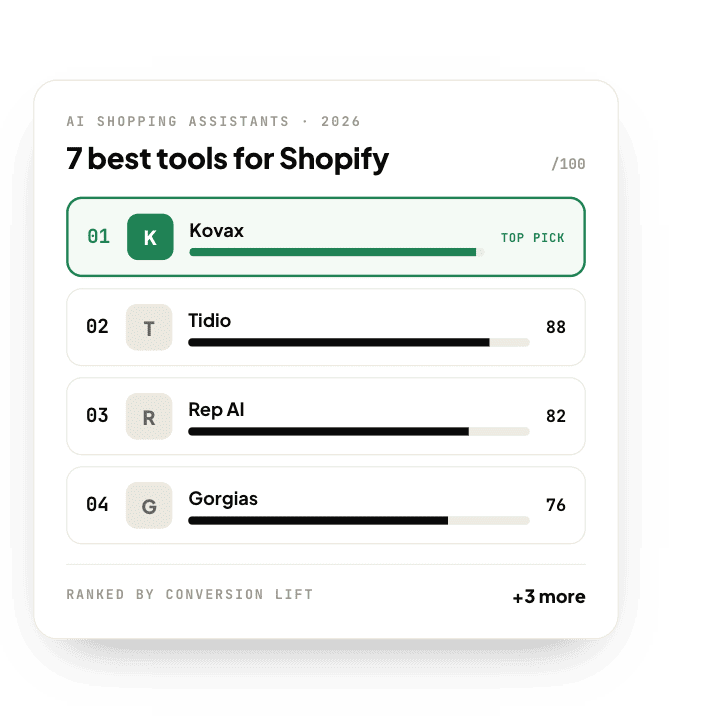
The 7 Best AI Shopping Assistants at a Glance
| Tool | Best for | Channels | Before or after purchase | Starting price (Oct 12, 2026) |
|---|---|---|---|---|
| Kovax | Stores that sell and support over phone, WhatsApp, chat, and email | Voice calls, WhatsApp, chat, email, SMS | Both, plus outbound calls | Free to install; paid plans from $49.99/month plus usage |
| Gorgias Shopping Assistant | Brands already running Gorgias as their helpdesk | On-site chat (helpdesk adds voice and SMS) | Both, chat-led | Ticket-based helpdesk plans plus a fee per AI resolution |
| Rep AI | On-site conversion and proactive engagement | Web chat, Messenger, Instagram, WhatsApp, email via helpdesk | Mostly before | Not listed publicly; 14-day free trial |
| Zipchat | Small stores that want chat, WhatsApp, and Instagram quickly | Chat, WhatsApp, Instagram, Messenger, email | Both | From $64/month billed annually |
| Alhena AI | Larger catalogs that also want AI search visibility tools | Web chat, social, voice product | Both | Free for 25 conversations; paid from $199/month billed annually |
| Tidio Lyro | Budget-conscious stores starting with chat | Live chat, Messenger, Instagram, WhatsApp, email | Mostly support | Lyro from $32.50/month for 50 conversations |
| Ringly | Stores that only need inbound phone support | Phone | After | $99/month for 50 conversations, then $1.99 each |
The 7 Best AI Shopping Assistants for Shopify, Reviewed
1. Kovax: Best Omnichannel AI Shopping Assistant
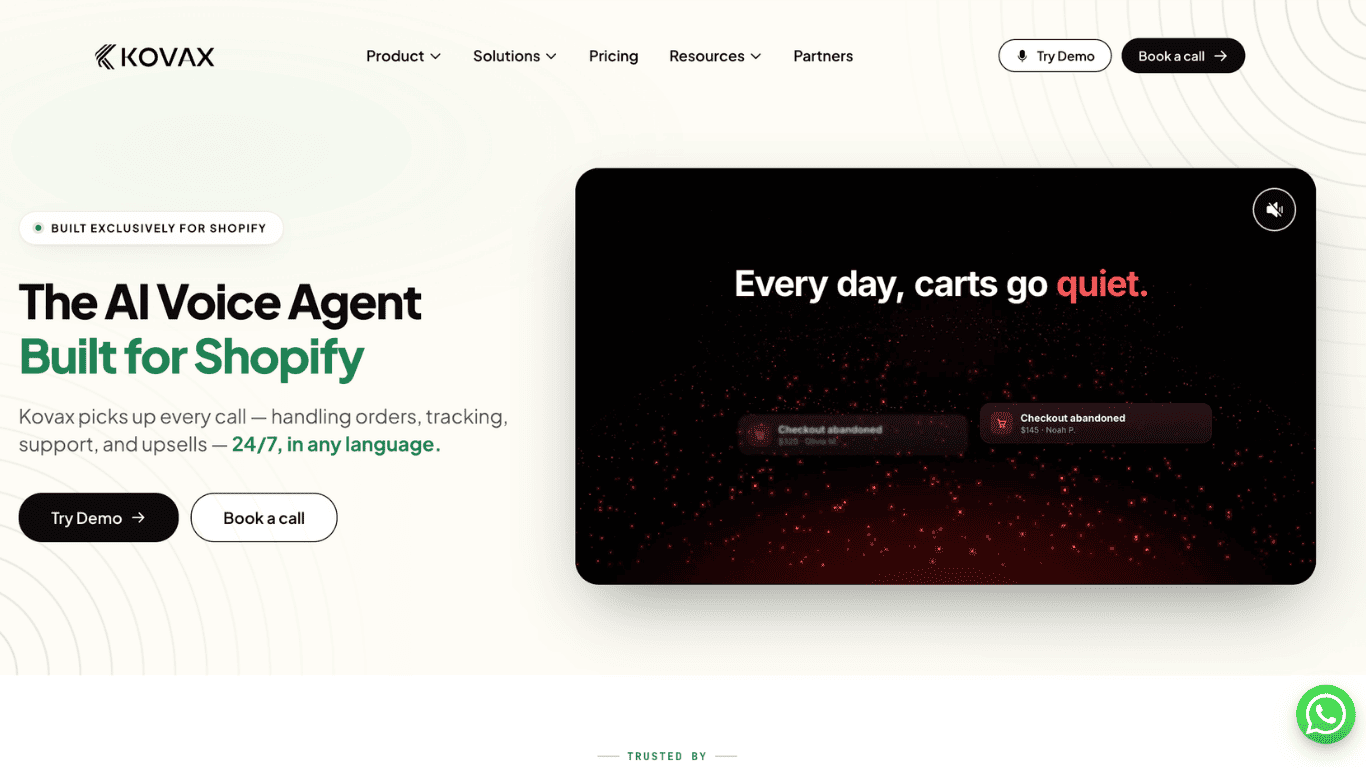
Kovax runs one AI agent across phone calls, WhatsApp, website chat, and email, answering from your products, policies, and past orders. It connects natively to Shopify, so order and product data stay current without middleware, and it replies in more than 20 languages (see our guide to multilingual support for Shopify stores). When it hits a question it cannot answer, it hands the conversation to your team with a summary.
The part most shopping assistants skip is outbound. Kovax’s outbound sales agent can call a shopper who abandoned a cart, then follow up on WhatsApp in the same thread, and it tags each buyer as high, medium, or low intent based on what they said on the call.
Published results:
- Monster Piercing, a UK body jewellery brand, raised cart recovery from 8% by email to 19% with an AI call followed by WhatsApp, a 2.4x lift with a 77% WhatsApp read rate.
- eSkinStore handles 400+ support calls a month across 20+ countries with one support person.
- Eeveve cut cost per call from $26.67 to under $4, with 85 to 90% of calls handled autonomously.
Pros:
- Covers voice, WhatsApp, chat, email, and SMS from one agent
- Handles both pre-purchase questions and post-purchase support
- Outbound calling for abandoned carts and cash-on-delivery (COD) confirmation
- Connects to Gorgias, Zendesk, and Freshdesk if you already use a helpdesk
Cons:
- Built for Shopify only
- No Instagram or Messenger DM support listed today
- Klaviyo integration is still marked “coming soon”
- Several integrations (Shiprocket, GoKwik, Razorpay) serve Indian checkout stacks, so U.S. stores will mostly use the Shopify, helpdesk, and WhatsApp connections
Pricing: Free to install, with a support call needed to continue after setup. Paid plans are Starter at $49.99/month, Growth at $199.99/month, and Ultimate at $399.99/month. Each plan includes usage, and calls are billed per minute (30 cents a minute on Starter, dropping to 25 cents on Ultimate). WhatsApp service conversations are free.
2. Gorgias Shopping Assistant: Best if You Already Use Gorgias
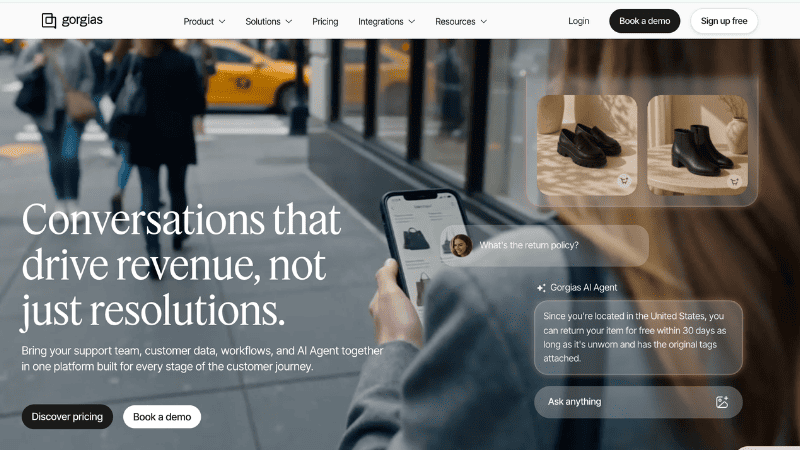
Gorgias Shopping Assistant sits in your on-site chat and greets visitors proactively based on their behavior, recommends products, suggests add-ons, and offers a discount only when it predicts purchase intent. It is trained on your Shopify store and lives inside the same Gorgias helpdesk that handles your tickets.
Gorgias reports aggregate results of 10% higher average order value and a 62% conversion uplift in chat on that page. Treat these as vendor figures rather than independent benchmarks.
Pros:
- Strong product recommendation and upsell logic
- One inbox for AI and human conversations
- Large integration library for Shopify brands
Cons:
- Makes most sense if Gorgias is already your helpdesk (we compare the two in Gorgias vs Kovax)
- The shopping assistant itself is chat-based; voice and SMS are separate helpdesk add-ons
- Per-resolution billing makes the monthly bill harder to forecast
Pricing: Gorgias pricing is based on helpdesk ticket volume, from 50 to 5,000 tickets a month, with the AI Agent charged each time it resolves a conversation. Voice and SMS cost extra.
3. Rep AI: Best for On-Site Conversion
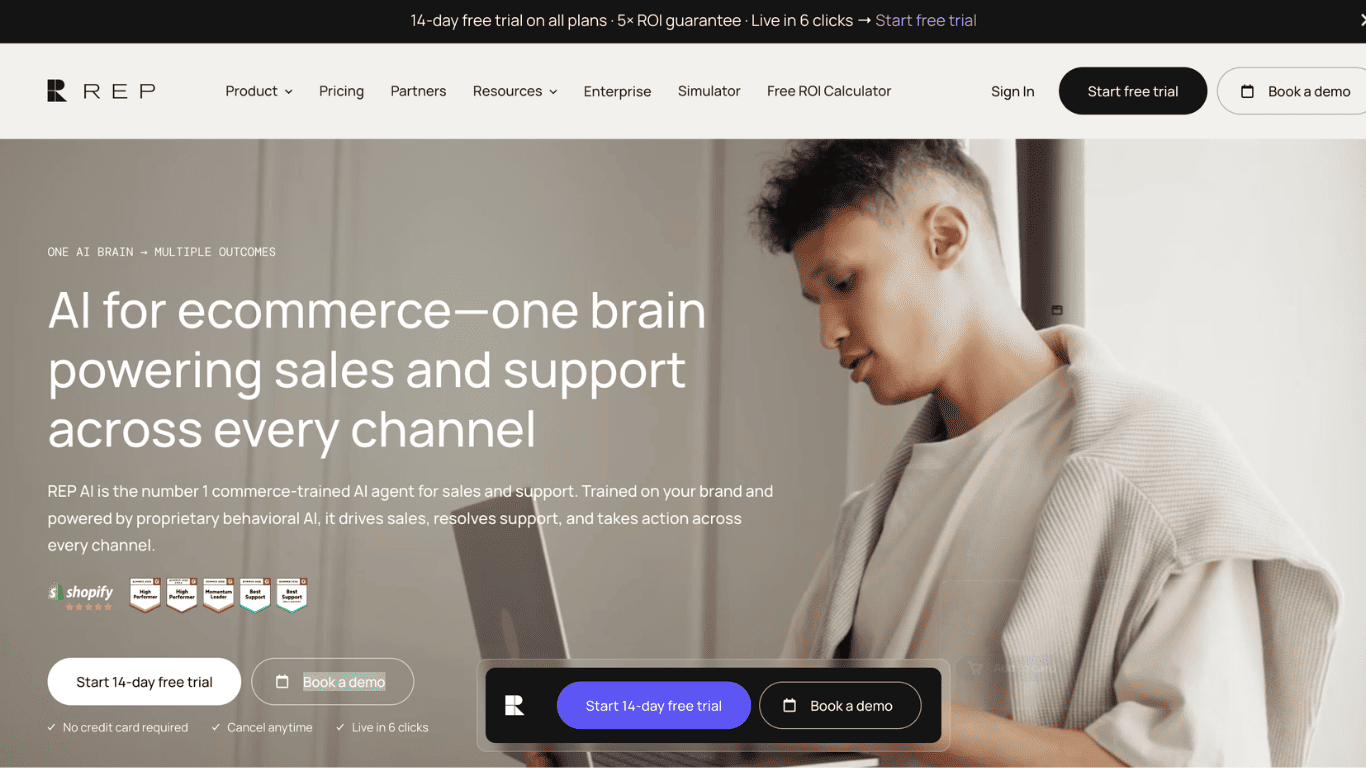
Rep AI watches on-site behavior such as hesitation, repeated comparisons, and exit intent, then starts a conversation only when it detects conversion risk. It also adds an AI module below product images and a conversational search bar. The same AI now runs across web chat, Facebook Messenger, Instagram DMs, WhatsApp, and email (email through helpdesk integrations such as Gorgias and Zendesk), and syncs conversation topics into Klaviyo so you can build segments from what shoppers actually asked.
Pros:
- Focused on turning browsers into buyers
- Conversation insights that feed marketing
- 14-day free trial and a stated 5x return on investment guarantee
Cons:
- No voice or phone channel
- Omnichannel mode is still labeled beta
- No public prices
Pricing: The Rep AI pricing page lets you build a custom plan rather than listing fixed prices.
4. Zipchat: Best Quick Start for Small Stores
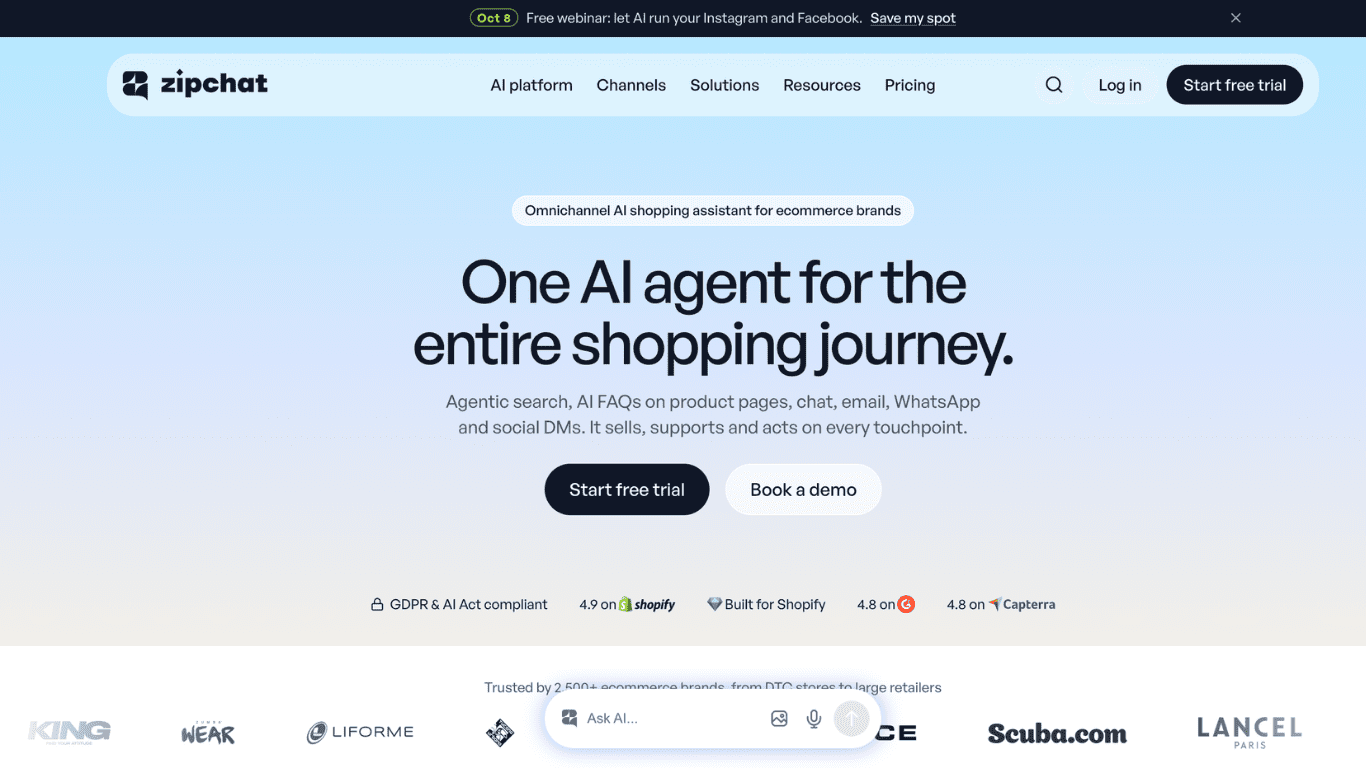
Zipchat deploys one AI across website chat, WhatsApp, Instagram, Messenger, and email, recommends products, answers order questions, and can create discount codes during a conversation. Setup is a Shopify app install, and it replies in the shopper’s language automatically.
Pros:
- Every channel included on every plan
- Fast setup with a 7-day trial and 30-day money-back guarantee
- Works on Shopify, WooCommerce, BigCommerce, and Wix
Cons:
- Billed per AI reply, so long conversations use more of your quota
- No voice channel
Pricing: On the Zipchat pricing page, Starter is $64/month billed annually ($80 billed monthly) for 750 replies, about 300 conversations. Extra replies cost $49 per 250.
5. Alhena AI: Best for Large Catalogs
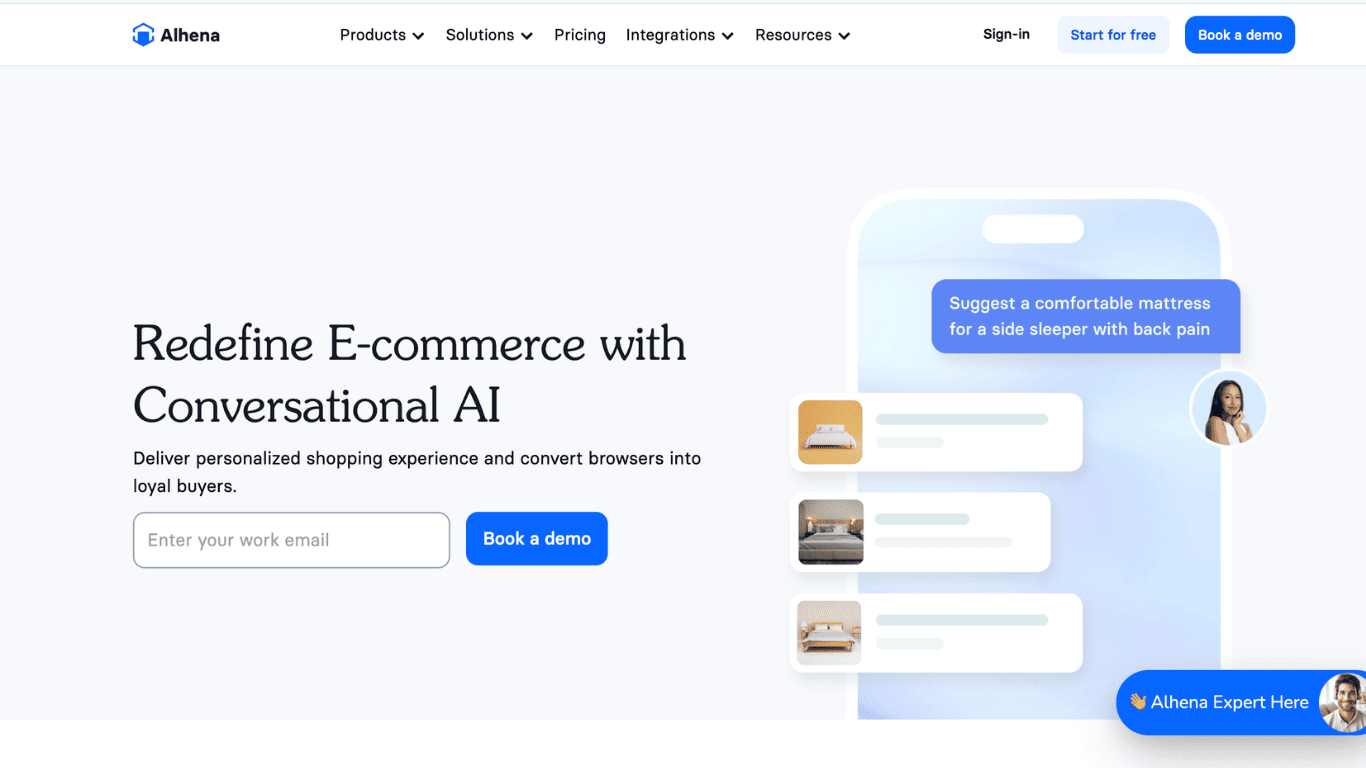
Alhena AI (formerly Gleen) sells an AI shopping assistant and a support concierge, plus a voice AI product and social commerce tools. Its plans also bundle AI visibility monitoring, which tracks how your brand shows up in ChatGPT, Perplexity, Gemini, and Google AI Overviews.
Pros:
- Handles up to 50,000 SKUs on paid plans
- Combines shopping help with AI search visibility tracking
- Free plan to test with real shoppers
Cons:
- Conversation allowances are small for the price
- Overage credits add up at higher volumes
Pricing: Alhena’s plans start free for 25 conversations a month. Essentials is $199/month billed annually for 200 conversations, Growth is $499 for 550, and Scale is $999 for 1,200. Extra conversations cost $1.20 each.
6. Tidio Lyro: Best Budget Starting Point
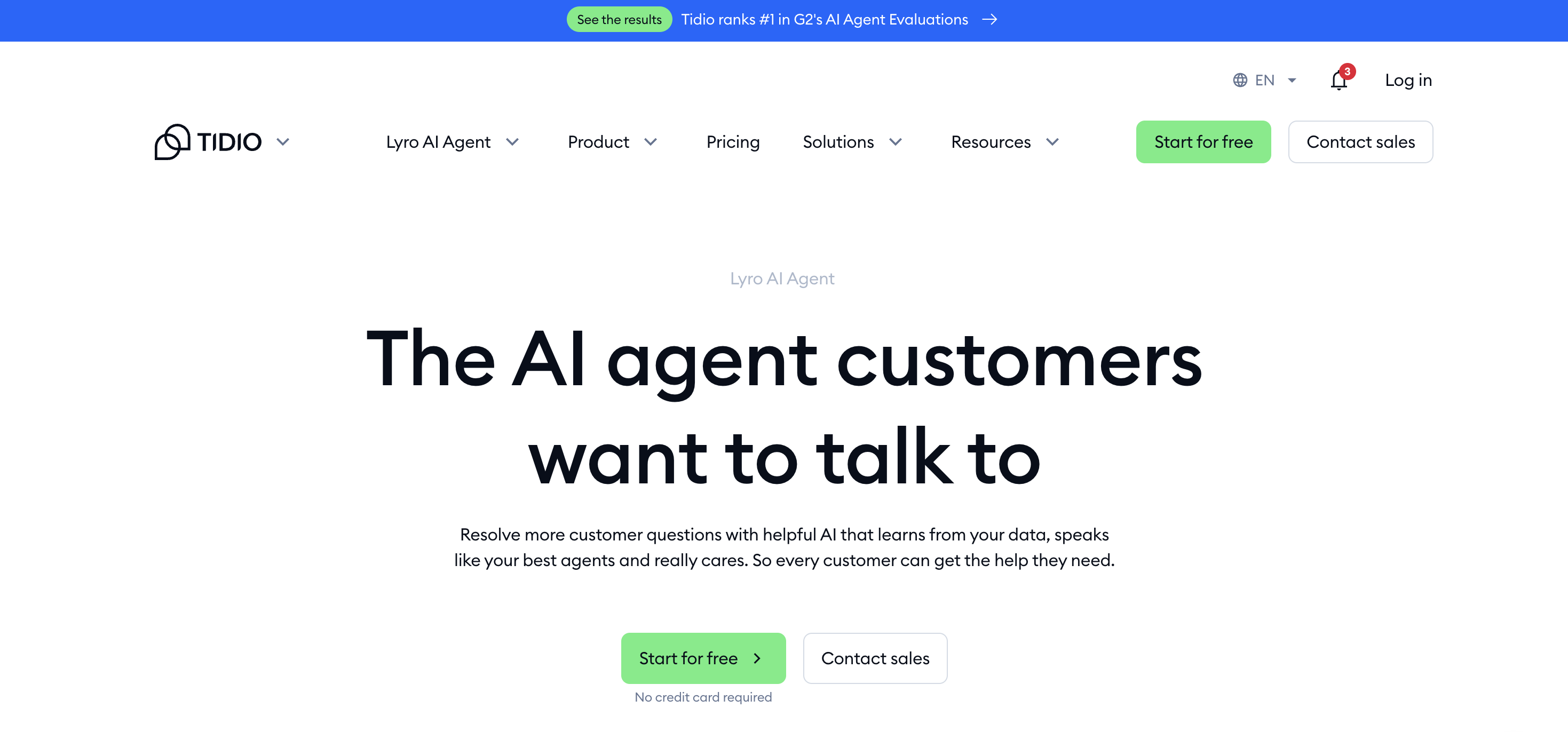
Tidio combines live chat, a helpdesk, and Lyro, its AI agent. Lyro answers from your support content, hands off to a human, and can recommend products once you buy a paid Lyro quota. Tidio connects to Messenger, Instagram, WhatsApp, and email, and says its customers average a 75% resolution rate with Lyro.
Pros:
- Low entry price and 50 free Lyro conversations to start
- Live chat, ticketing, and AI in one tool
- Native Shopify actions on the Growth plan and above
Cons:
- Pricing is split across separate products, so the total takes some working out
- Stronger on support than on selling
- No voice channel
Pricing: On Tidio’s pricing page, Lyro starts at $32.50/month for 50 AI conversations. Tidio’s Growth plan, which adds native Shopify actions, starts at $49.17/month.
7. Ringly: Best for Phone-Only Support
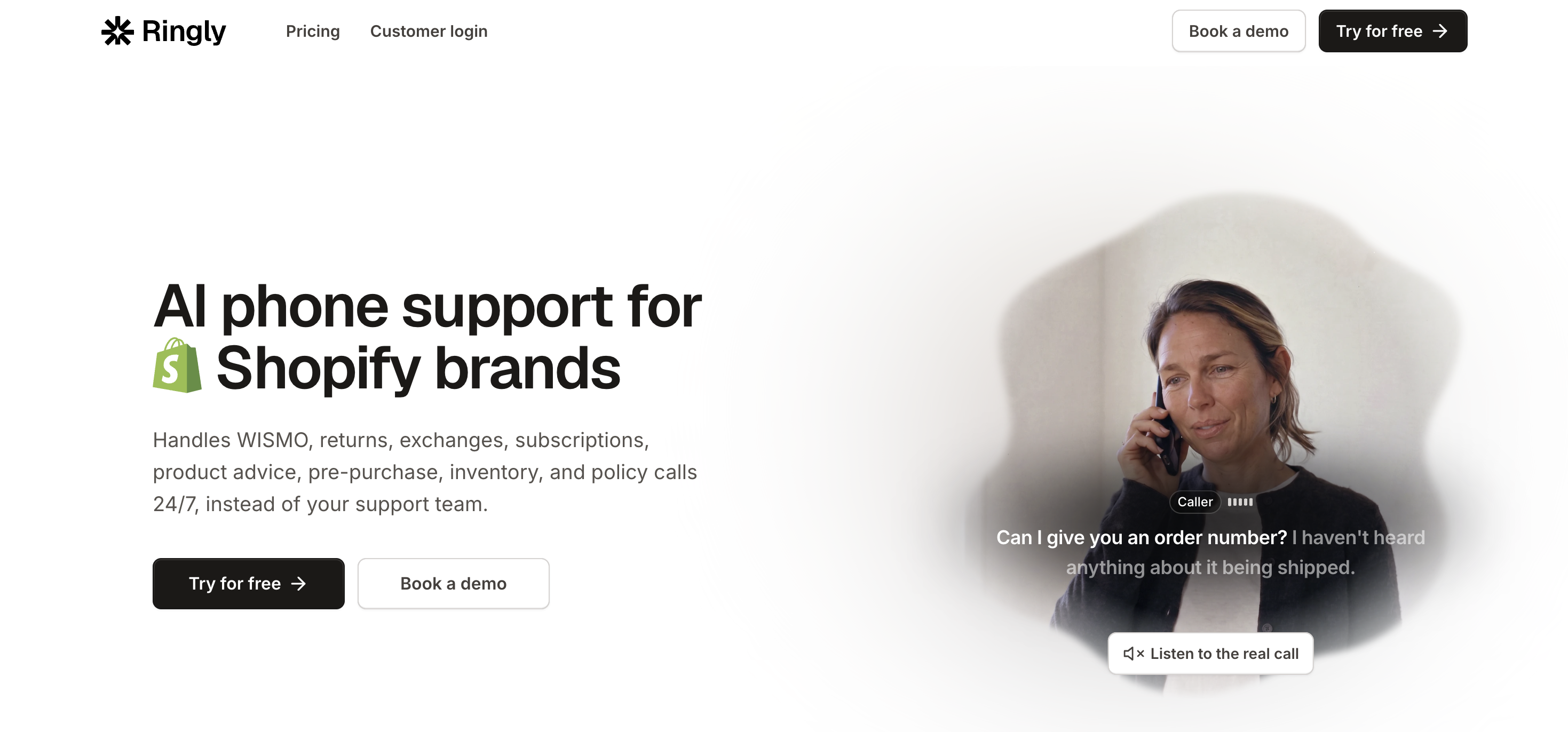
Ringly is an AI phone agent for Shopify stores. It answers inbound calls, tracks orders, handles returns and product questions, speaks 40 languages, and hands off to your team when needed. It does not handle chat, WhatsApp, or email.
Pros:
- Flat price per call regardless of length
- Spam, hang-ups, and wrong numbers are not billed
- Offers a 65% resolution guarantee, checked after your first 90 days
Cons:
- Phone only
- Ringly’s own pricing page says it is not for outbound or cold calling
- Shopify stores only
Pricing: Ringly’s pricing is $99/month for 50 conversations, then $1.99 per conversation.
Before vs. After Purchase: Where Each Tool Stops
Most comparisons rank tools without asking which half of the customer journey they cover. This table shows it directly.
| Task | Kovax | Gorgias | Rep AI | Zipchat | Alhena | Tidio Lyro | Ringly |
|---|---|---|---|---|---|---|---|
| Product questions on site | Yes | Yes | Yes | Yes | Yes | Yes | No |
| Product questions by phone | Yes | No | No | No | Not listed | No | Yes |
| Proactive outreach to hesitant or abandoning shoppers | Calls and WhatsApp | On-site chat | On-site, on exit intent | Chat and WhatsApp | Not listed | Rule-based Flows | No |
| Order status questions | Yes | Yes | Yes | Yes | Yes | Yes | Yes |
| WhatsApp conversations | Yes | No | Yes | Yes | Not listed | Yes | No |
The pattern is clear. Chat-first tools are strong before checkout and on the website. Phone-only tools are strong after checkout. If your customers use both, you either run two tools or pick one that covers both. Our omnichannel marketing guide explains why that hand-off between channels matters.
Five Questions to Test Any AI Shopping Assistant Before You Pay
Vendor demos use scripted questions. Use your own. Ask each tool these five, worded the way your customers actually write them.
- “Do you have this in a size 8, and will it arrive by Friday?” A good answer checks live inventory and your shipping rules. A weak one quotes your shipping policy page.
- “Is this safe for sensitive skin?” or “What is this made of?” A good answer uses your product data and says when it does not know. A weak one invents a confident answer. Monster Piercing found that material and sizing questions were exactly what stalled checkouts when email was the only follow-up.
- “Which should I buy, A or B, for a beginner?” A good answer compares the two on the shopper’s stated need and links both. This is the selling part of the job.
- “Where is order #1042?” A good answer returns the real tracking status. A weak one asks for an email address and sends a link.
- “I want to speak to a person.” Count the steps. A good assistant hands off immediately with the conversation summary attached.
If a tool fails question 2, stop there. A confident wrong answer about materials or safety costs more than no answer at all.
When Shoppers Bring Their Own AI Shopping Agent
There is a second kind of AI shopping assistant: the one your customer brings. Since September 2025, U.S. ChatGPT users can buy products without leaving the chat through Instant Checkout, built on OpenAI’s open Agentic Commerce Protocol, co-developed with Stripe. OpenAI said over a million Shopify merchants would be added to it.
For a store, two details in OpenAI’s announcement matter. The merchant stays the merchant of record and handles fulfillment, returns, and customer support with its existing systems. And merchants pay a fee on completed purchases.
In practice, that means an AI agent can sell your product in someone else’s interface, but every “where is my order?” and “how do I return this?” still lands on your phone line, inbox, and WhatsApp. An AI shopping agent on the customer’s side increases the need for one on yours, especially after the sale.
Which AI Shopping Assistant Fits Your Store
Match the tool to where your store is losing money:
- Customers call, message on WhatsApp, and chat, and your team is small: Kovax. One agent covers all of those, including outbound cart recovery calls.
- You already run Gorgias and want chat to sell more: Gorgias Shopping Assistant.
- On-site conversion is the main goal and phone is not a channel for you: Rep AI.
- You want chat, WhatsApp, and Instagram live this week on a small budget: Zipchat. If WhatsApp is the main channel, also see our list of WhatsApp marketing apps for ecommerce.
- You have a very large catalog and care about how AI search engines describe your brand: Alhena AI.
- You are starting from zero and want the cheapest way to test AI chat: Tidio Lyro.
- Phone calls are your only real problem: Ringly.
For the revenue side of this decision, our guides to abandoned cart recovery by email, SMS, and voice and upselling and cross-selling go deeper. For the support side, see handling Shopify phone support without hiring.
FAQ
What is an AI shopping assistant?
Software that talks to shoppers in natural language, answers product questions from your catalog, recommends products, and guides people to checkout. Many also handle post-purchase questions like order tracking and returns.
What is the best AI shopping assistant for Shopify?
It depends on your channels. For stores that get phone calls and WhatsApp messages as well as chat, an omnichannel tool such as Kovax covers the most ground. For chat-only stores, Gorgias, Rep AI, Zipchat, and Tidio Lyro are the main options, and Ringly suits stores that only need phone support.
How is an AI shopping assistant different from a chatbot?
A traditional chatbot follows a fixed script. An AI shopping assistant reads your live product and order data, understands questions written in the shopper’s own words, and can take actions such as checking stock or starting a return. Our conversational AI for ecommerce guide explains the difference in more detail.
How much does an AI shopping assistant cost?
On the vendors’ own pricing pages, entry plans run from about $32 to $199 a month, with usage charged per conversation, per reply, per resolution, or per call minute. Compare the billing unit, not just the plan price, because it decides your bill once traffic grows.
Is an AI shopping assistant the same as an AI shopping agent?
They overlap. “Shopping assistant” usually means a tool a store installs to help its own shoppers. “Shopping agent” increasingly means an AI that shops on the customer’s behalf, such as ChatGPT’s Instant Checkout. Stores need to be ready for both.
What to Read Next
- Choosing between chat tools? Read our ecommerce chatbot buyer’s guide for the six checks to run before you install one.
- Losing carts more than tickets? See abandoned cart recovery by email, SMS, and voice for which channel recovers the most.
- Want the full picture of how an omnichannel agent works? Our walkthrough of how Kovax works covers setup, channels, and handoff.
- If you want one agent answering your calls, WhatsApp, chat, and email from your Shopify data, you can see how Kovax handles customer conversations.