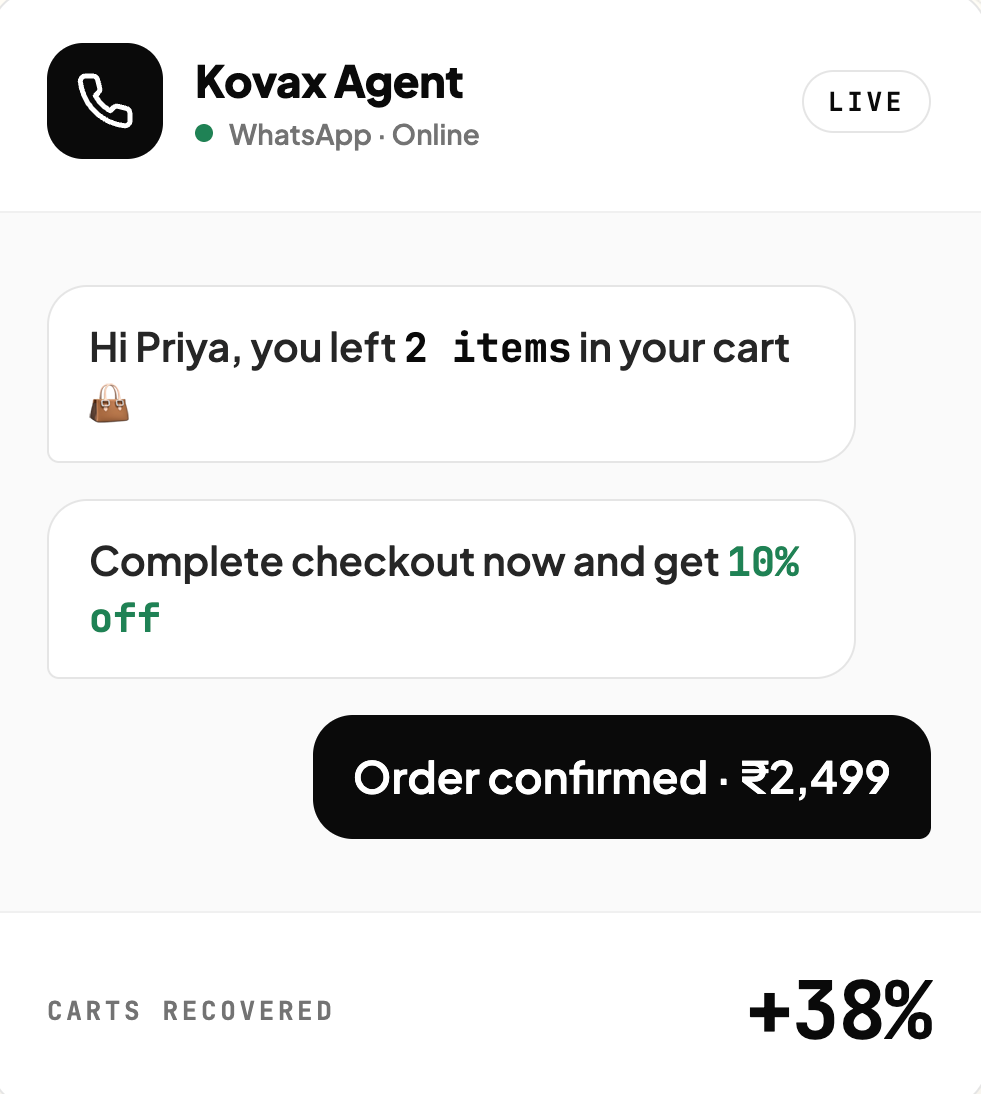
Someone added your product to their cart, got to checkout, and left. It happens on roughly seven out of ten carts, and most of those shoppers were one small nudge away from buying. Abandoned cart recovery is how you go get them back.
Here's the thing almost nobody says out loud: most stores run abandoned cart recovery on autopilot with a single email flow, then wonder why they're only clawing back a sliver of the money. Email is fine. It's just the floor, not the ceiling. The carts worth the most are often the ones email never reaches.
This guide covers what abandoned cart recovery actually is, why shoppers bail in the first place, what a good recovery rate looks like so you know if yours is any good, and then the part that matters most: how the channels stack up. Email, SMS, WhatsApp, and voice, side by side, with honest notes on where each one wins and where it quietly loses you sales.
Curious how much revenue is sitting in your abandoned carts right now? Run your numbers in the ROI calculator →
What is abandoned cart recovery?
Abandoned cart recovery is the process of following up with shoppers who added items to their cart but left before paying, to bring them back to finish the purchase. Some people call it abandoned shopping cart recovery. Same thing. You're recovering revenue that was seconds away from landing and then didn't.
Cart abandonment is the problem. Abandoned cart recovery is the response. When a shopper drops off at the checkout page, a recovery flow reaches back out (by email, text, WhatsApp, a push notification, or a phone call) with a reminder and often a reason to come back, like their items are still waiting or shipping is on them.
The reason it's worth doing is pure math. Those shoppers already wanted the product enough to add it. They're the warmest leads you'll ever get. Recovering even a modest share of them usually beats the return on chasing brand-new traffic, which is why abandonment gets its own dedicated flows instead of getting lumped in with the rest of your marketing. Kovax's abandoned cart recovery agent is built around exactly that: it calls customers who left items behind and guides them straight back to checkout.
Why shoppers abandon carts
Before you can recover a cart, it helps to know why it got left. The reasons are pretty consistent across stores, and most of them happen right on the checkout page.
Surprise costs at checkout. This is the big one, every year. Shipping, taxes, and fees that show up only at the final step make people feel baited, and they leave. If your free shipping threshold is unclear or your shipping cost is a late surprise, you're manufacturing abandonment.
Being forced to create an account. Making someone sign up before they can pay adds friction at the worst possible moment. Guest checkout exists for a reason.
Not enough payment options. If a shopper's preferred method (a wallet, buy-now-pay-later, whatever they trust) isn't there, some of them just close the tab rather than dig out a card.
Just browsing. A big chunk of abandonment is people comparison shopping, saving items for later, or getting distracted. These carts aren't lost, they're paused, and they're exactly who recovery is built for.
Trust and timing. First-time visitors who don't know you yet often add to cart as a "maybe" and need a second touch before they commit. Nothing went wrong. They just weren't ready in that exact minute.
Notice that most of these are fixable or recoverable. Some you fix on the checkout page itself (clearer costs, guest checkout, more payment options). The rest you win back with a good recovery flow.
What's a good abandoned cart recovery rate?
Before you judge your own numbers, you need a benchmark, because "we recovered some carts" tells you nothing.
The honest answer is that a good abandoned cart recovery rate depends heavily on the channel and how fast you follow up. Email-only recovery flows commonly land in the low double digits for the share of abandoners who come back, and the average abandoned cart recovery rate across email-only setups tends to sit somewhere in that same modest range. Add SMS and the number climbs. Layer in a direct channel like a phone call for high-value carts and it climbs further, because you're reaching people email never pulled back.
So the benchmark isn't one number, it's a ladder. Email alone gets you the baseline. Every additional, more direct channel you stack on top raises the ceiling. If you're running email only and recovering low double digits, you're not underperforming, you're just leaving the top of the ladder unclimbed.
The metric that actually matters underneath all this is your conversion rate on recovery: of the people you reach, how many finish checkout. That's where channel choice makes or breaks the result, which brings us to the comparison.
Recovery channels compared: Email vs SMS vs WhatsApp vs Voice
This is the section most guides skip, so here's the straight comparison. Four ways to chase an abandoned cart, and what each one is actually good at.
| Channel | Reach / open rate | Best for | The catch |
|---|---|---|---|
| High volume, low open rate | The default first touch, longer messages, an email template with product images and a discount | Crowded inbox, easy to ignore, slow. Most carts never reopen it | |
| SMS / text | Very high open rate, read in minutes | Fast, short nudges and time-sensitive offers | Character limits, opt-in rules, feels intrusive if overused |
| High open rate, conversational | Two-way chat, regions where WhatsApp is the default, richer media | Needs opt-in and template approval, less common in the US | |
| Voice (phone call) | Direct, personal, hard to ignore | High-value carts, hesitant first-time buyers, questions holding up the sale | Doesn't scale by hand, which is exactly where AI voice comes in |
A few things fall out of that table.
Email is the workhorse and it should stay in your mix. It's cheap, it scales, and a well-built abandoned cart recovery email with the right template still recovers real money. But its open rate is the weak link. Most abandoners never open the follow-up, so email alone caps out early.
SMS and text for abandoned cart recovery fix the open-rate problem. Texts get read fast, so a short "your cart's still here, free shipping ends tonight" can beat a beautiful email that nobody opens. WhatsApp abandoned cart recovery plays a similar role and shines in markets where it's the everyday messaging app, with the bonus of real two-way conversation.
Then there's voice, and this is the channel almost nobody uses well. A phone call is the most direct, hardest-to-ignore touch you have. For high-value carts and hesitant first-time buyers, a quick call that answers the one question holding them back (is this in stock, can I return it, what's the shipping and order status timeline) closes sales the other channels can't. The reason stores skip it is obvious: calling every abandoner by hand doesn't scale.
That's the gap Kovax fills. An AI voice agent can call abandoned carts automatically, have a natural conversation, answer the shopper's question, and walk them back to checkout, at a scale no human team could staff. You get the recovery power of a phone call without hiring a call floor to make them. Voice stops being the channel you can't afford and becomes the one that recovers the carts email and SMS left on the table.
The takeaway isn't "voice instead of email." It's that a layered approach wins: email for reach, SMS for speed, and voice for the high-value carts that deserve a real conversation.
Abandoned cart recovery strategies that work
Channels are the how. These are the abandoned cart recovery strategies and tips that decide whether the how actually converts.
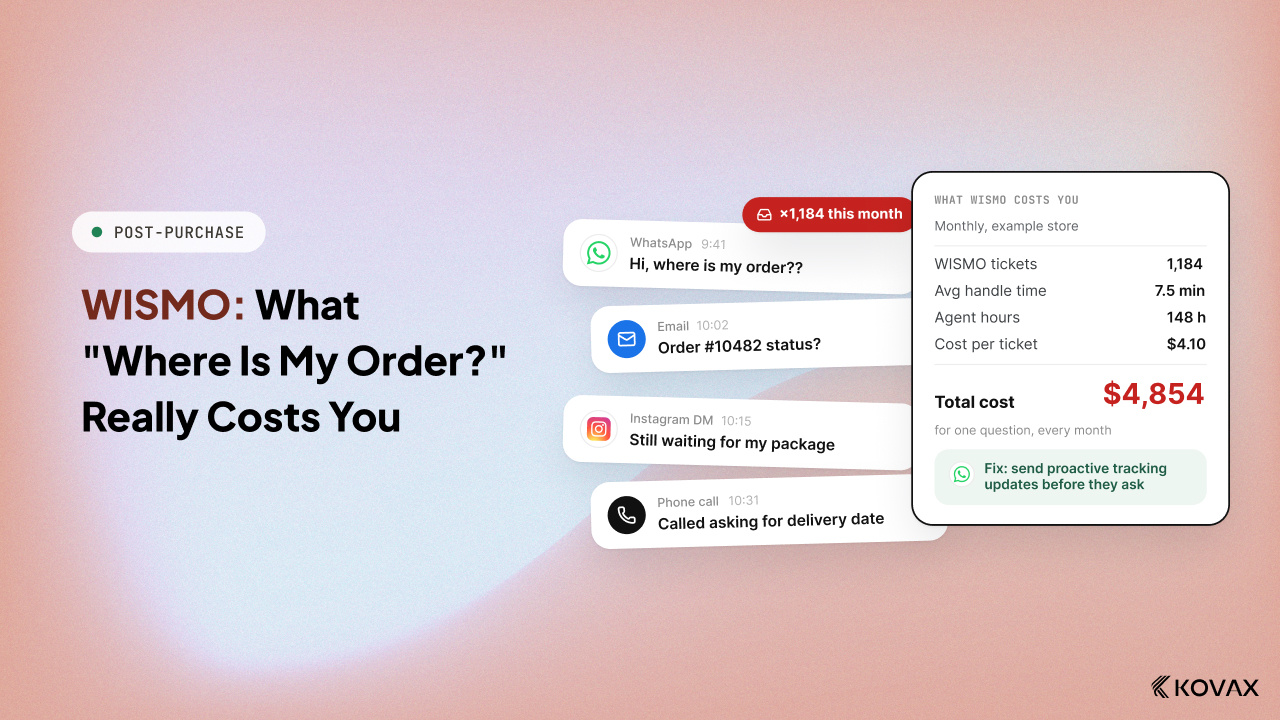
Move fast on the first touch. Recovery rates drop the longer you wait. The first message should go out within an hour or two while the shopper still remembers what they wanted, not the next morning. It's the same speed principle that cuts down WISMO tickets after a sale: the faster you close the information gap, the less revenue and goodwill you lose to silence.
Sequence your channels, don't spam one. A strong flow might open with an email, follow with an SMS a few hours later if there's no bite, and reserve a voice call for the carts worth the most. Each channel covers the other's blind spot instead of repeating it.
Fix the checkout reason, not just the symptom. If people abandon over surprise shipping, a recovery discount is a bandage. Show costs earlier, surface your free shipping threshold, and add the payment options people keep asking for. Fewer carts to recover beats better recovery.
Give a real reason to come back. "You left something" is weak on its own. Pair the reminder with the nudge that fits the shopper: free shipping, a small time-boxed discount, low-stock urgency, or simply answering the question that stalled them.
Save the heavy artillery for heavy carts. A $30 cart and a $400 cart don't deserve the same effort. Let email and SMS handle the long tail, and point your voice calls at the high-value carts where a recovered sale actually moves the number.
Shopify abandoned cart recovery
If you're doing abandoned cart recovery on Shopify, you've got a head start: Shopify already fires basic abandoned checkout emails, and the app ecosystem covers SMS, WhatsApp, and now voice. The move for most Shopify stores is to layer them. Keep Shopify's abandoned cart recovery email flow, add an SMS app for speed, and connect a voice agent like Kovax to your Shopify checkout data so high-value abandoned carts get a real call automatically. Because it reads live from Shopify, the agent knows exactly what's in the cart and what to say, with nothing for you to maintain by hand. Pricing scales with usage, not headcount, you can see exactly how on the pricing page.
Frequently asked questions
What is abandoned cart recovery?
Abandoned cart recovery is the process of following up with shoppers who added items to their cart but left before buying, to bring them back to complete the purchase. It usually runs through automated flows across email, SMS, WhatsApp, push notifications, or phone calls.
What is a good abandoned cart recovery rate?
It depends on your channels. Email-only flows commonly recover a modest low-double-digit share of abandoners, and adding more direct channels like SMS and voice raises that ceiling. Rather than chasing one benchmark number, track the conversion rate of the shoppers you actually reach and add channels until it stops climbing.
How does abandoned cart recovery work?
When a shopper abandons at checkout, a recovery flow triggers a follow-up: a reminder of what they left, often paired with an incentive like free shipping or a small discount, sent through one or more channels. The goal is to reach them fast, answer whatever stopped them, and link them straight back to their cart.
What tools are best for abandoned cart recovery?
Most stores use a mix: their platform's built-in emails (Shopify sends these automatically), an SMS or WhatsApp app for faster touches, and increasingly an AI voice agent like Kovax for high-value carts that convert better with a real conversation. The best setup layers channels rather than relying on email alone.
Can you recover carts by SMS or phone call?
Yes, and they often outperform email. SMS gets opened within minutes, so it's great for quick, time-sensitive nudges. Phone calls are the most direct touch of all and work especially well on high-value carts and hesitant first-time buyers. An AI voice agent lets you make those calls at scale without a human team.
Recovering carts with email alone? See how Kovax's abandoned cart recovery agent calls your high-value abandoned carts automatically and brings shoppers back to checkout, straight from your Shopify data.