Gorgias vs Kovax, in 30 seconds
- What it is: Gorgias is a helpdesk and ticketing layer that organizes support conversations for a human team, with AI resolving some tickets automatically. Kovax is a usage-based AI agent that answers Shopify support inquiries directly, by phone, WhatsApp, chat, or email, without a ticket being created first.
- The catch nobody tells you: Gorgias's Shopify app sits at 4.2 stars across 617 reviews, with 9% of ratings at one star and specific complaints about lost features (like live cart visibility) and per-conversation AI billing. Its plans run $60 to $900+ a month by ticket tier, and overage charges kick in right as a store's busiest month drives ticket volume up.
- Who this is for: Shopify store owners comparing a ticket-based helpdesk against an AI agent built to resolve repetitive support inquiries, especially by phone, without adding headcount.
Picture two ways to run a busy restaurant floor. One option is an excellent reservation and table-management system. It organizes every party, keeps the kitchen informed, and makes sure nobody gets lost in the queue. The staff still does the actual serving, the system just keeps everything sorted.
The other option is a host who greets people at the door and resolves most of what they need right there, a seating change, a menu question, a to-go order, without pulling in the rest of the floor staff unless something genuinely needs a person.
Neither approach is wrong. They organize work differently, and choosing between Gorgias and Kovax for a Shopify store's support desk works a lot like choosing between those two setups.
This guide walks through what Gorgias genuinely does well on Shopify, where its own App Store reviews say it falls short, and how Kovax approaches the same customer inquiries with a different model.
Why store owners end up comparing the two
Support tools rarely get chosen all at once. A store starts with a shared inbox, adds live chat, then a ticketing layer to keep it organized, then eventually looks at AI to cut down repetitive volume. Gorgias sits at that ticketing-and-AI-layer step for a large share of Shopify stores, reporting that it powers customer conversations for 40% of Shopify brands, a figure from the company itself, not independently audited here.
The comparison usually comes up once a store notices that a better-organized inbox hasn't actually reduced how many messages come in, just how neatly they're sorted. That's the point where some stores start looking at tools built to answer directly instead of tools built to organize.
What the two are actually built to do
Gorgias organizes the conversations a support team handles. It's a helpdesk and AI layer, built so a team can see order history, chat, email, and social messages in one inbox, with an AI Agent that can resolve some tickets on its own and a Shopping Assistant that helps with product questions. A person still configures and oversees the system.
Kovax is built to answer the inquiry directly, by phone, WhatsApp, chat, or email, using live Shopify order data, without requiring a ticket to be created or triaged first. It hands off to a person only when something falls outside what it can resolve.
The takeaway: Gorgias centralizes and partly automates what a support team sees and does. Kovax is trying to be the first response itself, particularly by phone, a channel Gorgias added as an add-on rather than a core feature.
Gorgias, honestly
Credit where it's due. Gorgias has been built specifically for ecommerce since it launched on March 1, 2017, and it shows in the product: live Shopify order and customer data sits inside every ticket, the AI Agent can resolve repetitive tickets end to end, and the Shopping Assistant is built to help with product questions during a live conversation rather than after a sale is already lost. On the Shopify App Store, Gorgias holds a 4.2 out of 5 rating across 617 reviews, with 83% of those ratings at five stars. A recent review from a long-time user put it plainly: "Gorgias is the single most valuable application in our Shopify technology stack... I genuinely cannot imagine operating our customer service organization without it." (source)
The same review page shows where it falls short for some stores. 9% of ratings sit at one star, and the complaints tend to be specific rather than vague. One reviewer, five days into using the app, described losing a feature they'd specifically chosen Gorgias for: "Live cart visibility was removed in November last year, and their own support did not know this when I asked... If your support depends on seeing what the customer is actually buying, look elsewhere." (source) The same review raised a cost concern about the AI Agent's per-conversation billing. Worth noting, Gorgias's own pricing page and third-party pricing breakdowns don't fully agree on the exact per-resolution rate at the time of writing, so treat any single figure for that add-on as directional rather than confirmed.
The wider helpdesk category, honestly
This isn't only a Gorgias trait. Most tools in the Shopify customer service app category, Zendesk, Freshdesk, Tidio, and Gorgias among them, are built around the same core idea: organize and route conversations well, with AI increasingly layered on top to resolve some of them automatically. What none of them were originally built to be is a direct-answer channel by phone. Voice support shows up in Gorgias as an add-on, not the foundation the product was designed around.
That distinction matters most for stores whose support volume leans heavily on the phone, COD confirmation, order status calls, or return coordination that a customer would rather just talk through, since a ticketing-first tool has to bolt voice on rather than start there.
The part nobody talks about: ticket-based pricing has its own busy-month problem
Gorgias doesn't charge per agent, which is worth crediting directly. Its Basic, Pro, and Advanced plans all include unlimited agents, with cost instead tied to how many tickets a store handles each month, $60 a month for 300 tickets on Basic, scaling up to $900 a month for 5,000 tickets on Advanced, plus a per-100-ticket charge for anything beyond the included allowance.
The part that gets less attention is what that means during a store's busiest months. A holiday sale or a viral product moment doesn't just raise order volume, it raises ticket volume in roughly the same proportion, and overage charges kick in right as a store is already spending more on ads, discounts, and fulfillment. It's a different mechanism than a per-seat tool's hiring problem, but the timing is the same: the tool costs more exactly when margins are already tightest.
A system billed on resolved calls rather than ticket count doesn't remove that trade-off entirely, but it ties cost to a different, sometimes steadier variable. This isn't a reason to dismiss ticket-based pricing outright, plenty of stores have predictable enough volume that it works fine. It's simply the part of the cost structure that rarely gets said out loud.
Will switching mean worse support for my customers?
This is the real concern underneath most of this comparison, and it deserves a direct answer.
- The repetitive share of tickets is what moves, not the judgment-heavy share. Order status, COD confirmation, and simple returns questions are both the most repetitive and the most common. Those are what a system like Kovax is built to take off the queue, while anything genuinely complex still reaches a person with full context attached.
- Every call and conversation is recorded, so quality can be checked directly rather than taken on faith.
- Nothing requires removing Gorgias on day one. Most stores that adopt a system like Kovax run it alongside an existing helpdesk and shift specific, repetitive volume over gradually, phone-based COD confirmation first, for example.
What each one actually covers
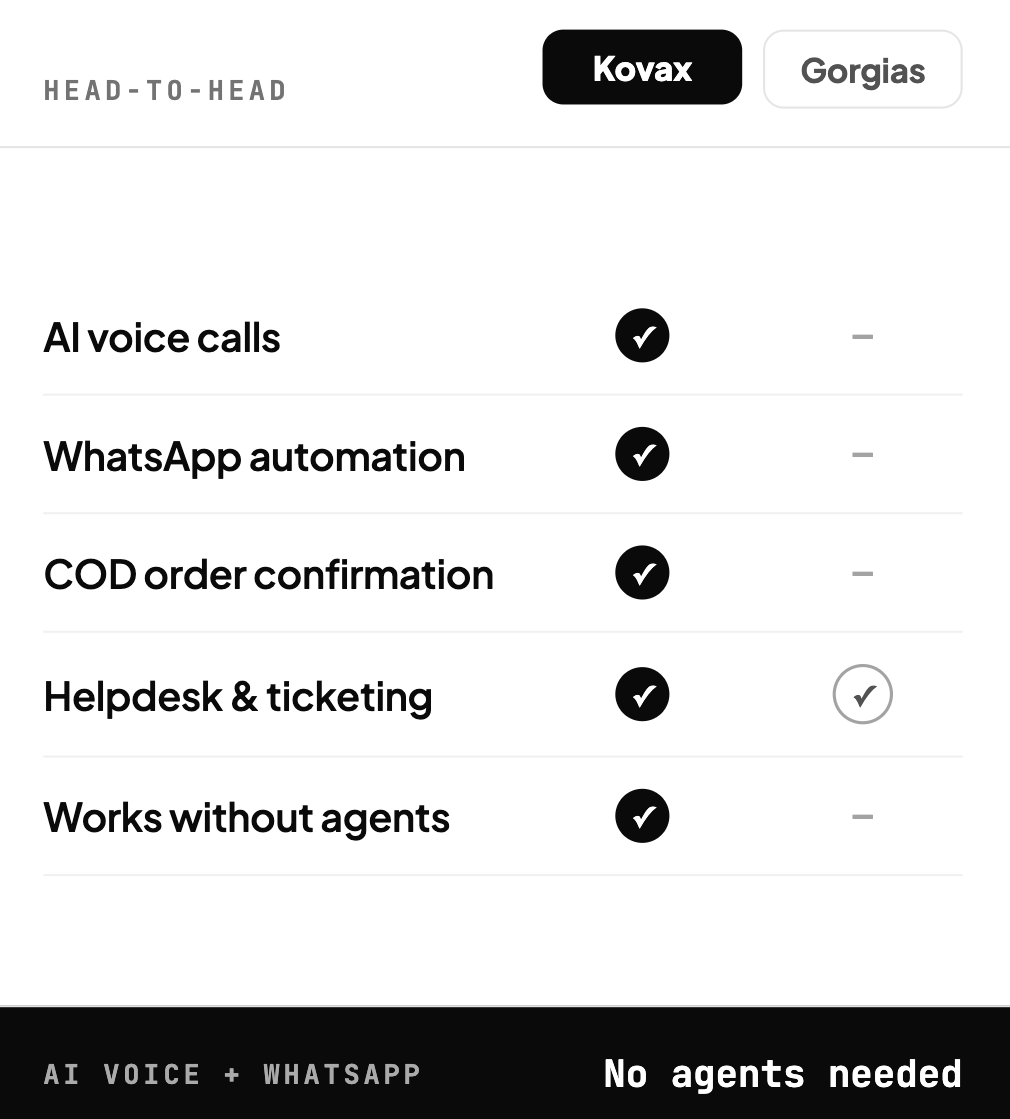
Gorgias covers: a unified inbox across email, chat, social, and SMS, an AI Agent for autonomous ticket resolution, an AI Shopping Assistant for product questions, voice as an add-on, 100+ integrations, and analytics on conversation volume and outcomes.
Kovax covers: inbound and outbound phone calls, WhatsApp, SMS, and email, grounded in live Shopify order, product, and customer data. That includes COD confirmation calls placed within minutes of an order, address and intent checks before a risky order ships, abandoned cart follow-up by call and message, and order tracking answered the moment a customer asks, in 20 or more languages.
The overlap is real on chat and messaging. It's smaller on the phone, where Gorgias treats voice as an add-on and Kovax treats it as the core channel.
Gorgias vs Kovax at a glance
| Gorgias | Kovax | |
|---|---|---|
| Who answers | A human agent, with AI resolving some tickets automatically | An AI agent, escalates to a human only when needed |
| Channels | Email, chat, social, SMS, voice as an add-on | Phone, WhatsApp, SMS, email |
| Pricing | Ticket-based, $60 to $900+ a month by tier, unlimited agents | Usage-based, no per-agent or per-ticket tier |
| Best for | Stores wanting one organized inbox with growing AI automation across chat and email | Stores wanting phone-first inquiries answered directly without a ticket layer |
Common mistakes stores make when comparing the two
- Assuming ticket-based pricing is automatically cheaper than per-agent pricing. It can be, but only if ticket volume stays predictable. A viral moment or a bad shipping week can push a store into overage charges fast.
- Not budgeting separately for the AI Agent's per-resolution fee. It sits outside the base plan and scales with how much of the AI layer actually gets used.
- Treating voice as a minor add-on decision. For a store where phone-based COD confirmation or order questions are common, this is closer to a core requirement than an extra.
- Skipping the 1-star reviews before committing to annual billing. The specific, dated complaints tend to say more about day-to-day friction than either company's marketing pages.
A simple plan for deciding
Week 1: Pull real ticket and call volume by channel, chat, email, and phone specifically.
Week 2: Separate that volume into repetitive, rules-based inquiries versus genuinely case-by-case ones. Most stores find the split more lopsided than expected.
Week 3: If phone volume is low and most inquiries are chat or email, a helpdesk like Gorgias may cover it well. If phone volume is meaningful, weigh a phone-first system against Gorgias's voice add-on directly.
Week 4: Pilot on one channel, whether that's COD confirmation calls or chat-based WISMO questions, and measure the actual change in ticket volume before expanding further.
Where to go from here
Neither tool is wrong for every store. Gorgias has organized ecommerce support conversations since 2017, and for a store leaning on chat and email with growing AI automation, that depth is real. Kovax takes a different starting point, that phone-based inquiries deserve a direct answer, not a ticket.
See how Kovax handles phone-based support on the Shopify App Store.