In this guide:
- Why product returns are becoming ecommerce's quiet profit killer
- What counts as a normal return rate, and why "zero returns" is the wrong goal
- Shopify returns, refunds, or exchanges, honestly
- The return policy angle most Shopify stores get backwards
- The big fear: tightening return rules without losing repeat customers
- How to reduce returns in ecommerce, practically
- Common mistakes stores make handling Shopify returns
- A simple week-by-week plan to cut your return rate without hurting loyalty
- FAQ
- Where to go from here
Why Product Returns Are Becoming Ecommerce's Quiet Profit Killer
Nobody budgets for returns the way they budget for ad spend, but they probably should. The average ecommerce return rate now sits at 20.8%, roughly two to three times higher than the 8.72% return rate physical stores see, according to data compiled by Ringly. Roughly one in five online orders comes back.
Each of those returns is not free. Processing a single return costs retailers between $10 and $65, once you count shipping, labor, inspection, and restocking. On a low-margin product, that can eat the entire profit from the sale, and then some.
This is not a problem you fix by tightening the return window and hoping fewer people notice. Shoppers check your return policy before they buy, not after, so how you handle returns is already shaping whether people purchase from you at all.
What Counts as a Normal Return Rate, and Why "Zero Returns" Is the Wrong Goal
Return rates vary a lot by category, and comparing yourself to the wrong benchmark will send you chasing a number that was never realistic. Apparel runs 20 to 30%, footwear around 18%, home goods 15 to 20%, electronics 8 to 11%, and beauty and skincare as low as 4 to 10%. A 15% return rate is great for a clothing brand and a red flag for an electronics store. Know your category before you panic about your number.
Here's the part that surprises most merchants: making returns harder does not just lower your return rate, it lowers your sales too. 82% of consumers say free returns are an important factor when deciding where to shop, and 81% actually read the return policy before buying. A confusing or stingy policy does not stop returns, it stops purchases.
Takeaway: The goal is not zero returns. It's a return rate that matches your category, paired with a process smooth enough that a return doesn't cost you the customer along with the product. Good returns management is what makes that possible without it becoming a full-time job for your support team.
Shopify Returns, Refunds, or Exchanges, Honestly
Merchants use these three words interchangeably, and it causes real confusion, both internally and with customers on the phone.
Shopify returns, honestly
A return is the physical process, the customer sends the item back. This is the logistics half of the equation: a return label, a shipping window, and a decision about what happens once the item is back in your hands.
Shopify refund, honestly
A refund is the money moving back to the customer. It can happen with or without a physical return (store credit for a damaged item that isn't worth shipping back, for instance). Customers conflate "I returned it" with "I got my money back," and the gap between those two moments is where most "where's my refund" calls come from.
Shopify exchange, honestly
An exchange swaps the item for a different size, color, or product entirely. This is the option merchants underuse the most, and it's the one that keeps revenue in the business instead of sending it back out the door. A customer who exchanges is still a customer. A customer who refunds is, for that order at least, gone.
The honest takeaway: if your team defaults to refunds because it's the path of least resistance, you're quietly training customers to ask for their money back instead of a better fit.
The Return Policy Angle Most Shopify Stores Get Backwards
Most stores treat a strict return policy as protection. The data says the opposite. 92% of consumers say they'll buy again if returns are easy, according to Ryviu's research on return policy and loyalty, and 58% are more likely to purchase again specifically because of a positive return experience.
The psychology is simple even if it feels counterintuitive: a generous, clearly stated policy is a trust signal, not an invitation to abuse. It tells a hesitant shopper that you stand behind what you sell, which lowers the anxiety of buying something they can't touch or try on first. A policy buried in the footer, written in legal language, does the opposite. It makes people wonder what you're hiding.
The fix isn't necessarily "make returns free." It's making the policy visible, plain, and easy to find on the product page and at checkout, not just in a legal document nobody reads until they're already frustrated.
The Big Fear: Tightening Return Rules Without Losing Repeat Customers
Say it plainly: a small share of customers exploit lenient return policies, and stores that have been burned by it get defensive fast. That instinct is understandable, but it's worth separating from the much larger group of honest shoppers who just need a fair process.
71% of consumers say a bad return experience would stop them from shopping with a retailer again. That's the real risk of overcorrecting. On the other side, 76% of first-time customers who have an easy return say they'd shop again, which means the return itself isn't what damages loyalty, a bad return experience is.
There is a real behavior worth watching for, though: 63% of consumers admit to "bracketing," buying multiple sizes or variations of the same item with plans to return what doesn't fit. That's not fraud, it's a rational response to sizing uncertainty, and it's a signal to fix your size guide, not to punish the customer. Save the stricter rules (shorter windows, restocking fees, exchange-only terms) for narrow, high-abuse categories, not your entire catalog.
The practical middle ground looks like this: keep the policy generous and clearly stated for the vast majority of honest shoppers, and reserve manual review for the small set of accounts with an unusually high return frequency. Most Shopify stores don't need a blanket policy change, they need a way to spot the outliers without treating everyone like one.
How to Reduce Returns in Ecommerce, Practically
Most returns are preventable before the order ever ships, not after it comes back. Sizing, fit, and color issues account for roughly 45% of all retail returns, more than any other cause. That single number should tell you where to spend your effort first.
Fix the product page, not just the policy. Accurate photos, honest sizing charts, and real customer photos in reviews close the gap between what someone expects and what arrives.
Communicate proactively after the order ships. A customer who knows exactly where their package is and when it's arriving is less likely to panic-return out of uncertainty. This is also where a lot of return-adjacent support volume lives, "where is my order," "can I still return this," "how do I start a return." Kovax's support agent is built to handle exactly this kind of call, answering from live order data instead of a static FAQ page.
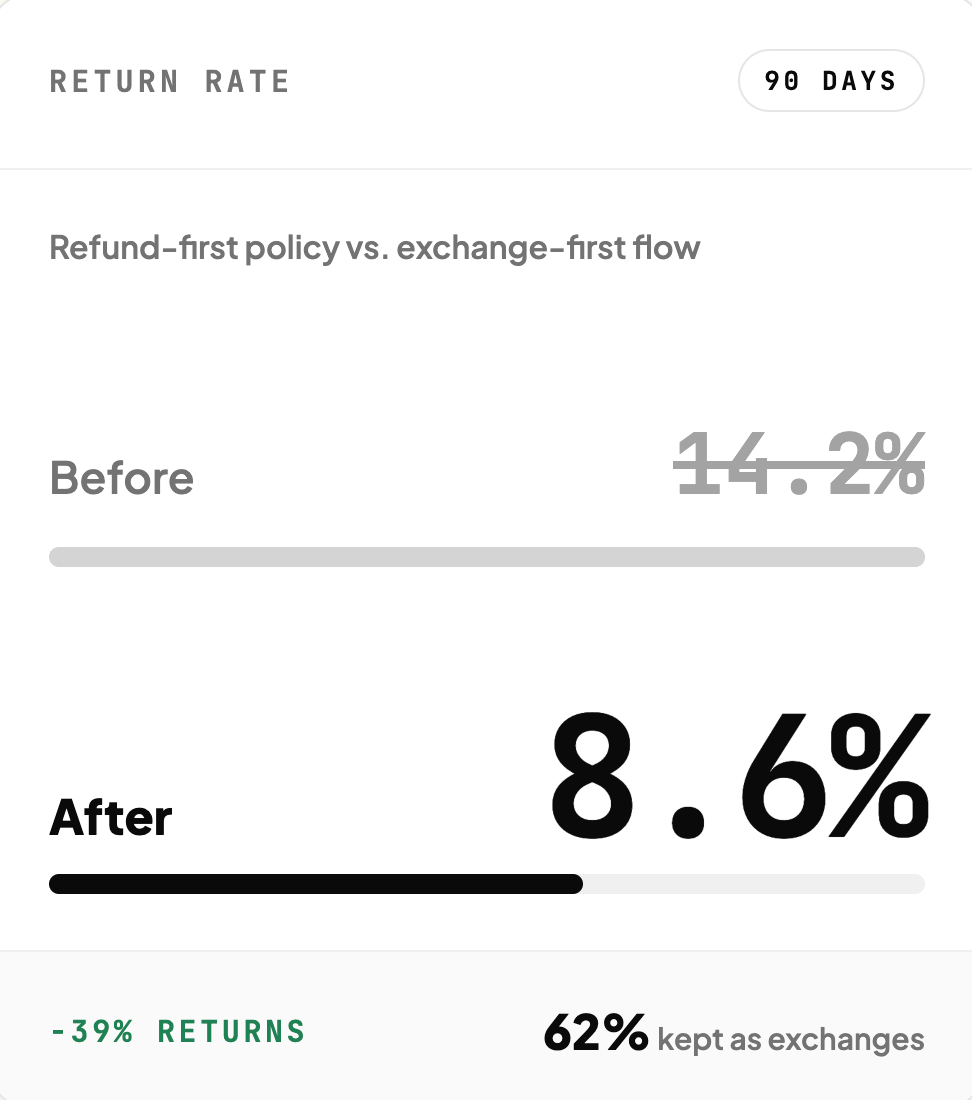
Make exchanges the default suggestion, not refunds. A slight incentive toward exchange, even a small one, keeps revenue in the business and often solves the customer's actual problem better than a refund does.
Keep the return window reasonable, not aggressive. 30 to 60 days gives customers room to decide without creating a fire drill on your end.
For context on what this looks like in practice: one baby and kids brand using Kovax's support agent resolved roughly 80% of inbound calls, including returns and order questions, without a human picking up. That's a self-reported figure from our own case study, not an independent audit, but it reflects the kind of volume a proactive support setup can absorb before it ever turns into a return-driven complaint.
Common Mistakes Stores Make Handling Shopify Returns
- Hiding the return policy in the footer. If a shopper has to search for it, you've already lost some of the trust it was supposed to build.
- Going silent after a return is initiated. Customers who don't hear anything assume the worst and call to ask, which is entirely avoidable with a simple status update.
- Defaulting every return to a refund. As covered above, this quietly trains customers away from staying.
- Treating every return like a potential fraud case. Most returns on Shopify have a boring, fixable explanation. Applying fraud-level scrutiny to all of them frustrates the honest majority to catch the small minority.
A Simple Week-by-Week Plan to Cut Your Return Rate Without Hurting Loyalty
Week 1: Pull your actual return rate and reasons by product category. You can't fix what you haven't measured, and "sizing" versus "damaged in transit" need completely different fixes.
Week 2: Fix the product pages responsible for the most returns, better photos, clearer sizing, accurate descriptions. This is where the 45% "expectation gap" number gets addressed directly.
Week 3: Make your return policy visible and simple, on the product page and at checkout, not just buried in a policy document.
Week 4: Set up proactive order and return-status communication so customers aren't calling to ask what they could already see. If phone volume around WISMO and returns is part of that gap, Kovax's features are built around answering those calls from live Shopify data rather than a script.
For a related read on the other side of this funnel, our guide on abandoned cart recovery covers what happens before checkout, while this one covers what happens after delivery.
FAQ
How do I reduce returns in ecommerce without upsetting customers?
Start with the product page, not the policy. Since sizing, fit, and color issues cause close to half of all returns, better photos, sizing charts, and honest descriptions prevent more returns than any policy change will.
How do I manage ecommerce returns at scale without hiring a bigger team?
Most of the manual work in returns is repetitive: checking order status, explaining the policy, confirming a refund timeline. That's exactly the kind of volume Kovax's support agent is designed to absorb, answering directly from your Shopify order data.
How do I write an ecommerce return policy that customers actually trust?
Keep it short, plain, and visible. State the return window, how to start a return, what condition items need to be in, and how long refunds take. Publish it on the product page and at checkout, not just in a linked legal document.
Does a generous return policy actually increase returns?
It can increase the number of returns slightly, but it also increases purchases and repeat purchases by more. 92% of consumers say they'll buy again if returns are easy, so the net effect usually favors the generous policy.
Is bracketing (ordering multiple sizes to return what doesn't fit) something I should try to stop?
Not directly. It's a response to sizing uncertainty, not bad faith. Fixing your size guide and adding a fit tool addresses the root cause better than restricting the return policy does.
Where to Go From Here
If your team is buried in "where's my order" and "how do I return this" calls every week, that's revenue-adjacent support work sitting on someone's plate that doesn't need a human doing it manually. See how Kovax's support agent handles order, refund, and return questions on a real Shopify store and install the free plan to test it against your own return volume before committing to anything bigger.