In this guide:
- Why conversational AI is becoming ecommerce's default customer channel
- What conversational commerce actually means, and how it works
- Ecommerce chatbot, live chat software, or AI voice agent, honestly
- The AI shopping assistant angle most Shopify stores miss
- The big fear: handing customer service to AI
- How an AI answering service and AI sales assistant actually handle calls and chats
- Common mistakes stores make with an AI chatbot for ecommerce
- A simple week-by-week plan to add conversational AI to your Shopify store
- FAQ
- Where to go from here
Why Conversational AI Is Becoming Ecommerce's Default Customer Channel
Think about the last time you messaged a brand instead of emailing them. You probably didn't think twice about it. That's the shift. Conversational AI is what happens when that same expectation, instant, two-way, no-hold-music, gets applied to an entire store.
The scale of this shift is not small. The conversational commerce market is projected to grow from $12.64 billion in 2026 to $22.56 billion by 2031, according to Mordor Intelligence. That's not a niche feature anymore. It's becoming the default way stores talk to customers, the same way live chat widgets became default a decade ago.
For a Shopify store, this isn't really about installing a chatbot. It's about picking which conversations, chat, voice, or shopping guidance, you actually want automated, and which ones still need a human. Kovax breaks this into three separate agents for exactly this reason, because one tool trying to do all three jobs usually does none of them well. Get the split right, and support stops being a cost center. Get it wrong, and you've just built a faster way to frustrate people.
What Conversational Commerce Actually Means, and How It Works
Conversational commerce is the umbrella term for buying and getting support through a conversation, chat, voice, or messaging, instead of clicking through menus and forms. It covers three separate jobs that often get lumped together:
- Support: answering "where is my order," "what's your return policy," or "does this fit true to size"
- Sales guidance: helping someone choose between two products or decide if something is right for them
- Recovery: reaching out when someone abandons a cart or an order needs confirmation
Here's the part most explainers skip: these three jobs need different tools. A chatbot is fine for FAQs. It's a poor fit for a hesitant customer who needs reassurance before finishing a $200 order. That's usually where voice comes in, because people trust a real-sounding conversation more than a chat bubble when the stakes are higher.
Takeaway: Don't ask "should we add conversational AI." Ask "which of these three jobs, support, sales, or recovery, is costing us the most right now." That answer decides where you start.
Ecommerce Chatbot, Live Chat Software, or AI Voice Agent, Honestly
These three get used interchangeably in marketing copy. They are not the same thing, and picking the wrong one for the job is the single most common reason conversational AI rollouts underperform.
Ecommerce chatbot, honestly
A dedicated ecommerce chatbot is text-based, sits on your site or in-app, and is built to answer store-specific questions using your product catalog and order data. It's cheap to run and good at volume. Its weakness: most shoppers still won't type a full sentence into a widget when they're frustrated. They want to talk, not type.
Live chat software, honestly
Live chat software (think the classic chat-with-an-agent widget) is built around a human on the other end, with AI layered on top to triage or suggest replies. It's reliable but it doesn't scale past your staffing. If your team is asleep at 2 a.m., live chat is asleep too, unless there's a fully autonomous layer behind it.
AI voice agent, honestly
An AI voice agent answers or makes phone calls, the channel every other option skips. This matters more than people assume: not every customer wants to type at all, and voice remains the format people use when something feels urgent, a stuck delivery, a payment issue, a hesitation right before checkout. It's also the hardest of the three to get right, which is why most "conversational AI for ecommerce" content quietly ignores it. Kovax's support agent and cart recovery agent both run on voice for exactly this reason.
None of these three is universally "best." The honest answer is that a store handling meaningful order volume usually ends up needing at least two of them working together, not one replacing the others.
The AI Shopping Assistant Angle Most Shopify Stores Miss
Most conversational AI coverage frames this as a support-cost story. That undersells it. An AI shopping assistant that can answer "will this work for oily skin" or "what's the difference between these two bundles" in real time isn't just cutting ticket volume, it's replacing the moment a shopper would otherwise close the tab and go compare on Google.
This is where the revenue case gets concrete. According to data compiled by HelloRep, shoppers who engage with AI-powered chat convert at 12.3%, compared to 3.1% for those who don't, a roughly fourfold difference. That gap isn't about the AI being clever. It's about answering the one question that was stopping someone from buying, at the exact moment they had it.
The mistake stores make here is treating the assistant as a support tool that happens to sit near products, instead of a sales tool that happens to also answer support questions. The framing changes what you measure and what you optimize for. Kovax's feature set is built around that sales-first framing rather than treating it as an afterthought.
The Big Fear: Handing Customer Service to AI
Say it plainly: handing any part of customer service outsourcing to AI feels risky, because customer conversations are where trust gets won or lost. This fear is reasonable, not irrational, and worth addressing directly instead of waving away.
Here's what actually tends to go wrong, and what doesn't:
It doesn't usually go wrong because the AI sounds robotic. Voice and chat AI in 2026 sound close enough to natural that this stops being the top concern within the first few weeks of use.
It does go wrong when there's no clear handoff to a human. If a shopper gets stuck in an AI loop with no way out, that's the moment trust breaks, not the automation itself.
It does go wrong when the AI is given more authority than it has information for. An assistant that guesses at refund policy instead of saying "let me check and follow up" will eventually promise something the store can't honor.
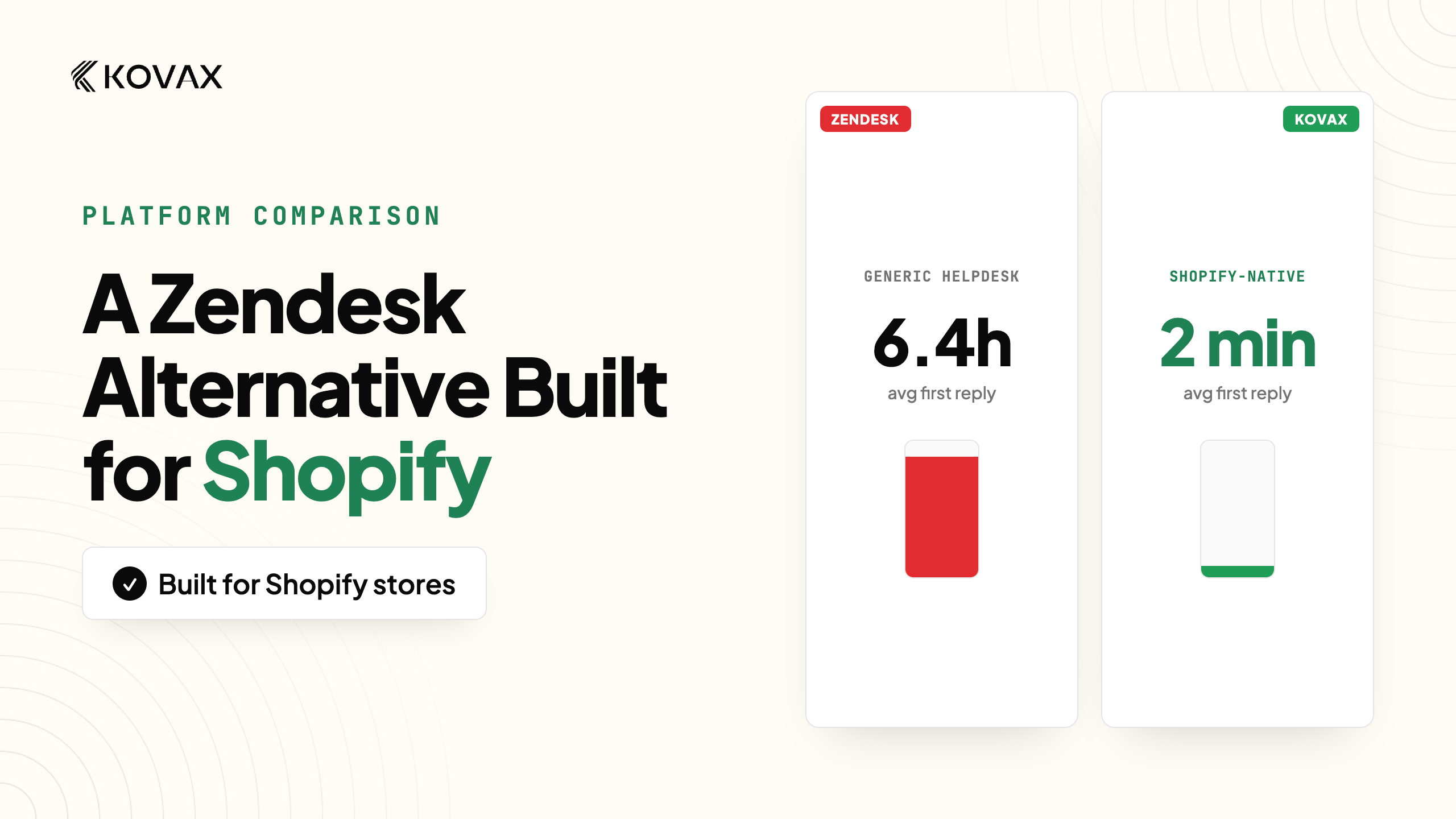
The stores that get burned skipped the boring part: defining exactly what the AI is allowed to decide on its own, and where it must stop and escalate. That's the first thing covered in how Kovax sets up an agent, before pricing or install. If you're evaluating vendors in this space, alongside names like Zendesk and other established players, that escalation logic is the question to ask about first.
How an AI Answering Service and AI Sales Assistant Actually Handle Calls and Chats
Strip away the marketing language and here's what's actually happening under the hood on a decent implementation:
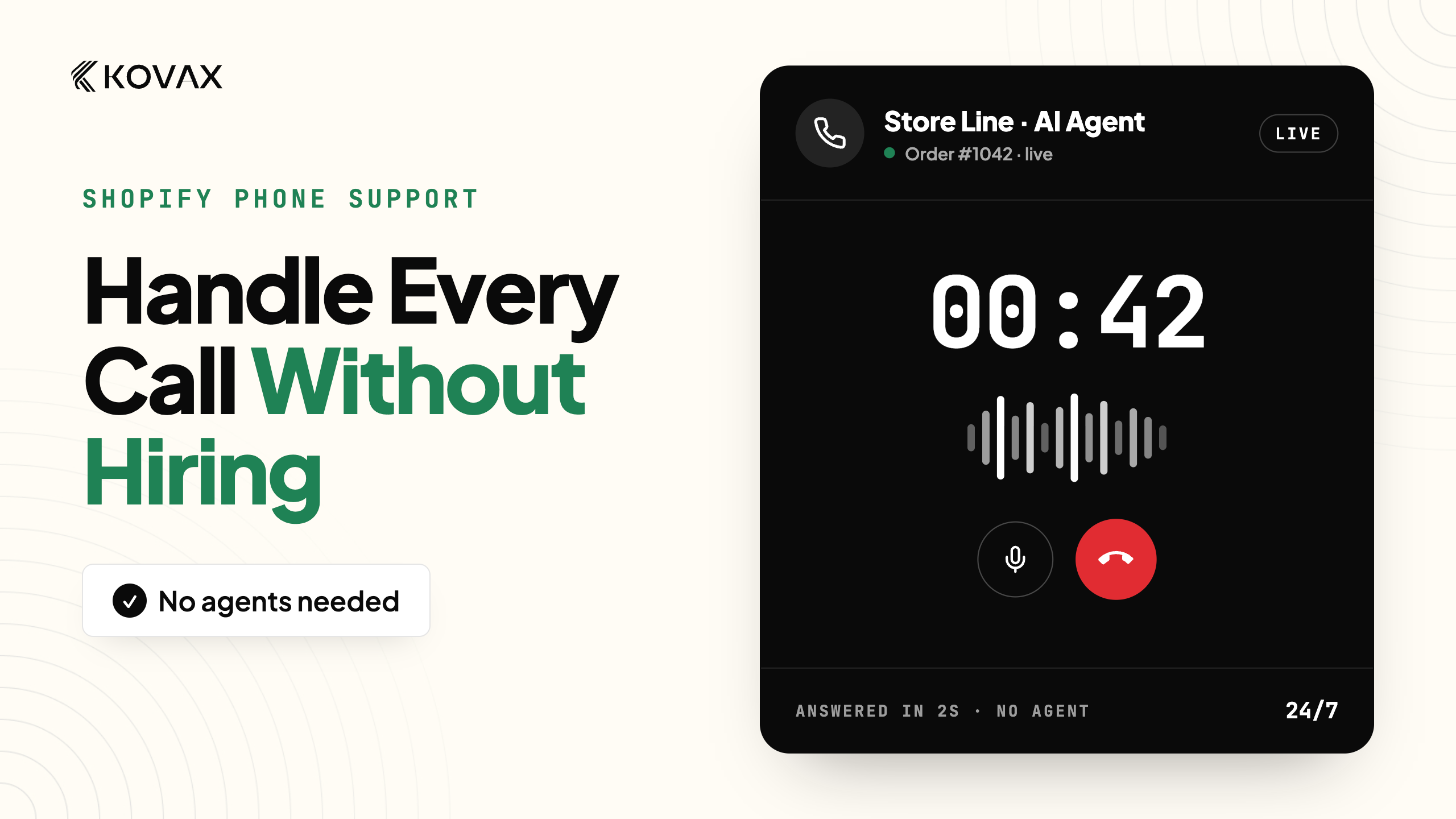
On the voice side, an AI answering service picks up the call, pulls the customer's order or account context in real time, and either resolves the question directly (a WISMO check, a return status) or books an outbound follow-up if the issue needs a person. The better systems respond in under a second, because a delay on a phone call feels like dead air, which people hang up on.
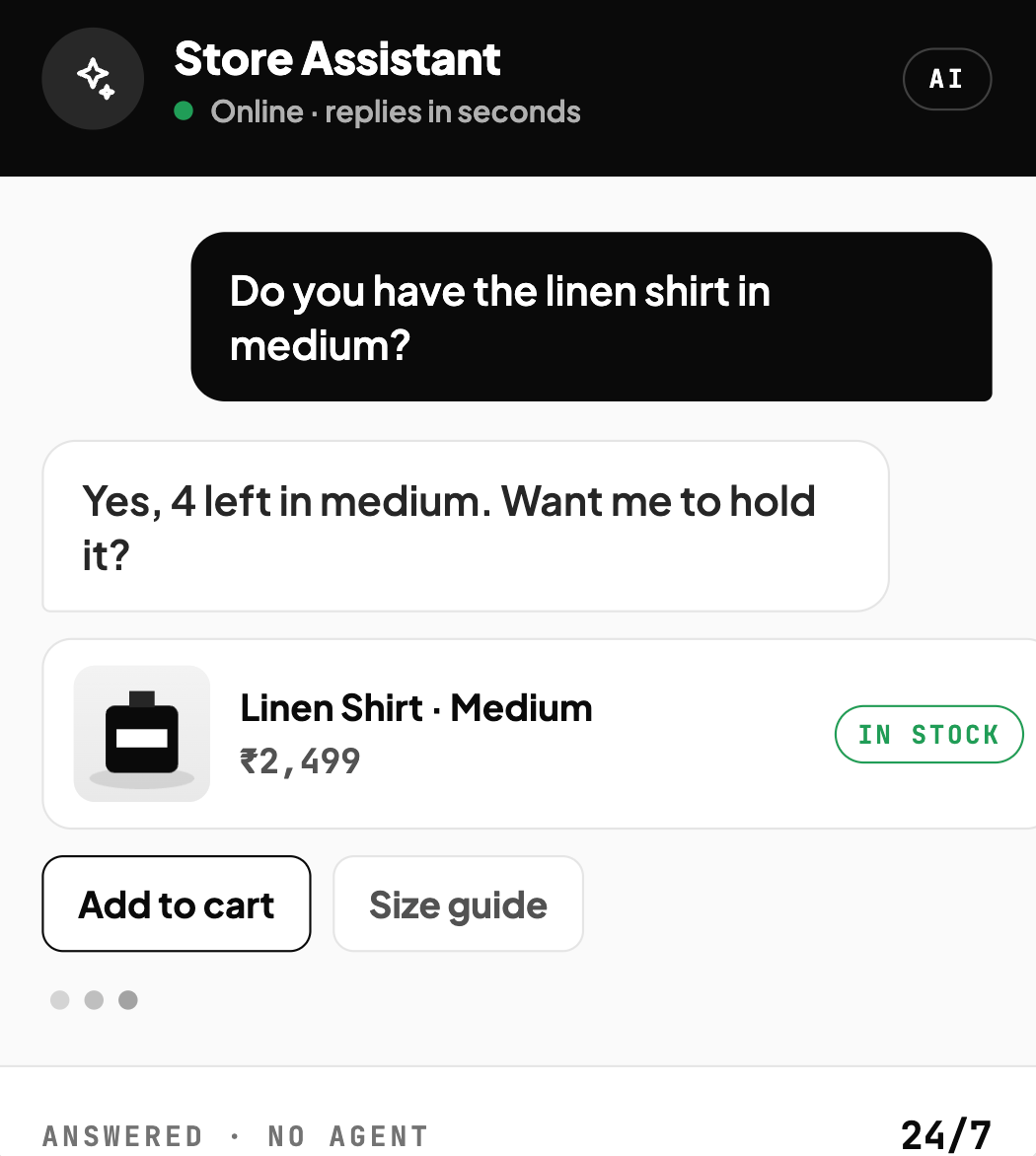
On the chat side, an AI sales assistant works from your actual catalog, not a generic script, so "do you have this in a size 10" gets a real, current answer instead of a canned response. It should also know when to stop selling and start escalating, the same discipline from the fear section above.
The through-line: both are only as good as the data feeding them. An AI agent that can't see live inventory or order status is just a chatbot wearing a better outfit. This is worth confirming directly with any vendor before signing anything, ours included.
Common Mistakes Stores Make with an AI Chatbot for Ecommerce
- Launching with zero escalation path. If a shopper can't reach a human when they need one, you've traded a slow support team for a frustrating one.
- Treating the AI chatbot for ecommerce as a support-only tool. As covered above, the real value is often on the sales side, not just ticket deflection.
- Turning it on for every channel at once. Voice, chat, and post-purchase follow-up each need separate testing. Doing all three in week one makes it impossible to tell what's working.
- Never reviewing real conversation transcripts. The fastest way to catch a bad answer before a customer complains about it is to actually read what the AI is saying, weekly, not quarterly.
If phone support specifically is the piece you're stuck on, this breakdown of handling Shopify calls without hiring covers the cost math in more depth.
A Simple Week-by-Week Plan to Add Conversational AI to Your Shopify Store
Week 1: Pick one job, support, sales guidance, or recovery, based on where you're losing the most time or revenue right now. Don't try to cover all three.
Week 2: Connect the AI to real store data: live inventory, order status, return windows. An assistant answering from a static FAQ document will get outdated fast.
Week 3: Set the escalation rules before launch, not after. Decide exactly what the AI can promise and what it has to hand off.
Week 4: Launch to a portion of traffic or calls, not everything. Read the transcripts daily for the first two weeks.
Most of the Shopify AI tools available today are built around this exact staged rollout, because the stores that skip straight to "automate everything" are the ones that end up rolling it back. Kovax's pricing page is structured around this too, a free tier to test the rollout before committing to a custom plan, and the ROI calculator is a fast way to sanity-check the math before week one even starts.
For context on how this plays out with a real store: one baby and kids brand using Kovax's voice agent went from a $4,000-a-month fixed support cost to $0, while cutting cost-per-call from $26.67 to under $4. That's a self-reported result from our own case study, not an independent audit, but it reflects the kind of gap a staged rollout is meant to close.
FAQ
Is conversational AI the same as a chatbot?
No. A chatbot is one type of conversational AI, text-based and usually rule-driven or lightly AI-assisted. Conversational AI is the broader category that also includes voice agents and more advanced, context-aware assistants.
Does conversational commerce actually increase sales, or just cut support costs?
Both, but the sales impact is usually bigger and less discussed. Chatbot-powered websites see roughly a 23% higher conversion rate overall, per Experro's research, and conversational AI prompts recover close to 35% of abandoned carts that would otherwise be lost.
What's an example of conversational commerce outside of chat widgets?
A customer calling a store's support line and having an AI voice agent confirm their order, check delivery status, or offer a discount to complete an abandoned checkout, all without a human on the line, is conversational commerce. So is a WhatsApp thread where a bot recommends a product size.
Do customers actually prefer talking to AI over a human?
It's split, and the honest answer matters here. About 62% of consumers now say they'd rather use a chatbot than wait for a human agent, per Experro, but that preference depends entirely on the AI actually resolving the issue instead of stalling.
Is this only useful for large Shopify stores?
No. Smaller stores often benefit more per dollar spent, because they can't staff 24/7 support the way larger teams can, and a missed after-hours call or chat is proportionally a bigger loss.
Where to Go From Here
If missed calls, slow chat replies, or 2 a.m. "where is my order" messages are costing you sales right now, start with the one job that's hurting most, not all three at once. See how Kovax's voice and support agents work on a real Shopify store and install the free plan to test it against your own call volume before committing to anything bigger.