Quick answer: AI agents for ecommerce are software assistants that do real store jobs on their own, like calling shoppers who leave a cart, answering customer calls, and checking cash-on-delivery orders before they ship. A chatbot only replies. An agent takes action. For most online stores, that is where AI for ecommerce pays off first.
Eeveve, a baby play mat brand, paid $4,000 a month for one person to answer about 150 phone calls. After it switched to an AI agent, its fixed support cost dropped to $0, and it saved $48,000 a year. That is AI for ecommerce working in a real store, not in a slide deck.
This guide explains, in plain words, what AI agents are, what they can and can't do, what they cost, and how to start.
What Is an AI Agent for Ecommerce?
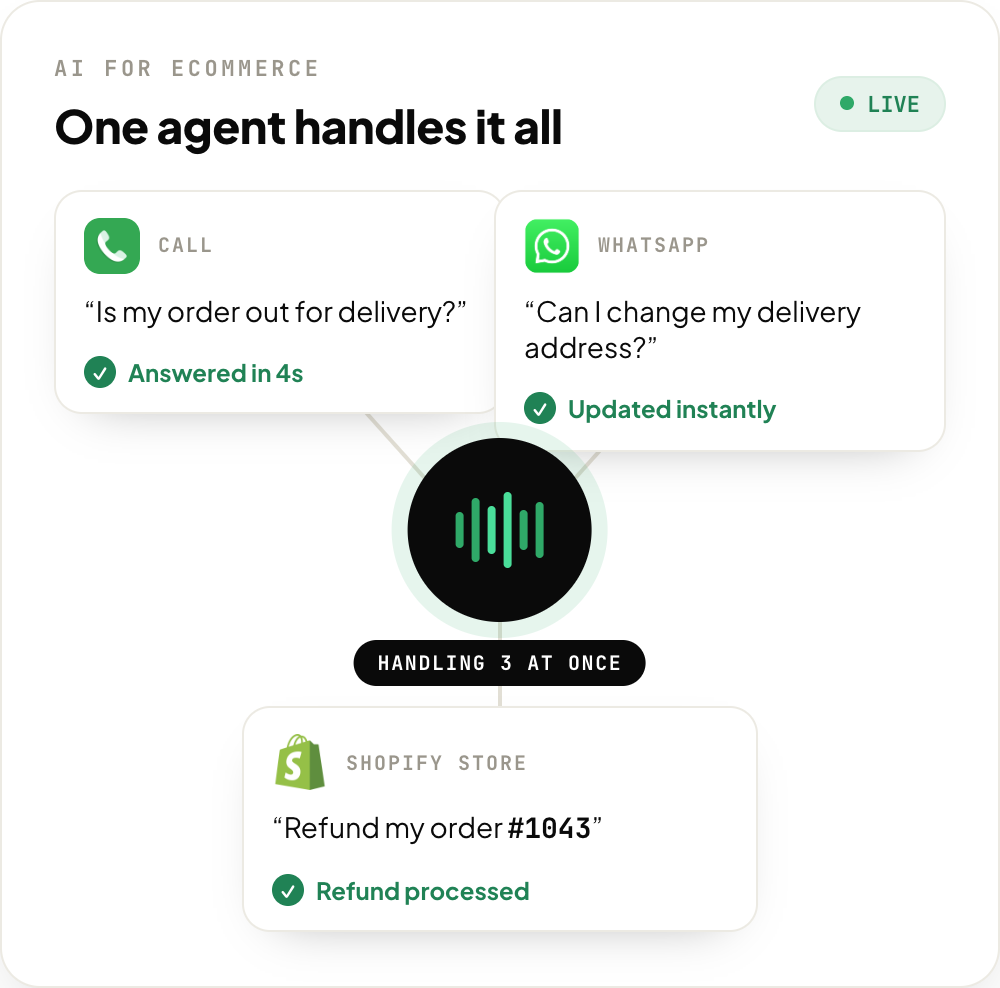
An AI agent for ecommerce is a computer assistant that can understand a goal, decide what to do, and finish the task by itself inside your store. Gartner describes agentic AI as systems that "act autonomously to complete tasks", instead of just giving people information.
Definition: An ecommerce AI agent is software that connects to your store, learns your products and policies, and then completes jobs like calling a shopper, answering a question, or checking an order, without a person stepping in each time.
Think of the difference between a vending machine and a new store employee. A vending machine does one fixed thing when you press a button. A trained employee listens, figures out what the customer needs, and handles it. An AI agent works like that employee, only it never sleeps and can take many calls at once.
How Is an AI Agent Different From a Chatbot or Automation?
A chatbot answers questions. An automation follows a fixed rule. An AI agent decides what to do and then does it. The table shows the difference.
| Automation | Chatbot | AI agent | |
|---|---|---|---|
| What it does | Follows one fixed rule | Replies to typed questions | Understands the goal and finishes the task |
| Store example | "Send an email 1 hour after a cart is left" | Answers "What is your return policy?" in a chat window | Calls the shopper, answers their sizing question, and texts a checkout link during the call |
| Can it take action? | Only the one action it was set up for | Mostly no, it gives answers | Yes, it can check orders, confirm addresses, and follow up |
| Handles surprises? | No | Sometimes | Yes, it adjusts to what the customer says |
| Best for | Simple, repeated steps | Common questions | Jobs that need a real conversation and a result |
If you want the details on the first two, our guides to ecommerce chatbots and customer service automation go deeper.
What Can AI for Ecommerce Actually Do?
Today, AI for ecommerce does six main jobs well. Each one below comes with a real store that proves it.
- Win back shoppers who leave their cart
- Answer your store's phone and messages
- Check cash-on-delivery orders before they ship
- Answer "Where is my order?" questions
- Sell and suggest add-ons during a conversation
- Fix problems like wrong addresses or failed payments early
How Do AI Agents Win Back Abandoned Carts?
An AI agent calls the shopper within minutes of them leaving checkout, answers their question, and can text a checkout link while still on the call. Kovax describes this flow on its cart recovery page.
Real example: Monster Piercing, a UK body jewellery store, used email reminders, and only 8% of shoppers came back. After adding AI calls with a WhatsApp follow-up, won-back carts rose to 19%, which is 2.4 times better. Even more telling, 8 out of 12 calls turned straight into orders. Our comparison of email, SMS, and voice cart recovery explains why calls work so well.
How Do AI Agents Answer a Store's Phone and Messages?
An AI agent picks up every call and message, day or night, using your real product details and store policies. That means no voicemail and no customer waiting until morning.
Real example: Eeveve paid $26.67 per call when a person sat by the phone. With an AI agent, that dropped to under $4 per call, and the agent handled 85 to 90% of calls on its own. The founder said: "We were paying $4K a month for someone to sit by the phone and take maybe 5 calls a day. Now the AI handles almost all of them, even the tricky ones." Our guide to Shopify phone support without hiring covers this job in detail.
How Do AI Agents Check Cash-on-Delivery Orders?
With cash on delivery, the shopper pays when the parcel arrives. Some shoppers refuse the parcel at the door, and the store pays shipping both ways for nothing. An AI agent calls each shopper within minutes of the order, checks the address, and asks if they still want it. Orders with a "yes" ship, and the rest are held.
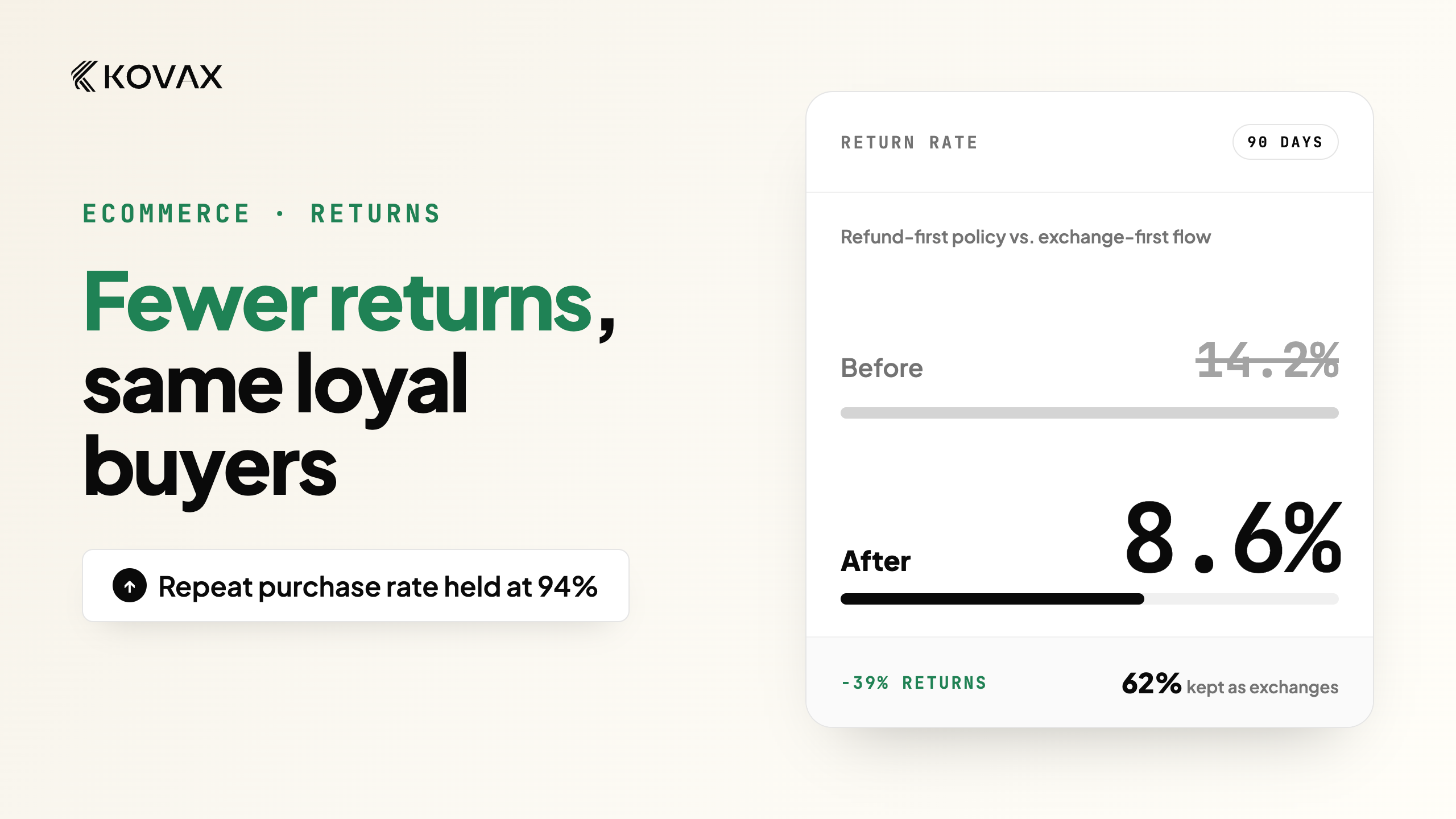
Kovax reports this approach confirms 95% of cash-on-delivery orders and cuts returned parcels by 50%. Our guide to returned parcels in eCommerce shows how much those failed deliveries cost.
How Do AI Agents Handle "Where Is My Order?" Questions?
"Where is my order?" is one of the most common questions any store gets. An AI agent looks up the order and tells the customer exactly where it is, in seconds. Kovax says its support agent automates 80% of these calls.
Real example: eSkinStore, a Canadian skincare store shipping to 20+ countries, had just one support person, so calls from other time zones went to voicemail. With AI agents, it now answers 100% of calls and has handled 1,400+ in total. Our WISMO guide explains what these calls really cost a store.
Can an AI Sales Agent Upsell Shoppers?
Yes. An AI sales agent can suggest a matching product during a call, the same way a good store clerk might say, "That serum works great with this moisturizer." Because it knows your live product catalog, it only suggests items you actually have. Kovax reports a +27% higher average order value from upselling during calls, and its Outbound Sales Agent also scores each buyer by how likely they are to purchase.
How Do AI Agents Fix Problems Before Shoppers Notice?
AI agents can reach out first when something looks wrong, like an address that might be incorrect or a payment that failed.
Real example: eSkinStore runs four agents at once: one for questions, one for delivery problems, one that checks addresses before shipping, and one that follows up on failed payments. Together, they have protected more than CAD 31,000 in orders that were at risk of being lost, with the same one support person on the team.
What Results Do Stores Get From AI Agents?
Stores using AI agents report lower support costs, more won-back sales, and calls answered around the clock. Here are the measured results from three Kovax stores.
| Store | Problem | What the AI agent did | Result |
|---|---|---|---|
| Monster Piercing (UK, jewellery) | Email won back only 8% of carts | Called shoppers after they left, then followed up on WhatsApp | 19% of carts won back (2.4x), 8 of 12 calls became orders |
| Eeveve (baby play mats) | $4,000 a month for about 150 calls | Answered calls using product and policy details | $48,000 saved a year, cost per call from $26.67 to under $4 |
| eSkinStore (Canada, skincare) | One person, 20+ countries, missed calls | Four agents for questions, delivery, addresses, and payments | 100% of calls answered, CAD 31,000+ in orders protected |
The bigger picture points the same way. Gartner predicts that by 2029, agentic AI will resolve 80% of common customer service issues without a person, leading to a 30% drop in operating costs.
What Can't AI Agents Do Yet?
AI agents are strong at common, repeated jobs, but they are not a full replacement for people. Here is where they still fall short:
- Hard or emotional cases. An upset customer with an unusual problem still needs a human. Good AI agents hand the call to your team with the full conversation attached, so the customer does not repeat themselves.
- Bad store information. An agent is only as good as what it learns. If your return policy page is out of date, the agent will repeat the old policy.
- The first few days. Agents need tuning. Eeveve found its agent's early answers about home design were too short, so the team adjusted them during a soft launch.
- Every single issue. Even Gartner's prediction covers 80% of common issues by 2029, which leaves the rest for people.
The simple rule: let the agent handle the repeated work, and keep your team for the moments that need a human touch.
What Is Agentic Commerce?
Agentic commerce is the next step: shoppers using their own AI assistants to research and even buy products for them. Instead of a person browsing ten tabs, an AI shopping assistant compares options and suggests what to buy.
It is already growing fast:
- Traffic to US retail sites from AI tools jumped 1,200% between July 2024 and February 2025, and those visitors had a 23% lower bounce rate.
- In the same Adobe survey, 39% of US shoppers had already used AI for online shopping.
- Agentic commerce could reach $1 trillion in US retail revenue by 2030, based on a McKinsey and ICSC forecast.
What it means for your store: AI shopping tools need clear, correct answers about your products, shipping, and returns. The same well-organized store information that helps your own AI agent also helps shoppers' AI assistants recommend you. Our guide to conversational AI for ecommerce explains how stores talk with shoppers through AI today.
How Much Does AI for Ecommerce Cost?
AI for ecommerce usually costs a monthly plan plus a small fee for each call or message. With Kovax, you can start free, then pay from $49.99 a month.
| Kovax plan | Monthly price | Phone calls | WhatsApp offers | Text messages |
|---|---|---|---|---|
| Free | $0 | 50+ calls to start | — | — |
| Starter | $49.99 | 30¢ per minute | 1¢ each | 3¢ each |
| Growth | $199.99 | 27¢ per minute | 1¢ each | 2¢ each |
| Ultimate | $399.99 | 25¢ per minute | 1¢ each | 1¢ each |
Prices from the Kovax pricing page, October 2026.
Simple math: on the Starter plan, $49.99 covers about 166 minutes of calls. Compare that with Eeveve's old setup, where each call cost $26.67 because a full-time person waited by the phone. The cheaper question to ask is not "What does the AI cost?" but "What does each handled call or saved sale cost me?"
How Do You Start Using AI Agents in Your Store?
You can start in five steps, and the setup itself takes a few minutes, with no code.
- Pick one leaky job first. Choose the problem that costs you most today: lost carts, missed calls, or refused cash-on-delivery parcels.
- Clean up your store information. Make sure product details, shipping times, and return policies are correct, because the agent learns from them.
- Install and let it learn. With Kovax, you connect your Shopify store in one click, and the agent learns your products and policies on its own.
- Soft launch and read the conversations. Turn it on for one job, read the call transcripts, and adjust any answers that feel off, just like Eeveve did.
- Measure one number, then grow. Track a single result, like won-back carts or cost per call. Once it improves, add the next job.
For a full walkthrough, see how Kovax works, our complete guide to the AI agent for Shopify.
What Do People Ask About AI Agents for Ecommerce?
What is AI for ecommerce?
AI for ecommerce means using artificial intelligence to run parts of an online store, like answering customers, winning back abandoned carts, checking orders, and suggesting products. The most useful form today is the AI agent, which completes tasks on its own instead of only giving answers.
Are AI agents the same as chatbots?
No. A chatbot replies to typed questions, while an AI agent can take action, such as calling a shopper, checking an order, confirming an address, or texting a checkout link. In short, a chatbot talks, and an agent talks and does.
Will AI agents replace my support team?
Not fully. AI agents handle common, repeated work, like order tracking and simple questions, and hand hard or emotional cases to a person. eSkinStore, for example, kept its one support person while its AI agents answered 100% of calls.
How much does an AI agent for ecommerce cost?
Most AI agents charge a monthly plan plus a fee per call or message. Kovax is free to start with 50+ calls, then paid plans are $49.99, $199.99, or $399.99 a month, with calls from 25¢ to 30¢ per minute.
Is AI ecommerce worth it for small stores?
Often yes, because small stores feel missed calls and lost carts the most. Eeveve, a small brand handling about 150 calls a month, cut its cost per call from $26.67 to under $4 and saved $48,000 a year with an AI agent.
Do I need a developer to set up an AI agent?
No. With Kovax, you install the app from the Shopify App Store in one click, and the agent learns your products and policies on its own. Setup takes three steps and a few minutes.
What Should You Do Next?
AI in ecommerce is no longer a future idea. AI agents already win back carts, answer phones, and stop wasted deliveries for real stores like Monster Piercing, Eeveve, and eSkinStore. Start with the one job that leaks the most money, measure the result, and grow from there.
If that job is phone calls, carts, or cash-on-delivery orders, you can try Kovax free on Shopify with 50+ calls included.
Install Kovax from the Shopify App Store or book a demo.
About Kovax: Kovax is an AI agent built only for Shopify stores. It handles phone calls, WhatsApp, text, email, and website chat for cart recovery, cash-on-delivery confirmation, and customer support in 20+ languages. The Kovax Shopify app launched in September 2025.
Related reading: How Kovax works · Abandoned cart recovery · Conversational AI for ecommerce · Ecommerce chatbots