RTO in eCommerce, in 30 seconds
- What it is: RTO (Return to Origin) is a COD order that never reaches the customer and ships all the way back to you - you pay both legs of shipping and earn nothing.
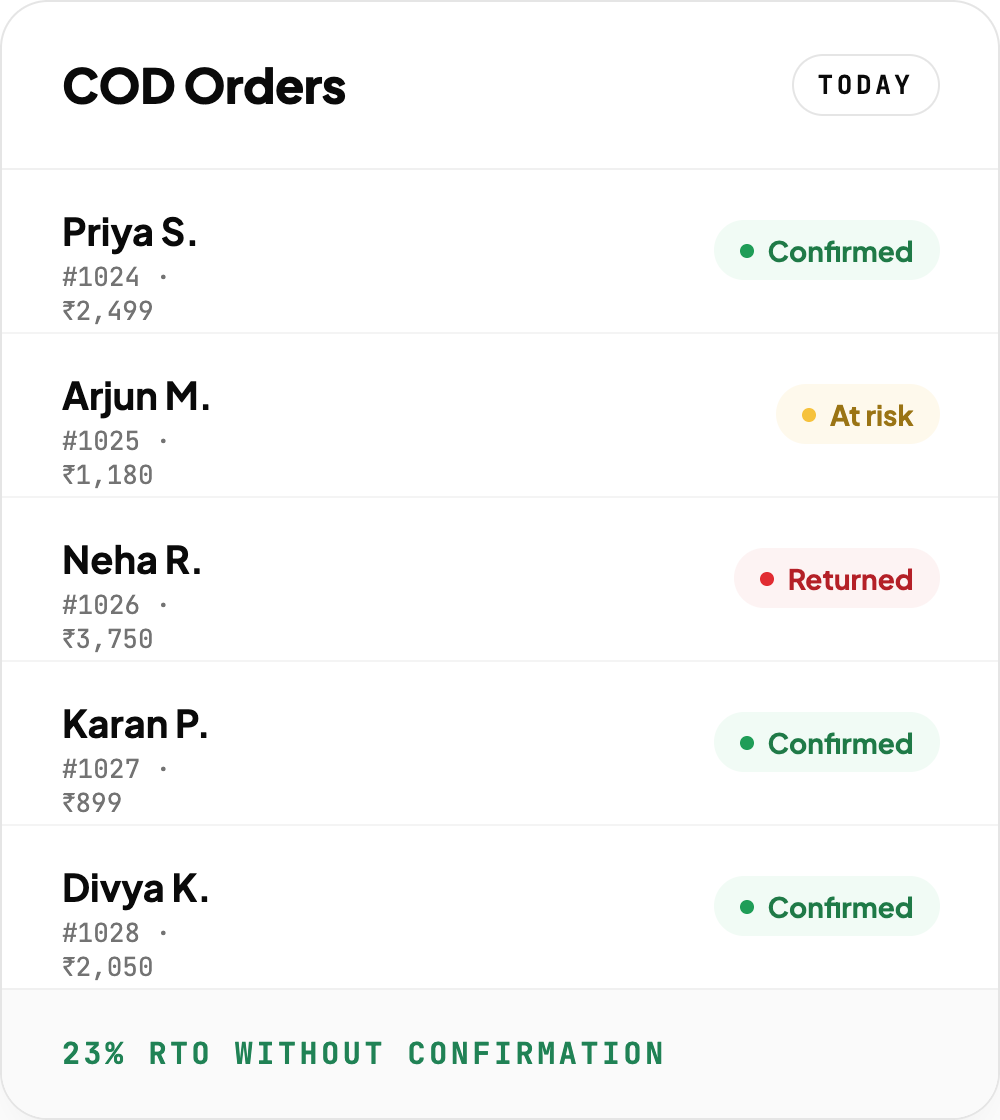
- The catch nobody tells you: most RTO isn't a logistics problem, it's a confirmation problem. The order was never verified before it shipped. Across 2,500+ COD orders we confirmed for 5 Shopify stores, simply calling to confirm before dispatch cut RTO from 40% to 10%.
- Who this is for: founders and ops leads at Indian D2C / Shopify brands running heavy cash on delivery (COD) volume, watching margin leak to returns they can't explain.
Open your courier dashboard at the end of a month and the story is always the same. A stack of orders marked "RTO - returned to origin." Each one shipped, traveled to a tier-2 or tier-3 pin code, never got delivered, and rode all the way back. You paid forward shipping, reverse shipping, repackaging, and the ad spend that won the order - and you have nothing to show for it.
We pulled the numbers across 2,500+ COD orders we've confirmed for 5 Shopify brands to write this, and the pattern held every time: RTO in ecommerce is rarely about bad couriers. It's about orders going out the door before anyone confirmed the customer actually wants them, at an address that actually exists. Fix that one gap and the returns stop.
If you run a COD-heavy store and your RTO sits north of 20%, this is the playbook to bring it down. Prefer to see it on your own orders? See how the COD confirmation agent works.
What is RTO in eCommerce?
RTO stands for Return to Origin. It's what happens when a shipped order can't be delivered and the courier sends it back to the seller. The full form of RTO is literally that - the parcel returns to its origin, your warehouse.
Two terms people mix up:
- Return to origin (RTO): the order was never delivered and comes back. You lose both shipping legs and the sale.
- A customer return: the order was delivered, then sent back. Different problem, different fix.
RTO is overwhelmingly a COD (cash on delivery) phenomenon. No prepayment means no commitment - so a buyer can refuse the parcel, go unreachable, or never have intended to pay. That's why rto in ecommerce is a far bigger line-item for COD-led Indian D2C brands than for prepaid-first stores.
Why RTO happens
Strip away the noise and almost every RTO traces back to one of five things:
- No order confirmation. The biggest one. The order shipped before anyone checked the customer still wants it. Impulse COD orders cool off fast.
- Wrong or incomplete address. A missing landmark, wrong pin code, unreachable phone - the courier can't complete the last mile, and a failed delivery attempt becomes an NDR, then an RTO.
- Fake or low-intent orders. COD invites them. No skin in the game means some orders were never serious.
- Buyer unreachable at delivery. One missed courier call and the parcel starts its journey back.
- Buyer's remorse on COD. By delivery day the customer has changed their mind - and refusing costs them nothing.
The thread: four of those five are solved before the parcel moves, by confirming the order and the address with the customer. That's the whole game.
What RTO actually costs your D2C brand
Founders underestimate the damage because RTO hides as a logistics line instead of a margin line. Run the math on a single RTO:
One RTO ≈ ₹500 - forward shipping + reverse shipping + repackaging + the Meta ad spend you burned to acquire that order.
Now scale it. A store doing 1,000 COD orders a month at 40% RTO eats 400 failed orders × ₹500 = ₹2,00,000 a month, gone. Cut RTO to 10% and that's 100 × ₹500 = ₹50,000 - a ₹1,50,000 monthly swing back into margin, with zero extra ad spend.
For some brands it's worse. Take GiftIndias, a personalized-gifting brand we work with - custom photo frames, oil-paint frames, neon name lights. Their products are made to order (a personalized frame can't be resold) and fragile (every RTO frame tends to come back broken). So an RTO is a triple loss: the shipping, the unsellable product, and a smashed frame. For a brand like that, a high RTO rate isn't a leak - it's a hole in the boat.
What's a healthy RTO rate?
There's no universal number - it scales with your COD share and geography. As a rough guide for Indian COD-led D2C, RTO commonly runs 25–40%, and brands that have it under control sit in single digits. Across the stores we confirm orders for, RTO settled around 10% after confirmation calls, down from 40%. The point isn't the exact benchmark; it's the gap between "ship and hope" and "confirm and ship."
How to reduce RTO in eCommerce
Ordered by impact. The first lever does most of the work.
1. Confirm every COD order before you dispatch it
The single highest-impact move. Before a COD parcel ships, call the customer to confirm they still want it and that the address is right. A confirmed order ships; an unconfirmed one waits.
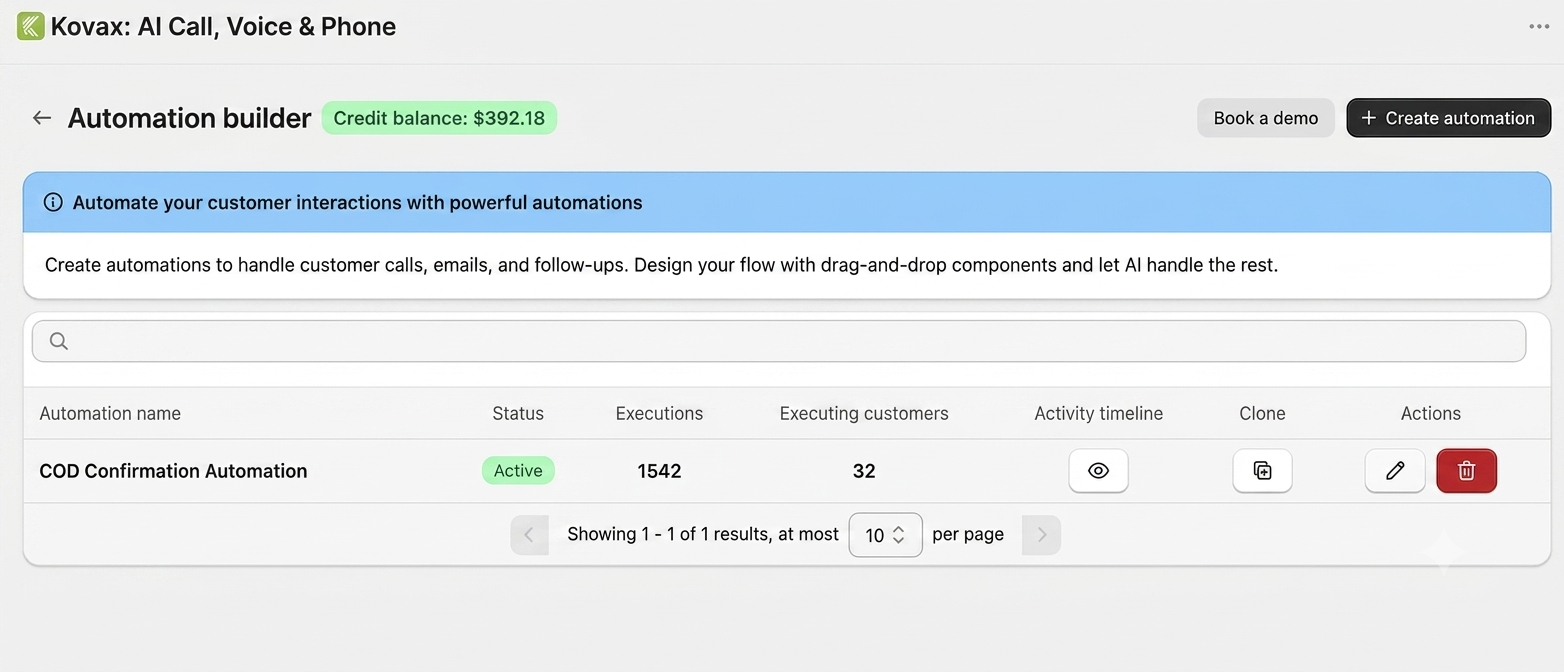
This is exactly what the Kovax COD confirmation agent automates. The moment a COD order is created in Shopify:
- It waits ~1 minute, then places an AI voice call in Hindi, Hinglish, or a regional language.
- No answer? It retries on an escalating schedule - after 1 hour, then 20 hours, then 24 hours - up to 4 attempts.
- On every call it confirms intent, verifies the address (pin code, landmark), captures a re-attempt slot, and raises a fraud flag on suspicious orders.
- Each order is auto-tagged back in Shopify -
rto_risk,merchant_action_required,category,merchant_summary- so ops knows exactly what to ship and what to hold.
The rule: if a customer doesn't pick up after all 4 attempts, the order is treated as an RTO risk and held - instead of shipping blind and paying ₹500 to watch it bounce back. Across our stores the agent reaches 80%+ of customers, and a confirmation call takes just 1.5–2 minutes, address included. (See exactly how confirmation calls reduce RTO.)
2. Fix the address on the call
Confirmation isn't only "do you still want it." Roughly 100–150 of every 1,000 customers we call ask to correct their address - a wrong pin code, a missing landmark, a better window. Catching that before dispatch turns a guaranteed failed delivery into a clean one. Address verification quietly removes a whole category of RTO.
3. Flag fraud and low-intent orders early
Some COD orders were never real. Auto-tagging high-risk orders (repeat refusers, mismatched details) lets you hold or convert them to prepaid before you spend a rupee shipping.
4. Nudge risky orders toward prepaid
For flagged or high-value COD orders, offering a small prepaid incentive on the confirmation call converts the riskiest deliveries into committed ones. A prepaid order almost never becomes an RTO.
5. Close the loop with your courier stack
Confirmation works best when it writes back into the tools you already run. The Kovax flow integrates directly with Shopify and with Shiprocket, Razorpay, GoKwik, and Shopflo, so confirmed orders flow to fulfillment and flagged ones don't - no manual list-juggling.
The proof: GiftIndias
Running 3,000+ COD orders a month with personalized, fragile products, GiftIndias had RTO at 35–40% - brutal for made-to-order goods. After putting confirmation calls in front of every COD order, RTO fell to 8–10%. They've confirmed ₹15,00,000 in COD orders through the agent and save roughly ₹1,00,000 every month that used to ship out and break on the way back.
For a brand shipping made-to-order, breakable products, that swing - from ~38% of orders bouncing back to under 10% - is the difference between a margin leak and a healthy P&L.
Common RTO mistakes that keep your rate high
- Shipping COD orders blind. Hope is not a confirmation step.
- Treating RTO as a courier problem. Most RTO is decided before the parcel moves.
- Calling only once. Our data shows it takes an escalating 4-attempt cadence to reach 80%+ of customers.
- Ignoring address quality. 10–15% of customers need a fix you'll only catch if you ask.
- No single RTO number. If you can't state your RTO rate this month, you can't manage it.
Frequently asked questions
What is RTO in eCommerce?
RTO stands for Return to Origin - a shipped order that couldn't be delivered and is sent back to the seller. It's most common with cash-on-delivery (COD) orders, where the buyer hasn't prepaid and can refuse or go unreachable at delivery.
What is the full form of RTO?
In eCommerce and shipping, RTO means Return to Origin. (In India, "RTO" also means Regional Transport Office - a different thing entirely.)
How do you reduce RTO in eCommerce?
The highest-impact step is confirming every COD order before dispatch - verifying the customer still wants it and the address is correct. Add address correction on the call, fraud flagging, prepaid nudges, and tight courier integration. Brands that confirm before shipping routinely cut RTO from 30–40% into single digits.
What is a good RTO rate?
It varies by COD share and geography, but Indian COD-led D2C often runs 25–40%, while well-managed brands sit in single digits. After adding confirmation calls, the stores we work with settled around 10%.
What causes RTO?
Mainly: no order confirmation before shipping, wrong or incomplete addresses, fake/low-intent COD orders, buyers unreachable at delivery, and COD buyer's remorse. Most are preventable before the parcel moves.
How does COD increase RTO?
With no prepayment there's no commitment, so it's easy for a buyer to refuse the parcel, go unreachable, or never intend to pay. Confirming the order (or converting it to prepaid) before dispatch is the fix.
Stop shipping orders that come back
Every unconfirmed COD order is a ₹500 coin-flip. Confirm before you ship and you keep the margin instead of mailing it to a tier-3 pin code and back.
See what RTO is costing your store - book a demo of the Kovax COD confirmation agent and we'll run the math on your real orders.
Related reading: Recover abandoned carts by phone · How Eeveve cut cost-per-call with voice AI