Ecommerce order fulfillment in 30 seconds
- What it is: everything that happens between a customer clicking “buy” and the package landing at their door, storage, picking, packing, shipping, and returns.
- The catch: the choice between doing it in-house and handing it to a 3PL is really a trade between control and time, not just cost, and most stores switch at the wrong moment.
- Who this is for: Shopify and D2C founders and ops leads deciding how to run fulfillment as orders grow.
Open your operations dashboard at the end of a busy month and the story is almost always the same: orders are up, and so is the pile of “where is my order” messages, the address fixes, and the refunds for parcels that showed up late. Fulfillment is the invisible half of ecommerce. Customers never see the warehouse, but they feel every day it adds to delivery, and they remember it. In Narvar’s 2025 State of Post-Purchase Report, a survey of 3,461 US consumers, 74% had experienced a late delivery in the past year and 50% said they were less likely to shop with that retailer again (Narvar). How you fulfill orders decides how often that happens.
This guide covers what ecommerce order fulfillment is, the exact steps involved, and the decision most growing stores get stuck on: keep fulfillment in-house, or hand it to a third-party logistics provider (3PL). By the end you will know which model fits your stage, roughly what each costs, and the one piece of the customer experience neither model actually solves for you.
New to a growing store, the support load that fulfillment creates is often the first thing to break. If that is your bottleneck, see how Kovax handles post-purchase calls and messages before you read on.
What is ecommerce order fulfillment?
Ecommerce order fulfillment is the complete process of getting an online order to the customer after they buy: receiving and storing inventory, picking and packing each order, shipping it, and handling any returns. It is the operational backbone behind every “your order has shipped” email.
It is worth separating two terms people use interchangeably. Order fulfillment is the whole chain from stored stock to delivered parcel. Shipping is just one link in that chain, the hand-off to the carrier. A store can have great shipping rates and still have poor fulfillment if picking is slow or stock counts are wrong.
There are four common ways to fulfill ecommerce orders: do it yourself (in-house or self-fulfillment), outsource to a third-party logistics provider (3PL), use a marketplace program like Fulfillment by Amazon, or route orders straight to a supplier (dropshipping). This guide focuses on the two that most established Shopify and D2C brands actually weigh against each other: in-house and 3PL.
The ecommerce order fulfillment process, step by step
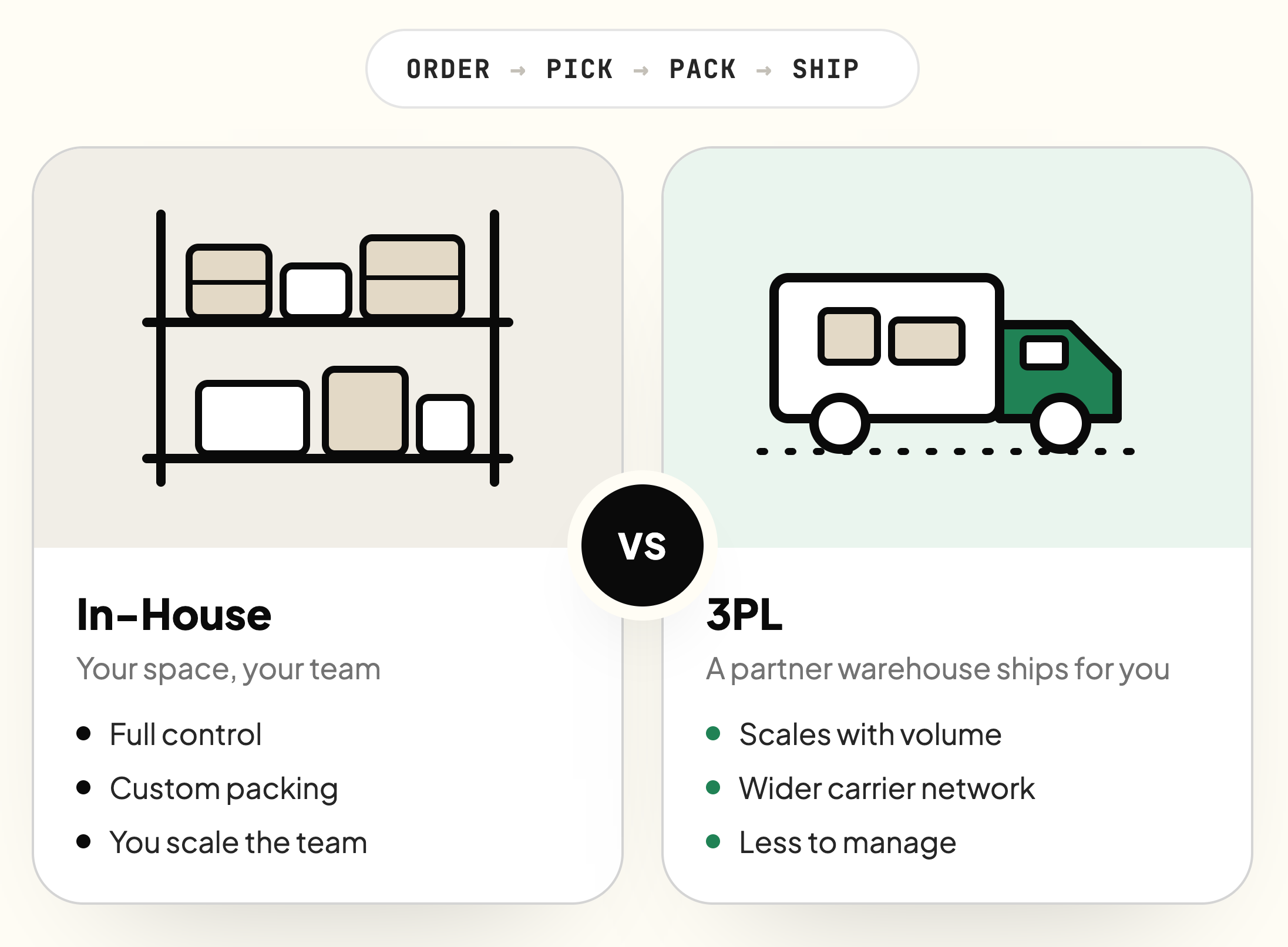
Whether you run it yourself or outsource it, the fulfillment process has the same five stages. Knowing them is what lets you spot where cost and delays hide.
- Receiving. Inventory arrives from your supplier or manufacturer, gets counted, checked for damage, and logged into your system. Accurate receiving is where clean stock counts start.
- Storage (warehousing). Products are shelved in a warehouse or stockroom, organized so they can be found fast. How stock is slotted directly affects how quickly orders get picked.
- Pick and pack. When an order comes in, the items are picked from their locations, checked, and packed with the right materials and paperwork. Pick-and-pack accuracy is what keeps the wrong-item refunds down.
- Shipping. The packed order is labeled and handed to a carrier, with tracking sent to the customer. Carrier choice and warehouse location decide the delivery speed the customer sees.
- Returns (reverse logistics). When something comes back, it has to be received, inspected, refunded or exchanged, and restocked or written off. Returns are part of fulfillment, not an afterthought, and they carry real cost.
Every one of these steps is a place an order can slow down or go wrong, and every slow-down eventually surfaces as a customer message. That is the thread running through the rest of this guide.
In-house fulfillment (self-fulfillment)
In-house fulfillment means you handle the whole process yourself: your own space, your own packing, your own team. This is where nearly every store starts, packing orders from a spare room, a garage, or a small unit.
Where in-house wins:
- Full control. You control how orders are packed, what the unboxing looks like, and how fast an issue gets fixed. For brands where packaging is part of the product, this matters.
- No per-order markup. You are not paying a provider’s margin on every pick and pack, so at low volume it is often cheaper.
- Direct visibility. Stock and orders are in the same building you are, so problems are seen and fixed on the spot.
Where in-house hurts:
- It does not scale cleanly. Doubling orders means more space, more people, and more hours. The work grows in step with sales.
- Fixed costs and time. Rent, shelving, packing staff, and your own hours are costs whether you ship 50 orders or 500.
- Slower reach. One location means longer transit times to far customers, and slower delivery is exactly what makes shoppers not come back.
In-house is strongest when volume is modest, the product needs special handling, or the brand experience depends on how the order is packed.
3PL fulfillment: what is a 3PL company?
A 3PL (third-party logistics) company is a provider that stores your inventory, then picks, packs, and ships your orders for you from its own warehouses. You send stock in; the 3PL fulfills orders as they come, and you pay for storage plus a fee per order.
Where a 3PL wins:
- It scales with you. A spike in orders is the provider’s problem to staff, not yours. You are buying capacity you do not have to build.
- Faster, wider delivery. Many 3PLs run multiple warehouses, so orders ship from a location closer to the customer, cutting transit time.
- You get your time back. Packing and shipping stop eating your week, which frees the founder to work on product, marketing, and growth.
Where a 3PL hurts:
- Less control. Someone else packs your orders. Custom unboxing and special handling are harder and sometimes cost extra.
- Per-order and storage fees. You pay receiving fees, monthly storage, and a pick-and-pack fee on every order. At low volume this can cost more than doing it yourself.
- You are one step removed. When something goes wrong in the warehouse, you are relaying it, not fixing it directly, and the customer still holds you responsible.
A 3PL is strongest when order volume is steady and growing, delivery speed matters, and your time is better spent on the business than in the stockroom.
In-house vs 3PL: side by side
| Factor | In-house fulfillment | 3PL fulfillment |
|---|---|---|
| Control over packing / brand | High | Lower (some offer custom) |
| Scales with order spikes | Poorly (you add space + staff) | Well (provider absorbs it) |
| Delivery speed / reach | One location, slower to far zones | Multiple warehouses, faster |
| Cost shape | Mostly fixed (rent, staff, hours) | Mostly variable (per order + storage) |
| Cheapest at | Low, steady volume | Mid to high, growing volume |
| Founder time cost | High | Low |
| Best for | Early stage, custom packaging | Scaling brands, speed-sensitive |
The honest read: neither is “better.” In-house trades money saved for time and control kept. A 3PL trades a per-order fee for speed, scale, and your hours back. The right answer is the one that fits your current volume and where your time is worth most.
In-house vs 3PL: which is cheaper?
Cost is where most stores make the call, so it is worth being precise about the shape of each, rather than quoting a single number that will not match your store.
In-house cost is mostly fixed. You pay rent on space, wages for packing, materials, and your own time, roughly the same whether orders are light or heavy. Divided across few orders, the per-order cost is high; divided across many, it drops. In-house tends to win while volume is low and steady.
3PL cost is mostly variable. You typically pay three things: a receiving fee when stock arrives, monthly storage based on space used, and a pick-and-pack fee per order plus shipping. There is little fixed overhead, so the cost tracks your volume up and down. A 3PL tends to win once volume is high enough that building your own equivalent operation would cost more than the fees.
The crossover point is different for every store, so the practical move is to run your real numbers: total monthly in-house cost divided by orders, versus a 3PL’s quoted per-order fee plus storage. Ask any 3PL for receiving, storage, and pick-and-pack fees in writing before you compare, because the per-order fee alone hides the storage and receiving costs.
One cost both models share and most forget: the support and delivery-issue load. Late parcels, address problems, and “where is my order” messages generate work no matter who packs the box, and that cost is real. More on that below.
When should you switch to a 3PL?
There is no fixed order count that means “switch now,” but there are clear signals. Move toward a 3PL when:
- Packing orders is eating the hours you should spend growing the business. When the founder is in the stockroom instead of on product or marketing, fulfillment has become the bottleneck.
- You cannot keep up with spikes. If sales events or seasonality regularly overwhelm your packing, you need capacity you do not have to hire for.
- Delivery speed is costing you customers. If a single location means slow delivery to big parts of your market, a multi-warehouse 3PL fixes reach.
- Space is the constraint. When stock no longer fits and more space means a real lease, the fixed cost of in-house is about to jump.
- You are going international. Shipping worldwide from one country is slow and expensive; 3PLs with regional warehouses solve this directly.
Stay in-house longer when volume is modest, margins are thin, or the packing experience is part of what customers pay for. The mistake is switching on ego (bigger feels better) rather than on these signals.
The part in-house and 3PL both leave on your plate
Here is what neither model solves: the customer still talks to you, not the warehouse. Whoever picks and packs the box, the “where is my order” message, the address correction, the refund request for a late parcel, all of it lands in your inbox and on your phone. Fulfillment moves the boxes; it does not answer the customer.
And that volume is not small. Post-purchase is when anxiety peaks, in Narvar’s survey, 66% of shoppers said they feel anxiety at least sometimes after ordering, and 73% said the estimated delivery date affected whether they bought at all (Narvar). Separately, HubBox’s 2024 survey of over 1,000 US shoppers found 27% of orders arrive late and 39% of shoppers are then less likely to buy from that brand again (HubBox via Chain Store Age). Every late or unclear delivery is both a support ticket and a retention risk.
This is the gap Kovax fills, and it is worth being clear about what it does and does not do. Kovax is not a 3PL and does not touch your warehouse. It is a set of AI voice and messaging agents that handle the customer side of fulfillment: answering order-status and WISMO (where is my order) calls 24/7, confirming and correcting delivery addresses before parcels ship, and following up on delivery and payment issues, over voice, WhatsApp, SMS, and email. It is the same customer service automation approach, aimed squarely at the questions fulfillment creates.
The proof is in live accounts. eSkinStore, a Canadian skincare brand shipping to more than 20 countries, uses Kovax agents to answer every inbound support call day or night, over 400 a month, and to protect CAD 31,000+ in at-risk orders by catching address and delivery problems before they turn into failed deliveries, all with a one-person support team. Baby and kids brand Eeveve cut its cost per call from $26.67 to under $4 and automated 85 to 90% of calls, saving around $48,000 a year. Across the platform, roughly 80% of inbound calls are resolved without a human. Whichever fulfillment model you pick, this is the load that keeps growing with orders, and it is the one you can automate without hiring, even while you add phone support without hiring a team.
Common ecommerce fulfillment mistakes
- Switching to a 3PL too early. Paying per-order fees before volume justifies them can cost more than staying in-house. Switch on the signals above, not on ambition.
- Comparing only the pick-and-pack fee. The headline per-order fee hides receiving and monthly storage costs. Compare the full quote.
- Treating returns as an afterthought. Reverse logistics is part of fulfillment and part of the cost. A model that ships fast but handles returns badly still loses customers.
- Ignoring the support load. Faster fulfillment reduces “where is my order” messages but never removes them. Plan for the customer questions, do not just react to them.
- One warehouse for a global audience. Shipping worldwide from a single location quietly kills delivery speed, and speed is what drives repeat purchases.
Frequently asked questions
What is ecommerce order fulfillment?
Ecommerce order fulfillment is the full process of getting an online order to the customer after purchase: receiving and storing inventory, picking and packing the order, shipping it, and handling returns. Shipping is just one step within fulfillment, not the whole thing.
What are the steps of the fulfillment process?
There are five: receiving inventory, storing it, picking and packing each order, shipping it with tracking, and processing returns. The same steps apply whether you fulfill in-house or use a 3PL.
What is a 3PL company?
A 3PL (third-party logistics) company stores your inventory and then picks, packs, and ships your orders from its own warehouses. You pay for storage plus a fee per order, instead of running the operation yourself.
In-house vs 3PL, which is cheaper?
It depends on volume. In-house cost is mostly fixed (rent, staff, your time), so it is usually cheaper at low, steady volume. A 3PL’s cost is mostly variable (per-order and storage fees), so it usually wins once volume is high and growing. Run your real monthly numbers to find the crossover.
When should you switch to a 3PL?
Switch when packing orders is eating the time you need to grow the business, when spikes regularly overwhelm you, when one location makes delivery too slow, when space runs out, or when you are expanding internationally.
Does fulfillment affect customer support volume?
Yes, heavily. Every delayed parcel, address error, or unclear delivery becomes a “where is my order” message or a refund request. Faster, more accurate fulfillment lowers that volume, but never removes it, which is why many stores automate post-purchase support alongside choosing a fulfillment model.
Get the fulfillment decision right, then automate what it leaves behind
Fulfillment is a trade, not a trophy: in-house buys you control and saves money at low volume, a 3PL buys you speed and scale as you grow. Pick the model that fits your stage, compare the full cost and not just the per-order fee, and switch when the signals say so, not before. Then handle the part both models leave you, the customer questions every delivery creates.
See what Kovax can answer for your store. Get Kovax on your Shopify store or book a demo.
Related reading: What is WISMO and how to cut “where is my order” calls · Reduce ecommerce returns without hurting loyalty · How eSkinStore runs support for 20+ countries