TL;DR
Social proof is the evidence that other people have bought, used, and trusted something, and it works because shoppers borrow the judgment of others when they are unsure. The research is strong: a product with five reviews is far more likely to be bought than one with none, and showing reviews lifts conversion sharply, more so for expensive products.
But not all social proof is equal. Real customer reviews, star ratings, and photos from actual buyers do the heavy lifting. Vanity counts, generic testimonials, and borrowed logos do very little, and fake or too-perfect proof can actively hurt, because shoppers are sharper than most brands assume. Nearly everyone reads reviews, most people read the negative ones on purpose, and a suspiciously perfect rating makes buyers trust a product less, not more.
The short version: collect real reviews, show the rating and the review count on the product page, include customer photos, and do not scrub the negatives. Honest social proof at the point of decision beats a wall of five-star quotes every time.
What Social Proof Actually Is
Social proof is a simple idea with a formal name. When people are unsure what to do, they look at what other people did and copy it, on the assumption that the crowd knows something they do not. The psychologist Robert Cialdini popularized the term, but the behavior is older than marketing: we trust a busy restaurant over an empty one without reading a single menu.
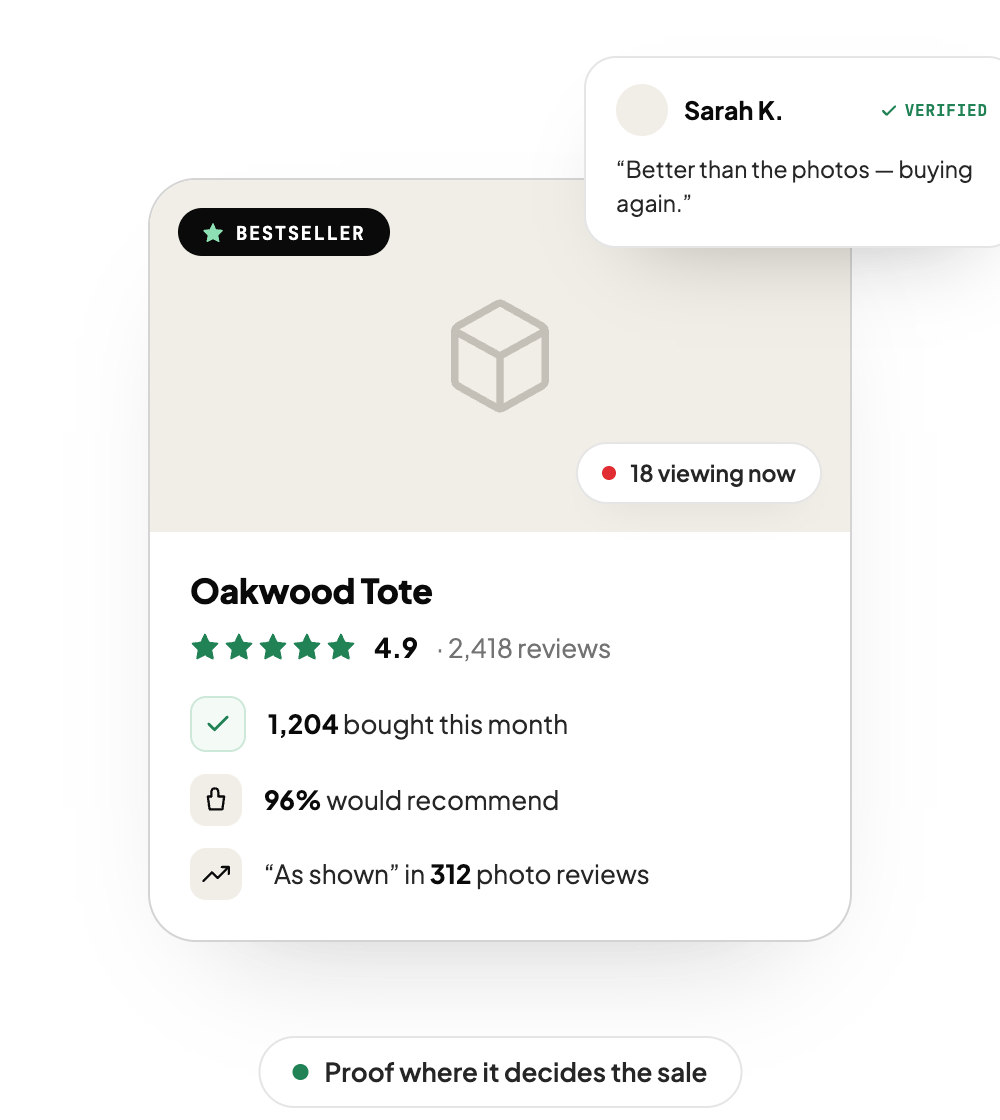
In ecommerce, social proof is every signal on your site that says other people already trusted this. That includes customer reviews and star ratings, photos and videos from real buyers (user-generated content, or UGC), written testimonials, counts ("12,000 sold," "few left in stock"), expert or third-party endorsements, certifications and awards, influencer or celebrity use, and "as seen in" press mentions. They all point at the same reassurance: you are not the first person to take this risk.
It is worth separating social proof from a related idea it often gets confused with. Trust badges, the little security and payment seals near the checkout button, are about safety, not popularity. Social proof says other people liked this; a trust badge says your card details are safe. Both matter, but they answer different questions, and this guide is about the first one.
Why Social Proof Works
Buying online means acting on incomplete information. You cannot hold the product, so you are estimating quality from photos and a description written by the person trying to sell it to you. That gap is exactly where social proof earns its keep. A review from someone with nothing to gain fills in what the product page cannot: does it run small, does it last, does it match the pictures.
There are two forces at play. The first is uncertainty reduction: other buyers have already run the experiment, so their experience lowers your perceived risk. The second is wisdom of the crowd: a large number of people making the same choice feels safer than a lonely one, even before you read a word of what they said. This is why a review count matters almost as much as the reviews themselves. The number is a signal all on its own.
The important nuance, and the reason so much social proof is wasted, is that these forces only work when the proof is believable. The moment it looks manufactured, both effects collapse, and you are left with decoration that shoppers have learned to ignore.
What the Research Actually Shows
The evidence for reviews specifically is some of the strongest in all of conversion research, and it is worth being precise about what it says, because the headline numbers get mangled constantly.
The most cited work is from Northwestern University's Spiegel Research Center. Their analysis found that the purchase likelihood for a product with five reviews is 270% greater than for the same product with no reviews. That figure is often misquoted as "reviews raise conversion 270%," which is not what it says. The conversion-rate lift is a separate finding from the same study: displaying reviews increased conversion by 190% for lower-priced products and 380% for higher-priced ones. The lesson in that gap is that social proof matters most when the perceived risk is highest, which is to say on your expensive items.
The reach of reviews is nearly universal. BrightLocal's 2026 survey found that 97% of consumers read reviews for local businesses, and that trust in reviews still sits around half, with about 49% trusting online reviews as much as a personal recommendation from friends or family (a figure that fluctuates year to year, so treat it as directional rather than fixed). Reviews are not a nice-to-have that some shoppers glance at. They are the default step before buying.
The effect shows up at the cash register too. One analysis by PowerReviews found a 108.6% lift in conversion when shoppers actually interact with ratings and reviews on a page, and that 45% of shoppers say they will not buy a product that has no reviews at all. That last number reframes the whole thing: for a large share of buyers, zero reviews is not neutral, it is a reason to leave.
A Real Example: Two Brands That Leaned In
Research figures are useful, but it helps to see what a serious social proof program looks like in practice. A caution before the numbers: the two examples below come from the review platforms' own published case studies, so they are self-reported marketing figures, not independently audited results. The mechanics are worth studying anyway, and read carefully they teach you as much about how to judge these numbers as about the tactics.
Dr. Squatch, a men's natural personal-care brand on Shopify, rebuilt its review program around one idea: make sure the proof is everywhere the shopper looks. Ahead of a deodorant-line relaunch, it ran a post-purchase email campaign offering a small incentive for photo and video reviews, so real social proof was live before the products went on sale. On the product page it replaced studio images with a gallery of customer photos and added review summaries and keyword filters, then reused that review content in paid social and email. In Okendo's own reporting, shoppers who interacted with reviews converted 79% higher and spent 16% more per order than shoppers who did not.
Here is where reading the number honestly matters. That 79% is an engaged-versus-not comparison, not a controlled test. Shoppers who stop to read reviews are already more interested in buying, so some of that gap was there before the reviews did anything. The fair takeaway is not "reviews add 79%," it is that surfacing real customer content everywhere pulls more shoppers into the higher-intent, higher-converting group, and keeps them there. That is still a strong reason to do it, just not the reason the headline implies.
Perry Ellis, a global apparel brand also on Shopify, ran a cleaner test. It A/B tested an AI review summary on selected products and measured conversion before and after. Conversion rose from 1.1% to 1.4%, a 25% relative lift, within two weeks, according to Yotpo's case study. This is more trustworthy because it is an actual before-and-after on the same pages rather than a comparison of two different groups of shoppers. In fairness, the same test also showed a 13% lower average order value even as revenue per session rose, it ran on select products over a short window, and it too is vendor-reported, so treat the exact figure as directional.
The real lesson sits across both. The brands that get results treat social proof as a system, collect it deliberately, surface it everywhere, and keep it honest, and the most believable gains show up as modest percentages like Perry Ellis's 25%, not the 400%-plus numbers you will see in splashier case studies. When you see a giant lift attributed to reviews, check whether it was measured on a self-selected engaged segment. It almost always was.
The Types of Social Proof, Ranked by What Works
Not every form of social proof pulls the same weight. Roughly from most to least effective for a typical store:
Customer reviews and star ratings. The workhorse. Specific, buyer-written, and tied to the exact product, they carry more weight than anything else because they are the hardest to fake convincingly. This is where to spend your effort first.
Photos and videos from real buyers. UGC is reviews with proof attached. PowerReviews found that 77% of consumers trust customer photos and videos when making a purchase decision, and 53% say that imagery from previous customers directly affects whether they buy. A photo of the product in someone's actual home does what a studio shot cannot.
Written testimonials. Useful, but weaker than reviews, because they are curated by you and therefore discounted by the reader. A testimonial with a full name, photo, and specific result beats an anonymous "Great product! Five stars!" by a wide margin.
Counts and "wisdom of the crowd" signals. "50,000 sold," "1,200 five-star reviews," "trending this week." These lean on the crowd effect and work well as a supporting signal, but on their own they are shallow, and inflated or vague numbers invite suspicion.
Expert endorsements, certifications, and awards. Strong in categories where authority matters, supplements, skincare, tools, safety products, and weak where it does not. A dermatologist's endorsement means a lot on a serum and nothing on a phone case.
Influencer and celebrity use. Can drive real traffic and desire, especially for younger audiences, but it is borrowed trust, and it fades fast if the fit feels paid rather than genuine.
"As seen in" press logos. The weakest common form. A row of media logos is easy to add, easy to fake, and shoppers know it. It rarely hurts, but it rarely moves anyone either.
The Star Rating Sweet Spot
Here is the finding that surprises people most: a perfect rating is not the goal. The Spiegel research found that purchase likelihood peaks when the average rating sits between 4.0 and 4.7 stars, and then actually declines as the rating approaches a flawless 5.0. A perfect score reads as too good to be true, and shoppers have been trained by fake reviews to distrust it.
The behavior behind that is revealing. PowerReviews found that 96% of consumers specifically look for negative reviews at least sometimes, and that 46% of shoppers are actively suspicious of a product with a perfect five-out-of-five rating. People are not looking for a product with no flaws. They are looking for a product whose flaws they can live with, and a few honest three-star reviews are what make the five-star ones believable.
The practical takeaway is counterintuitive but clear: do not hide or delete negative reviews, and do not chase a perfect score. A 4.5 with visible, reasonable criticism converts better than a suspicious 5.0. The negatives are not damage. They are what makes the whole thing credible.
Where to Put Social Proof
The same review does more work in some places than others. In rough priority:
The product page, above the fold. Show the star rating and the review count near the title, before the shopper scrolls. This is the single highest-value placement, because it is where the buy decision is actually made. Put the full reviews, with photos, lower on the page.
The listing and category pages. Star ratings next to each product help shoppers choose what to click, and shape the decision before they even reach the product page.
The checkout. A short, specific line of reassurance near the buy button, ideally about the thing people hesitate over (returns, shipping, sizing). This is where you pair social proof with practical trust signals to close the last gap.
Ads and email. A real review quote or a star rating in a subject line or ad creative earns clicks, because it is a stranger vouching rather than you selling. UGC in particular performs well as ad creative.
The home page. Useful for overall brand credibility (aggregate rating, review count, a standout testimonial), but lower priority than the product page, because it is further from the decision.
The rule of thumb: the closer the proof sits to the moment of choosing, the more it is worth. A brilliant testimonial on your "About" page is nearly wasted; the same testimonial next to the buy button is not.
When Social Proof Backfires
Social proof has a failure mode that most tactics do not: done badly, it does not just underperform, it actively lowers trust. The ways it goes wrong:
Fake or bought reviews. The fastest way to destroy credibility. Shoppers are good at spotting them, platforms penalize them, and a caught fake poisons the reviews that are real. It is also increasingly illegal in many markets.
Too-perfect proof. As above, a flawless 5.0 or a wall of glowing quotes with no dissent reads as staged. Some friction is what makes praise believable.
Generic, unattributed testimonials. "This product changed my life! J.D." convinces no one. Vague quotes with no name, photo, or specifics are pattern-matched instantly as marketing and discounted to zero.
Vanity counts that do not add up. "Join 2 million happy customers" next to eleven reviews creates a contradiction the shopper notices, and the mismatch undermines both claims.
Borrowed trust with no substance. Press logos, unrelated certifications, and influencer tags that clearly do not fit the product feel like reaching, and reaching signals weakness.
Negative proof by accident. "Only 3 people have bought this" or a near-empty review section can broadcast unpopularity. If a product has too little proof to help, it is often better to show none than to show a lonely one.
Social Proof by Business Type
The right mix depends on what you sell and what the buyer is worried about.
Considered or expensive products (furniture, electronics, appliances). Reviews and detailed UGC matter most here, because perceived risk is highest, and this is exactly where the research shows the biggest conversion lift. Depth beats volume: long, specific reviews with photos do more than a high count of short ones.
Low-cost, high-volume products (accessories, basics, consumables). Volume and rating do the work. A high review count and a solid star rating reassure at a glance, and shoppers rarely read deeply for a cheap, low-risk buy.
Beauty, supplements, and health. Expert endorsement and before-and-after UGC carry unusual weight, alongside reviews, because efficacy is hard to judge from a description and buyers want authority plus real results.
Fashion and apparel. Fit is the anxiety, so reviews that mention sizing and customer photos on real bodies outperform everything else. "Runs small, size up" is worth more than any star rating.
New or niche brands with few reviews. The hardest case. Lean on the reviews you have (make them prominent even at low counts once you clear the "lonely" threshold), founder and origin storytelling, and any specific, attributable testimonial. Do not fake volume; build it.
Services and B2B. Named testimonials with a title and company, case studies with real numbers, and logos of actual clients (not press) are the currency, because the buyer is making a considered, accountable decision.
How to Collect Reviews Worth Showing
For most stores the bottleneck is not where to display social proof, it is having enough of it. A product page cannot show reviews it does not have, and the research is blunt that zero reviews is a dealbreaker for a large share of shoppers. So collection is the real work. A practical playbook:
Time the ask to when they have used the product, not when they paid. A review request that lands the moment the order ships is too early; the customer has nothing to say yet. Send it a few days after estimated delivery, adjusted for the product, longer for something that takes time to judge like skincare or a mattress, shorter for a t-shirt. The goal is to catch them right after the product has proved itself.
Make leaving a review a single tap. The biggest drop-off is friction. Put the star selector directly in the email or message, so one tap opens a pre-filled form rather than a login wall. Every extra step loses reviewers.
Ask for a photo, and make it worth their while. Since customer imagery is among the highest-trust content you can get, prompt for it explicitly and offer a modest incentive such as loyalty points or a small discount. If you incentivize, disclose it and never make the reward conditional on a positive review, which is both against platform rules and, in many markets, illegal.
Do not gate reviews, resolve problems instead. It is tempting to route only happy customers to the review form and unhappy ones to a feedback inbox. That is review-gating, and it is against the rules of most platforms and the FTC. The honest version is better anyway: surface the negative experience to support first, fix it, and let the customer review the resolved experience. A recovered customer often leaves a more persuasive review than one who never had a problem.
Aim to clear the "lonely" threshold on every product. Getting each product from zero to a handful of reviews removes the single biggest barrier in the research. Prioritize your best sellers and your most expensive items first, since that is where reviews move the most money.
Keep it fresh. Reviews decay in usefulness; a wall of five-year-old reviews reads as stale and can imply the product has not sold recently. Keep the asks running continuously so recent reviews are always visible.
How to Tell Whether It Is Working
Social proof is unusually easy to fool yourself about, because the most obvious metric is also the most misleading. "Shoppers who read our reviews convert higher" is true in almost every store on earth, and it proves nothing, for exactly the reason the Dr. Squatch number needed a caveat: people who read reviews were already more likely to buy. If that is the only number you look at, you will always conclude social proof is working, even when a change made no difference.
The honest way to measure is to test at the page level. Compare conversion with a change versus without it, either as an A/B test (reviews shown to half of visitors, hidden from the other half) or a clean before-and-after when you add something like photo reviews to a set of pages. Watch conversion rate and revenue per visitor, not just average order value, because a tactic can lift one and quietly lower the other, as the Perry Ellis test showed. Give it enough traffic and enough time; a two-week window on a handful of products is noisy, and a single good or bad week can swing it.
Alongside the causal test, a few health metrics are worth tracking over time: review coverage (the share of your catalog with enough reviews to matter), the rating distribution (are you sitting in the believable 4.0 to 4.7 band, with visible negatives), review recency, and add-to-cart rate on product pages. None of these prove causation on their own, but together they tell you whether your social proof is healthy or quietly rotting. The point is to hold yourself to the same standard you would apply to any other channel: a real test, honest metrics, and enough patience to trust the result.
Common Mistakes With Social Proof
- Chasing a perfect rating. Deleting negatives to protect a 5.0 makes the score less believable and hides the criticism shoppers are actively hunting for.
- Collecting reviews but hiding them. Reviews sitting in an app dashboard instead of above the fold on the product page are worthless. Placement is the whole game.
- Leaning on the weakest forms. Pouring effort into press logos and vanity counts while neglecting the reviews and photos that actually convert.
- Treating all proof as interchangeable. A star rating, a testimonial, and an influencer post are different tools for different jobs; using the wrong one for the category wastes it.
A Simple Way to Start
If you are starting from little, work in this order.
First, collect real reviews systematically. The biggest gap for most stores is not placement, it is volume, and the fix is a reliable post-purchase ask. Email or message every buyer a few days after delivery and make leaving a review effortless. Getting from zero reviews to five on a product clears the single biggest hurdle in the research.
Second, show the rating and count on the product page, above the fold. Before you optimize anything else, make sure the proof you already have is visible at the moment of decision.
Third, ask for and display photos. Prompt happy customers to add a picture, and surface that UGC on the product page. It is the highest-trust content you can get and the hardest for a competitor to copy.
Fourth, leave the negatives alone. Respond to them, do not delete them. The honest mix is what makes the positives work.
Do those four things, in that order, and you will capture most of the value social proof has to offer before you touch anything more advanced.
FAQ
What is social proof in marketing?
Social proof is any signal that shows other people have bought, used, and trusted a product, such as reviews, star ratings, customer photos, testimonials, and sales counts. It works because shoppers reduce their own risk by borrowing the judgment of others, especially when they are unsure.
Does social proof actually increase sales?
Yes, and the evidence is strong for reviews specifically. Northwestern's Spiegel Research Center found a product with five reviews is 270% more likely to be purchased than one with none, and that showing reviews lifted conversion by 190% for cheaper products and 380% for expensive ones. The effect is largest where perceived risk is highest.
What is the best type of social proof?
Real customer reviews and star ratings, followed by photos and videos from actual buyers. They are specific, tied to the product, and hard to fake, which is why they convert better than testimonials, counts, or press logos. Match the type to the category: expert endorsements suit supplements, fit-focused reviews suit apparel.
Is a perfect five-star rating good?
Not really. Research shows purchase likelihood peaks between 4.0 and 4.7 stars and declines toward a perfect 5.0, and 46% of shoppers are suspicious of a flawless rating. A few honest negative reviews make the positive ones believable, so a credible 4.5 usually outperforms a suspicious 5.0.
Should I delete negative reviews?
No. Around 96% of shoppers look for negative reviews at least sometimes, so removing them hides exactly what buyers want to see and makes your rating look staged. Respond to negatives honestly instead; the mix of good and bad is what makes your social proof trustworthy.
How do I get more reviews?
Ask systematically. Send a post-purchase email or message a few days after delivery, keep the request short, and make leaving a review a one-tap action, ideally with a prompt to add a photo. Consistent, well-timed asks are the difference between a handful of reviews and enough to move conversion.
Where to Go From Here
Social proof is one of the most reliable levers in ecommerce, but almost all of its value depends on one thing you control: getting real reviews from happy customers and showing them where the decision happens. That starts with a good post-purchase experience and a timely ask, which is where strong customer support and follow-up on Shopify quietly pays off, because satisfied buyers are the ones who leave the reviews that become your best marketing.