Guest checkout in 30 seconds
- What it is: letting a shopper buy without creating an account, using just an email and shipping and payment details.
- The catch: forcing account creation is one of the top reasons people abandon a full cart, but guest checkout is not free, it trades a little customer data now for a lot fewer lost sales.
- Who this is for: Shopify and D2C store owners deciding whether to require accounts, offer guest checkout, or run both.
A shopper fills a cart, reaches checkout, and hits a wall: "Create an account to continue." A good share of them leave right there. Baymard Institute, which has tracked this across 50 studies, puts the average cart abandonment rate at 70.22%, and finds that 18% of US shoppers have abandoned an order specifically because "the site wanted me to create an account," the fourth most common reason people bail at checkout (Baymard). Guest checkout removes that wall. The question is whether removing it costs you anything worth keeping.
This guide answers that directly: what guest checkout actually is, how it stacks up against forced accounts, whether it really hurts customer retention, and how to offer it without giving up the repeat-customer relationship.
See what checkout friction is costing you with the ROI calculator
What is guest checkout?
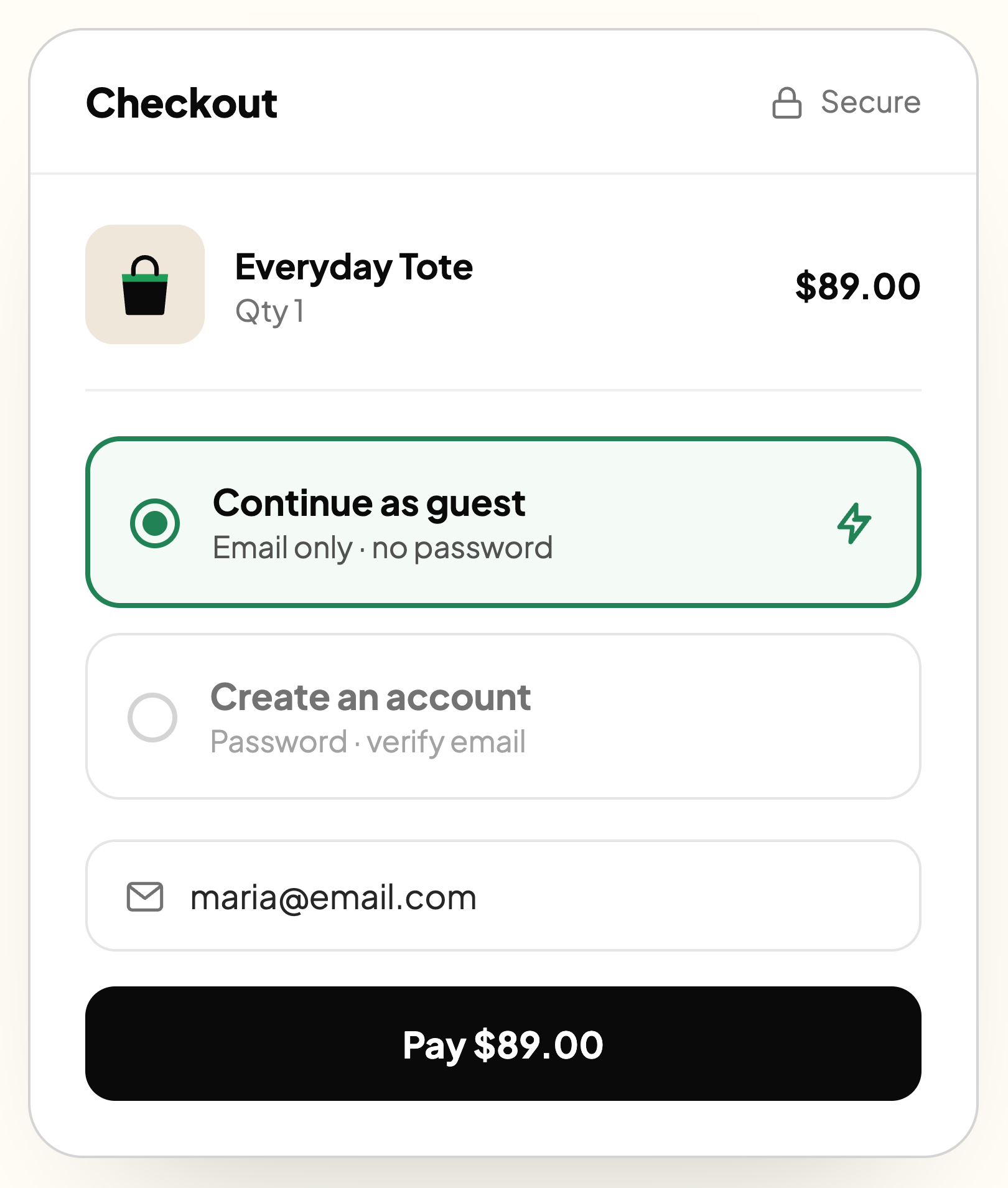
Guest checkout lets a customer complete a purchase without creating a password-protected account. They enter an email, shipping address, and payment details, and the order goes through. No password, no "confirm your account" email, no login to remember next time.
It is not the same as no data at all. You still capture the email and the order, which is enough to send a receipt, shipping updates, and follow-up marketing (with consent). What you skip is the forced account step that sits between a ready-to-buy shopper and the "place order" button.
Most platforms support it. On Shopify, guest checkout is a setting: you can require accounts, make them optional, or turn them off entirely and run guest-only. The default for most stores that care about conversion is accounts optional, with guest as the path of least resistance.
Guest checkout vs forced accounts
The trade is simple to state and easy to get wrong. Forcing accounts gets you a richer customer profile and an easier repeat purchase later. Guest checkout gets you more completed orders today. For most stores, the second matters more, because an abandoned cart is worth nothing regardless of how good the account data would have been.
| Guest checkout | Forced account creation | |
|---|---|---|
| Checkout friction | Low | High (extra step at the worst moment) |
| Conversion / completed orders | Higher | Lower (18% cite it as an abandonment reason) |
| Customer data captured | Email + order | Full account profile |
| Repeat purchase ease | Needs a nudge later | Easier (saved details, login) |
| Best for | Most stores, especially first-time buyers | Membership, wholesale, subscription models |
The pattern the data supports: ask for the account after the sale, not before it. You still get the relationship, you just stop making it the price of buying.
Does guest checkout hurt customer retention?
This is the real fear, that guest buyers never come back. It is mostly a myth, and here is why: a completed guest order still gives you the customer's email and purchase history. You can invite them to create an account after checkout, when the pressure to buy is gone, and convert them into a returning customer then.
What actually drives repeat purchases is not whether they made an account at checkout. It is the experience after the order, whether delivery was smooth, updates were clear, and questions got answered. A forced account on a bad post-purchase experience still churns. A guest order on a great one comes back. If retention is the goal, the post-purchase experience is the lever, not the login wall. (More on that in our guide to ecommerce customer retention rate.)
There is one honest catch with guest checkout, though: a guest buyer has no account to log into for order status, so they lean harder on you for updates. That shifts work to your post-purchase support, which is worth planning for rather than being surprised by. It is the same WISMO (where is my order) load, just concentrated on guest orders.
Should your store offer guest checkout?
For most stores, yes. Offer guest checkout if:
- You sell to first-time or one-off buyers. Every forced account is friction for someone who just wants the product.
- Your cart abandonment is high at the account step. If analytics show drop-off right at "create account," guest checkout is the direct fix.
- You run seasonal or gift purchases. Q4 and gift buyers especially do not want an account for a one-time order.
Lean toward requiring or strongly nudging accounts only if:
- Your model depends on the login, such as subscriptions, memberships, wholesale, or B2B with saved catalogs and terms.
- Repeat purchase is the whole business and the account genuinely improves the second-order experience.
The strongest setup for most D2C stores is not either-or: offer guest checkout as the default, then invite account creation right after purchase. You capture the sale first and the relationship second.
How to offer guest checkout the right way
Turning it on is one setting. Doing it well is a few more steps:
- Make guest the obvious path. Put guest checkout first, not buried under a login form. On Shopify, set customer accounts to optional so guest is the default flow.
- Ask for the account after the sale. A one-tap "save your details for next time" on the confirmation page converts guests to account holders without costing you the order.
- Keep the guest form short. Email, shipping, payment. Every extra field is a reason to leave. This is the core of checkout optimization: remove steps, do not add them.
- Nail post-purchase communication. Guests have no dashboard to check, so proactive shipping and delivery updates matter more. Clear updates cut the support load and build the trust that brings them back.
- Recover the guests who still bail. Some filled carts will abandon no matter how clean the flow. Capturing the email early lets you follow up, and a phone or message follow-up recovers far more than an email that sits unopened.
That last point is where a store's own numbers show up. Kovax's abandoned cart recovery agent recovers roughly 55% of the carts it reaches by phone, close to 3x what email-only recovery typically pulls in, because a call reaches the shopper an unopened email never does. And because guest buyers rely entirely on you for order updates, the support agent handles the resulting WISMO and delivery questions automatically. Baby and kids brand Eeveve used that approach to cut cost per call from $26.67 to under $4 and automate 85 to 90% of calls, saving about $48,000 a year. Guest checkout wins you the sale; tools like Kovax for recovery and post-purchase support keep it from turning into a support headache.
Frequently asked questions
What is guest checkout?
Guest checkout lets a customer buy without creating an account. They enter an email, shipping, and payment details, and the order completes without a password or login. The store still captures the email and order for receipts and follow-up.
Is guest checkout safe?
Yes. Guest checkout uses the same secure, PCI-compliant payment processing as an account order. The only difference is the shopper does not create a stored login. For the store, the transaction and fraud protections are identical.
Guest checkout vs account, which converts better?
Guest checkout converts better because it removes a step at the moment of purchase. Baymard finds 18% of US shoppers have abandoned an order because a site forced account creation, so requiring an account reliably costs completed sales.
Should my store offer guest checkout?
For most stores, yes, especially if you sell to first-time or one-off buyers or see drop-off at the account step. Lean toward accounts only if your model depends on the login, such as subscriptions, memberships, or wholesale.
How do I enable guest checkout on Shopify?
In Shopify, set customer accounts to optional (or off) in checkout settings so shoppers can buy without an account. Optional accounts let you offer guest checkout as the default while still allowing customers to create an account if they want.
Does guest checkout hurt customer retention?
Not on its own. A guest order still captures the email and purchase history, so you can invite the shopper to create an account after the sale. Retention is driven far more by the post-purchase experience than by whether an account was made at checkout.
The bottom line
Guest checkout is one of the clearest conversion wins available: it removes a top reason people abandon a ready cart, and it costs you almost nothing you cannot recover after the sale. Offer it as the default, invite the account afterward, and put your energy into the post-purchase experience, because that, not the login wall, is what actually brings customers back.
Install Kovax from the Shopify App Store or book a demo.
Related reading: Abandoned cart recovery: email vs SMS vs voice · Ecommerce customer retention rate · What is WISMO and how to cut order-status calls