Support volume rarely grows politely. A product launch, a holiday rush, or one viral post can double the inbox overnight, and suddenly someone senior is answering "where is my order?" emails at 1 a.m. That is usually the moment teams start comparing customer outsourcing companies.
The hard part is not finding a provider. There are thousands. The hard part is finding one that fits your volume, your channels, your budget, and the way your customers expect to be treated. This guide walks through what outsourcing actually covers, the main models, the real risks, how to evaluate a provider, the top 5 customer service outsourcing companies for 2026, and what it all costs.
What Is Customer Service Outsourcing?
Customer service outsourcing means paying an outside company to handle some or all of your customer conversations instead of hiring and managing that team yourself. The provider is usually a business process outsourcing (BPO) company, and it supplies the agents, the training, the supervision, and often the software.
Today the definition is wider than a call center. Many providers now blend human agents with AI that answers routine questions first, and some options are pure software that covers the repetitive front line on its own. If you sell online and want the ecommerce angle specifically, our guide to customer support outsourcing for ecommerce covers when it pays off and when it backfires.
What Services Can You Outsource?
Almost any customer-facing task with a clear process can be handed off. The most common scopes for outsourced customer service are:
- Inbound phone support: order questions, account issues, product guidance.
- Live chat and email: the bulk of ticket volume for most online businesses.
- Social and messaging channels: Instagram DMs, Facebook, and WhatsApp.
- Order tracking and "where is my order" questions: often the single biggest ticket category, as our breakdown of WISMO costs shows.
- Returns, refunds, and exchanges: policy-driven work that suits clear playbooks.
- Technical support: tiered from Level 1 (basic troubleshooting) to Level 3 (specialist issues).
- Multilingual support: native-language coverage for international customers.
- After-hours and overflow coverage: nights, weekends, holidays, and seasonal peaks.
- Back-office tasks: order entry, fraud review, data cleanup, and content moderation.
Customer Service Outsourcing Models
The model you choose shapes your cost, your control, and how much the provider feels like part of your team.
Dedicated Support Teams
Agents work only on your account. They learn your products, your tone, and your edge cases over time, which makes this the strongest option for brand consistency. You pay for every seat whether it is busy or not, so it suits steady, predictable volume.
Shared Support Teams
Agents split their time across several clients, and you typically pay per contact, per minute, or per hour used. It is cheaper and flexible for low or unpredictable volume, but agents carry less brand knowledge, so answers can feel generic.
Fully Managed Outsourcing
The provider owns the whole operation: hiring, training, quality assurance (QA), scheduling, reporting, and continuous improvement. You set the goals and review results. This works well when you have no internal support leader, but it means giving up day-to-day control.
Staff Augmentation
The provider sources and employs vetted agents, and you manage them inside your own workflows. You keep control of training and quality, while the provider handles recruiting, payroll, and backfilling when someone leaves. It suits companies that already have a support lead and a working playbook.
Onshore, Nearshore, and Offshore Support
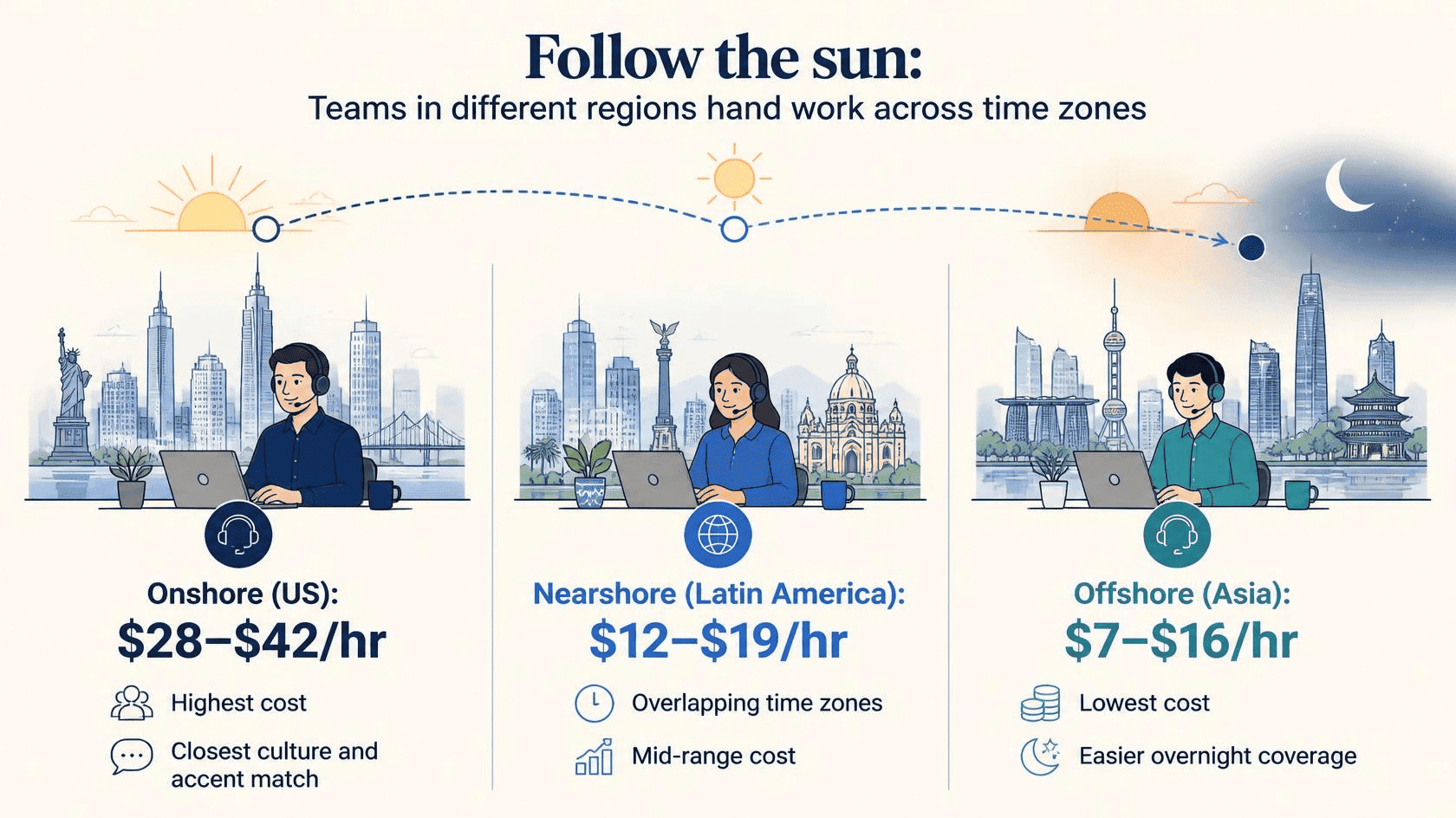
Where agents sit is the biggest single driver of price. 2026 market rates break down roughly like this:
| Location | Typical hourly rate | Trade-off |
|---|---|---|
| Onshore (US) | $28 to $42 | Highest cost, closest culture and accent match |
| Nearshore (Latin America) | $12 to $19 | Overlapping time zones, mid-range cost |
| Offshore (Asia) | $7 to $16 | Lowest cost, easiest route to overnight coverage |
Many providers now run a follow-the-sun model, with teams in several regions handing work across time zones so nobody works a permanent night shift.
AI and Human Support
The newest model splits the work. AI agents answer the repetitive, rules-based questions instantly on phone, chat, or messaging, and human agents take anything complex, emotional, or high-value. This is how most 24/7 customer service companies now deliver round-the-clock coverage without staffing every hour with people. For the cost and quality data behind this shift, see our roundup of customer service outsourcing statistics.
Benefits of Outsourcing Customer Service
- Round-the-clock coverage. Nights, weekends, and holidays get answered without building your own shift rota.
- Faster scaling. Seasonal peaks can be covered in weeks, then scaled back down, instead of carrying full-time salaries through quiet months.
- Lower cost per contact. Offshore and nearshore rates, plus shared infrastructure, usually beat fully loaded in-house costs at higher volume.
- Language reach. Providers already employ native speakers, so entering a new market does not require a new hiring plan.
- Speed to launch. Some providers advertise going live in one to two weeks, far quicker than recruiting and training an internal team.
- Focus. Your core team spends time on product, growth, and the conversations that genuinely need them.
Risks and Challenges to Consider
- Brand voice drift. Agents who do not know your products or tone give accurate but bland answers, and loyal customers notice.
- Missing context. If agents cannot see live order and customer data, simple questions turn into long back-and-forth threads.
- Agent turnover. The industry average is 6% to 8% monthly attrition, which means constant retraining and inconsistent answers that never appear on your invoice.
- Hidden costs. Setup fees, technology pass-through charges, and premium rates for languages or holiday cover can turn an attractive quote into a much larger bill.
- Data exposure. Every outside agent with system access is another point of risk for customer data.
- Lock-in. Long contracts and provider-owned knowledge bases make it painful to leave if quality slips.
- Management overhead. Outsourcing moves work, it does not remove it. Someone still has to review quality, update playbooks, and own the relationship.
What Work Should You Outsource First?
Start with work that is high volume, low judgment, and easy to measure. Keep the conversations that shape loyalty or need deep product knowledge close to home until the provider has proven itself.
| Outsource first | Keep in-house for now |
|---|---|
| Order status and tracking questions | Escalations and angry customers |
| Return and refund status updates | VIP and high-value accounts |
| After-hours and weekend coverage | Product feedback and bug triage |
| Overflow during sales and holidays | Complex policy exceptions |
| Basic product and shipping FAQs | Partnerships and wholesale enquiries |
A good rule: if you can write a clear playbook for it, it can be outsourced. If every answer depends on judgment, keep it until your provider has earned trust.
How to Choose a Customer Service Outsourcing Company
Match the Provider to Your Support Needs
List your monthly ticket volume, channels, hours, languages, and industry before you speak to anyone. Then check fit on size. Large enterprise BPOs often require 50 to 100 seat minimums and $1 million-plus annual commitments, so a growing brand with five agents' worth of work will be a poor match no matter how good the brochure looks.
Define Service Quality Metrics
Agree on the numbers before you sign, and write them into the service level agreement (SLA).
| Metric | What it tells you |
|---|---|
| Customer satisfaction score (CSAT) | How customers rate the help they received |
| First response time | How long customers wait for a first reply, per channel |
| First contact resolution (FCR) | Share of issues solved without a follow-up |
| Average handle time (AHT) | How long each conversation takes |
| QA score | How well answers match your policies and tone |
Review Training and Quality Assurance
Ask how long onboarding takes, who writes the training material, how many conversations are reviewed each week, and how often your team and theirs calibrate scoring together. Ask for monthly attrition figures and what happens when an agent leaves. A provider that cannot answer these clearly will struggle to keep quality steady.
Check Security, Privacy, and Compliance
Look for independent certifications such as SOC 2, ISO 27001 (information security), GDPR (EU data protection), and PCI DSS if agents ever touch payment data. Confirm who can access customer records, whether agents work from secure offices or home setups, and how access is removed when people leave.
Confirm Tools and Integrations
The provider should work inside your helpdesk, not force you onto theirs. Confirm they can use your ticketing tool, phone system, and messaging channels, and that agents can see order data directly. For an online store, that means live access to order status, tracking, and customer history.
Compare Total Costs and Contract Terms
Compare the full cost, not the headline rate. Ask every provider to itemize agent labor, setup, technology, QA, language premiums, and holiday rates. Setup fees alone range from $5,000 to $25,000 at mid-market providers and $50,000 to $200,000 at enterprise BPOs. Check notice periods, minimum terms, and penalties for scaling down.
Plan for Transitions and Provider Exit
Agree on the exit before you start. Your contract should state that you own all knowledge base content, macros, and customer data, that the provider will export it in a usable format, and how much notice either side must give. A clean exit clause is also leverage: providers work harder for clients who can leave easily.
Top 5 Customer Service Outsourcing Companies
These five cover the main options, from AI-first coverage to global enterprise BPO. All of them offer round-the-clock support, which makes them strong picks among customer support outsourcing companies for brands that sell across time zones.
| Provider | Type | Best for | Starting price | Contract |
|---|---|---|---|---|
| Kovax.ai | AI agent | Shopify stores automating calls, chat, WhatsApp, and email | Free install, paid plans from $49.99/month | Cancel anytime |
| TP | Global enterprise BPO | Large enterprises with big, multi-country programs | Custom quote | Multi-year typical |
| Hugo | Managed BPO | Startups and global brands wanting dedicated teams | $9/hour per agent | Month to month |
| Influx | Managed teams and staff augmentation | Growth-stage ecommerce and SaaS brands | $1,400/month per agent | Month to month |
| SupportYourApp | AI plus human BPO | SaaS, fintech, and ecommerce companies | Custom quote | Custom |
1. Kovax.ai
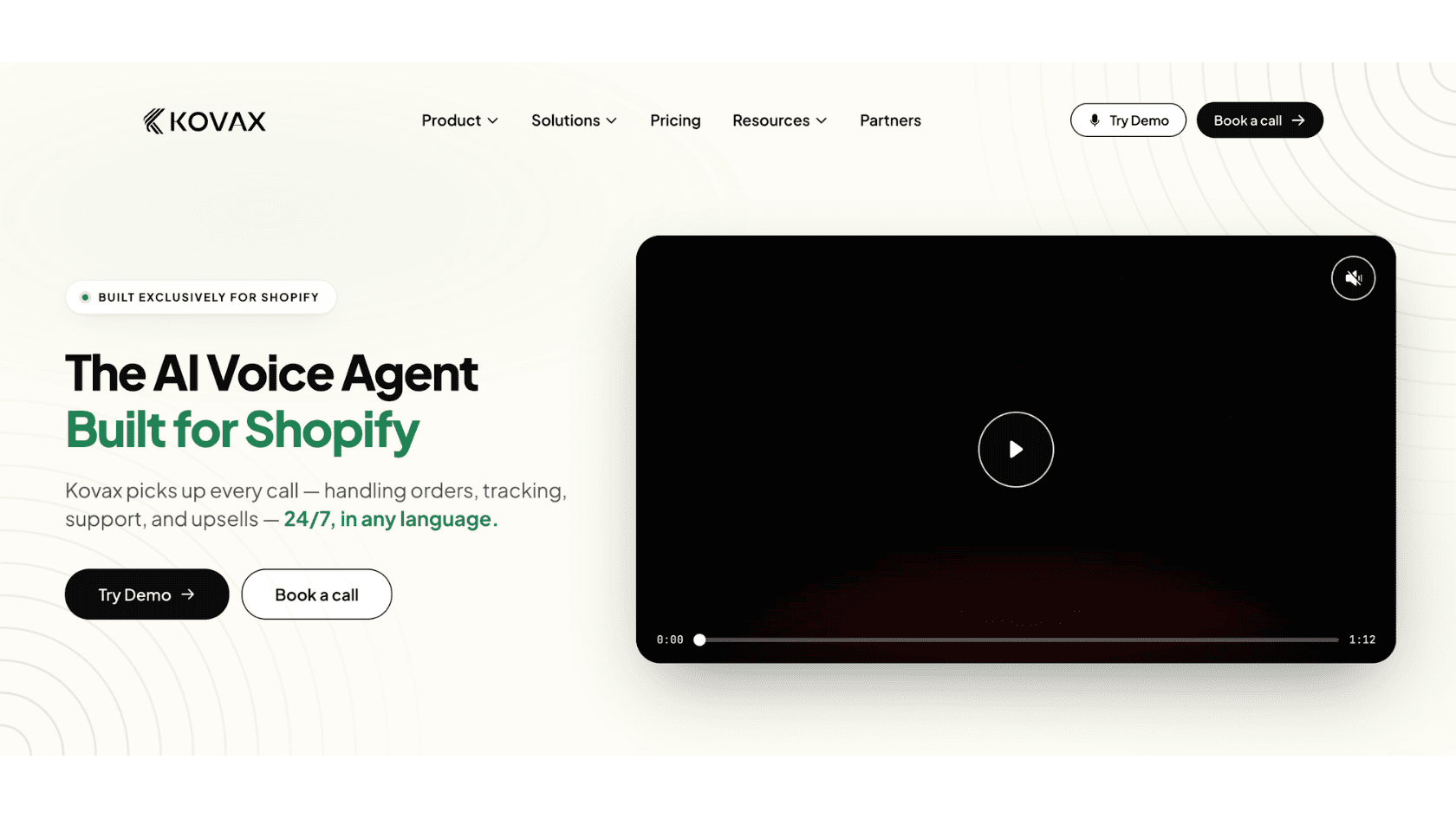
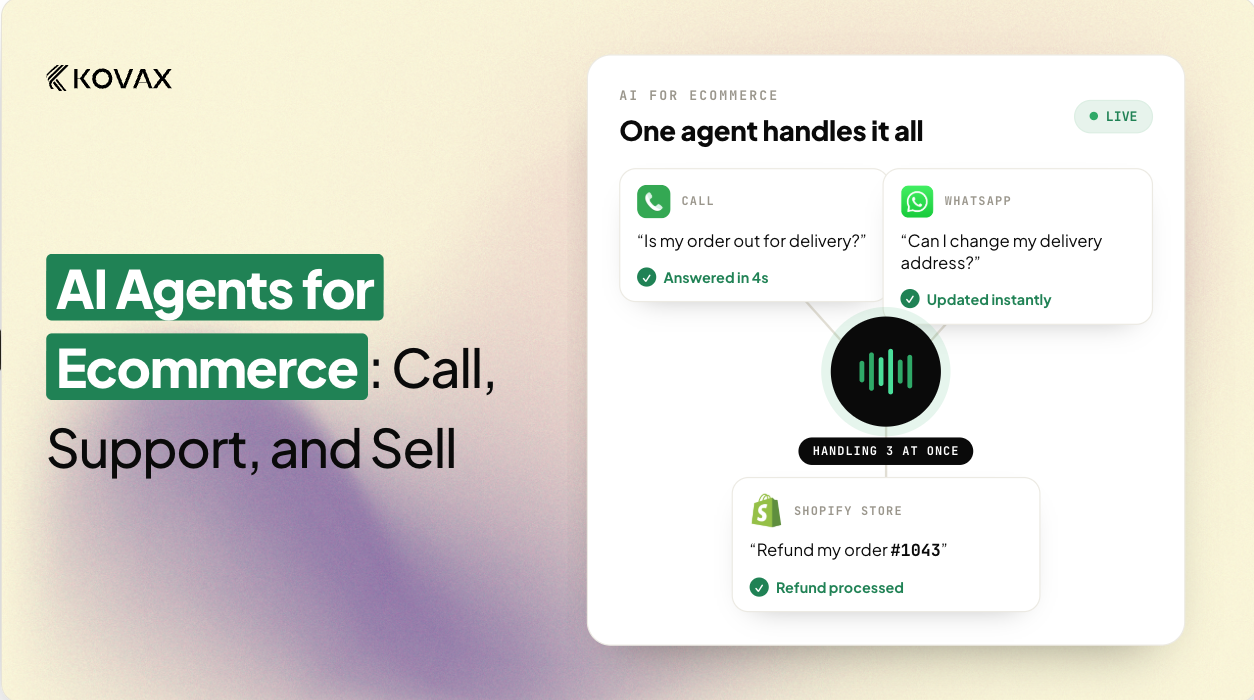
Kovax is not a staffing agency. It is an AI agent built for Shopify stores, and it takes over the repetitive front line that most stores would otherwise outsource to human agents. One agent answers calls, chat, WhatsApp, and email around the clock, pulling answers from your live catalog, policies, and order data.
- Coverage: 24/7 on every inbound channel, including nights, weekends, and holidays.
- Languages: more than 20 languages, replying in the customer's own language automatically.
- Integration: native Shopify app that syncs orders, products, and customers in real time.
- Handoff: questions it cannot answer go to your team with a full conversation summary.
- Setup: most merchants go live in about 5 minutes, with no training data needed.
- Pricing: free to install, with paid plans from $49.99 a month and calls billed from 25 to 30 cents a minute depending on plan.
Best for: Shopify stores that want instant, always-on answers to order tracking, returns, and product questions without hiring or managing agents.
Watch-outs: it only works with Shopify, and complex or emotional conversations still need people. Many stores pair it with a small in-house team or a human outsourcing partner for escalations.
2. Teleperformance (TP)
TP, the company formerly known as Teleperformance, is one of the largest customer experience providers in the world. It has a presence in about 100 countries, supports 400+ languages and dialects, and has operated for 48 years. Its services span customer care, technical support, trust and safety, and back-office work, with its own TP.ai tools layered on top of human teams.
- Coverage: global 24/7 delivery across onshore, nearshore, and offshore hubs.
- Strengths: scale, multilingual depth, and mature processes for regulated industries.
- Typical terms: enterprise engagements often require 50+ seats and $1 million-plus a year, with significant setup fees.
Best for: large enterprises running big, multi-country support programs.
Watch-outs: minimums and setup costs put it out of reach for most small and mid-sized brands, and customization moves slower than at boutique providers.
3. Hugo
Hugo builds dedicated, fully managed support teams for startups and established brands, with services across customer support, trust and safety, and AI data work. Its published pricing starts at $9 an hour per agent on month-to-month contracts.
- Coverage: 365/24/7 support in 60+ languages.
- Flexibility: teams can scale up or down with 24 hours' notice.
- Included: onboarding, management, QA, training, workforce management, and team leads.
- Speed: teams assembled in under 2 weeks.
- Security: ISO 27001 and SOC 2 certified, GDPR compliant.
- Retention: Hugo reports annual agent turnover of 4%.
Best for: brands that want a dedicated, brand-trained team at offshore rates without a long contract.
Watch-outs: final pricing depends on scope, so the $9 starting rate will rise for specialist roles, languages, or complex work.
4. Influx
Influx has provided 24/7 customer support since 2013 and focuses on growth-stage ecommerce, SaaS, and consumer brands. It offers two products: Talent as a Service, where you manage the agents, and Managed Operations, where Influx runs the whole function. Its pricing page is unusually transparent.
- Pricing: Talent as a Service from $1,400 a month per agent in Asia-Pacific and $1,700 in the Americas; Managed Operations from $2,000 a month per agent.
- Terms: month to month, no setup fee, one month's notice.
- Speed: Influx advertises launching in 1 week from signed agreement.
- Coverage: follow-the-sun teams across Asia-Pacific, Europe and Africa, and the Americas.
- Channels: email, chat, social, and voice.
Best for: ecommerce and SaaS brands that need dedicated agents quickly and want to start small, even with a single agent.
Watch-outs: languages beyond English carry a premium, and Managed Operations requires a team leader, which raises the minimum spend.
5. SupportYourApp
SupportYourApp has delivered outsourced support since 2010 and pairs human agents with its own AI products for chat, email, and voice. It mainly serves tech companies, SaaS, fintech, and ecommerce.
- Coverage: 24/7 support in 60+ languages, with clients in 30+ countries.
- AI layer: AI handles routine queries while human agents take complex and sensitive cases.
- Channels: chat, email, phone, social, in-app, and WhatsApp.
- Security: PCI DSS Level 1, ISO 27001, GDPR, and CCPA compliance.
- Launch: a published roadmap of roughly one month from first call to go-live, with an option to start with one agent.
Best for: tech and SaaS companies that want blended AI and human support with strong security credentials.
Watch-outs: pricing is quote-based, so budgeting requires a sales conversation, and the launch timeline is longer than the fastest providers.
How Much Does Customer Service Outsourcing Cost?
Across vetted providers, the average outsourced rate sits between $25 and $49 an hour, but real quotes range far wider depending on location, channels, languages, and hours. The pricing model matters as much as the rate:
| Pricing model | How you pay | Typical range |
|---|---|---|
| Hourly | Per agent hour worked | $7 to $42 by location |
| Per agent, per month | Flat fee per dedicated seat | From about $1,400 offshore |
| Per resolution | Per ticket solved | $1 to $7, averaging about $4 |
| AI agent | Monthly plan plus usage | From $49.99/month plus per-minute calls |
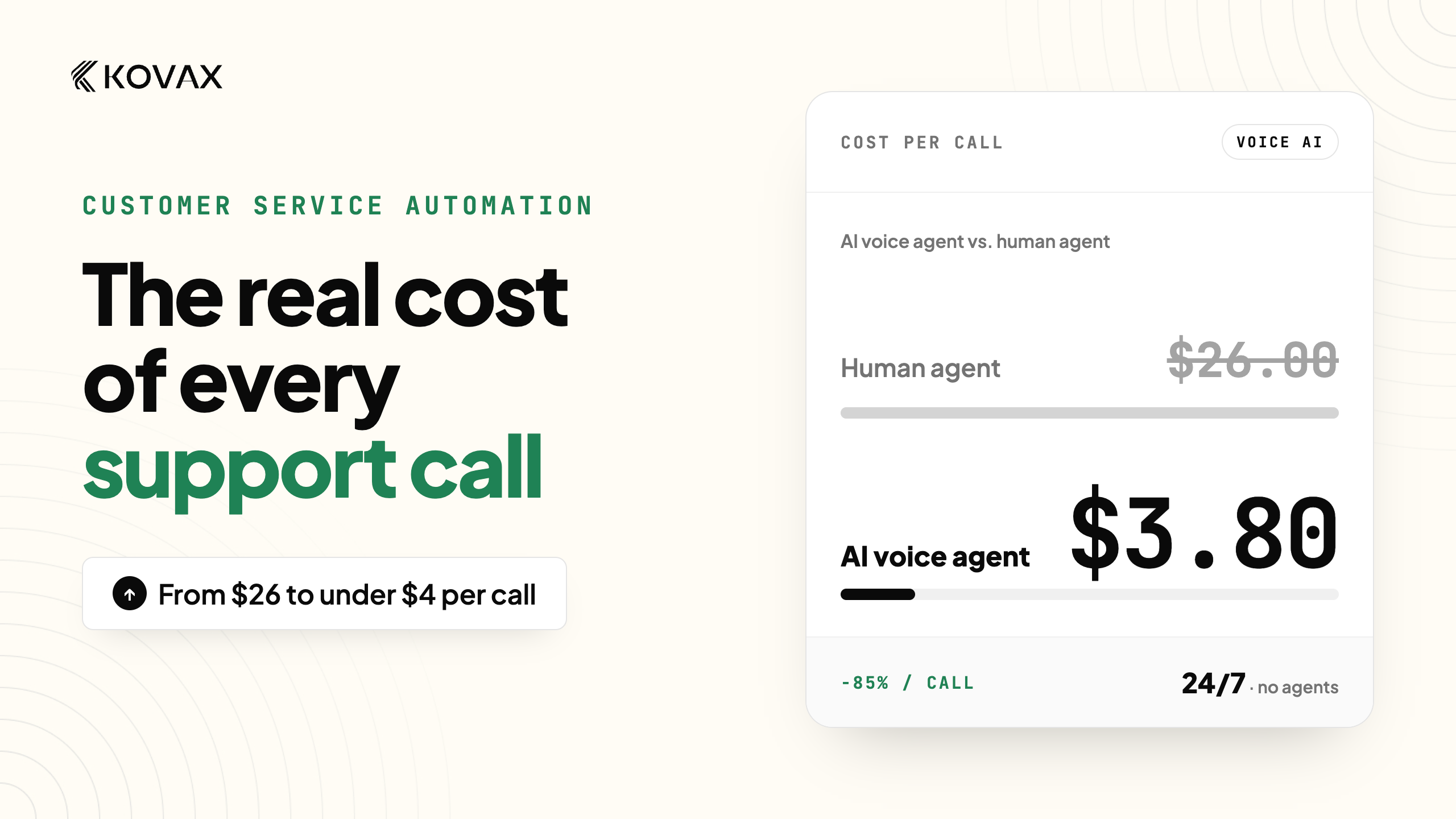
What 24/7 really costs. A week has 168 hours. One full-time agent works about 40, so covering a single seat around the clock takes roughly 4.2 agents, or five once you allow for breaks, leave, and sick days. At a starting rate of $1,400 per agent per month, that is about $7,000 a month before any language or holiday premiums. This is why many teams now let AI handle overnight volume and keep human agents for daytime and complex work.
On top of labor, budget for setup fees, any helpdesk or phone licenses the provider passes through, and internal time to manage the relationship. For deeper benchmarks on cost per ticket, satisfaction, and turnover, see our customer service outsourcing statistics for 2026.
How to Run a Customer Support Outsourcing Pilot
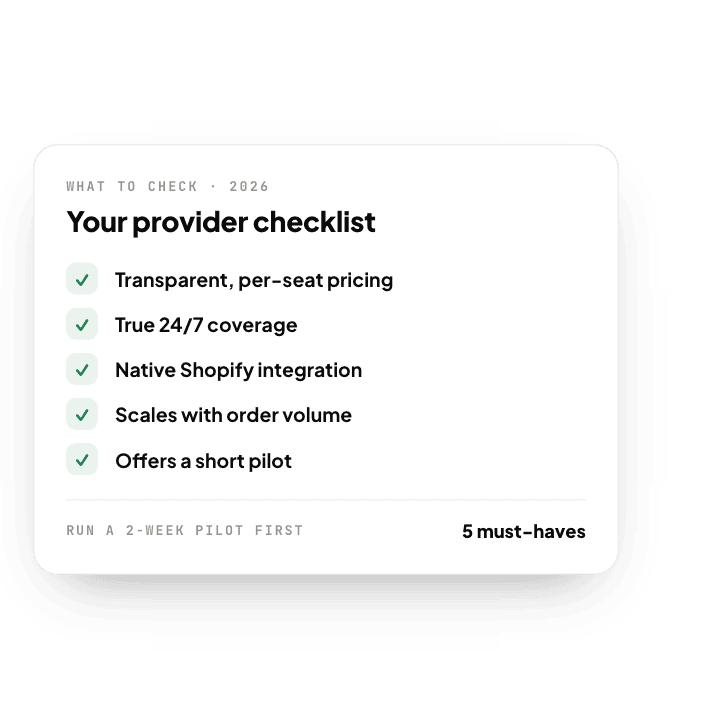
A pilot lets you test a provider on real customers before you commit. Month-to-month providers make this low risk.
- Pick one queue. Choose a contained slice such as after-hours chat or order-status emails.
- Record your baseline. Capture current CSAT, first response time, resolution rate, and cost per ticket.
- Set pass or fail criteria. Agree in writing what results justify scaling up.
- Share your playbook. Hand over macros, policies, tone guides, and escalation rules before day one.
- Run it for 30 to 60 days. Shorter pilots mostly measure the learning curve, not steady-state quality.
- Calibrate weekly. Review a sample of conversations together and score them against the same standard.
- Compare and decide. Measure cost per resolved ticket against your baseline, then scale, adjust, or exit.
Frequently Asked Questions
Is customer service outsourcing the same as using a call center?
Not quite. A call center traditionally handles phone calls only. Customer service outsourcing is broader and usually covers chat, email, social, and messaging apps too, often with AI and back-office work bundled in.
Is outsourcing customer service right for a small business?
It can be, if you choose a provider with low minimums. Several providers let you start with a single agent on a month-to-month contract. For very small volumes, an AI agent or a shared team is usually cheaper than a dedicated seat.
Should you outsource all customer support?
Usually not. Most businesses outsource repetitive, high-volume work and keep escalations, VIP customers, and product feedback in-house. That split protects quality while still cutting cost and response times.
How long does outsourcing implementation take?
It ranges from about 1 to 2 weeks at fast-moving mid-market providers to a month or more at larger BPOs. Complex programs with many languages or strict compliance can take longer. AI agents can go live in minutes.
Can outsourced support teams use AI?
Yes, and most now do. Providers use AI to answer routine questions, suggest replies to agents, and score conversations for quality. Ask any provider which AI tools they use and how they keep humans in the loop for complex cases.
Who is responsible for customer data handled by an outsourcing provider?
You are. Under laws such as GDPR, your business usually remains the data controller, and the provider acts as a data processor on your behalf. Your contract should include a data processing agreement that sets out security standards, access rules, and breach notification duties.
How to Choose the Right Outsourcing Partner
The right partner is the one that fits your volume, channels, and budget today, and can grow with you without locking you in. Start by mapping which conversations are repetitive and which need real judgment. Shortlist providers whose minimums and pricing match your size, insist on clear metrics and an exit clause, and prove the fit with a 30 to 60 day pilot before you scale. Many brands end up with a blend: AI for the always-on front line, an outsourced team for volume, and a small in-house core for the conversations that build loyalty.
If you run a Shopify store and want to see how AI handles that front line first, you can try a live Kovax demo.