Every growing Shopify store hits the same wall. Orders climb, and so do the questions: where is my order, can I change my address, why was I charged twice? At some point, the founder answering tickets at midnight is no longer a badge of honor; it is a bottleneck. Customer support outsourcing looks like the obvious fix. Hand the inbox to a specialist, pay a predictable rate, get your evenings back.
Sometimes that math works beautifully. Sometimes it quietly costs more than the payroll it replaced. This guide walks through when outsourcing your store's support genuinely pays off, when it backfires, what the real numbers look like in 2026, and how to make the call without guessing.
What customer support outsourcing actually means
Customer support outsourcing means hiring an outside company, usually a business process outsourcing (BPO) provider, to answer your customers' questions instead of building an in-house team. The provider supplies trained agents, the software, and the management, and you pay per hour, per agent, or per resolved ticket.
Modern providers rarely stop at answering phones. Most handle live chat, email, voice calls, and social messages together, and many now layer automation on top so simple questions get resolved before a human ever sees them. The scope matters more than the label because a chat-and-email desk during business hours is a very different service and a very different price from round-the-clock multilingual phone support.
For a Shopify store, the practical question is not "should I outsource support" in the abstract. It is "which parts of my support are repetitive enough to hand off, and which parts still need someone who knows my brand." That distinction runs through everything below.
When outsourcing customer support pays off
Outsourcing pays off when your ticket volume is high, repetitive, and growing faster than you can hire for it. If most of your inbox is order tracking, returns, and the same ten product questions, an outside team can clear that backlog cheaply and free your core people for work only they can do.
The upside is easiest to see in three situations:
- You are drowning in predictable tickets. When the bulk of contacts are "where is my order" and refund status, a trained external team resolves them at a fraction of in-house cost, and you stop losing nights to the queue.
- Your volume swings with the season. A BPO can add night-shift or holiday agents in weeks, then scale back down, so you are not carrying full-time salaries through a quiet January.
- You need coverage you cannot staff on your own. Round-the-clock or multilingual support is expensive to build in-house and straightforward to rent.
There is a revenue side too, not just a cost side. 73% of consumers will switch to a competitor after multiple bad experiences, and more than half will switch after only one, according to Zendesk Benchmark data. Slow or absent support is not a neutral cost-saving; it leaks customers. The flip side is just as real: 3 in 4 consumers will spend more with businesses that provide a good experience, per the same Zendesk data. Handing tickets to a team that answers them fast can protect revenue that a stretched founder quietly loses.
When outsourcing costs more than it saves
Outsourcing backfires when your support is a core part of the product, when volume is low, or when the work needs deep brand and catalog knowledge that a rotating external team cannot hold. In those cases, the headline hourly rate hides the real cost: slower answers, wrong answers, and customers who leave.
Watch for these signals that outsourcing is the wrong move right now:
- Your tickets are complex and brand-specific. If answering well means knowing your catalog, your tone, and your edge cases, a generalist agent will escalate constantly, and every escalation lands back on you.
- Your volume is still low. Below a few hundred tickets a month, contract minimums and setup fees can cost more than a part-time hire.
- Support is your differentiator. If customers choose you partly for the personal service, moving that off-brand can erode the exact thing that sets you apart.
The hidden costs are the ones that sink the business case. Setup and onboarding fees, quality-assurance charges, and premium rates for holiday scaling routinely turn an attractive quote into a larger bill, as Text's 2026 pricing breakdown lays out line by line. And a low rate paired with high agent turnover, where the industry average sits at 6% to 8% monthly attrition per Helpware's 2026 cost analysis, means constant retraining and inconsistent answers that never show up on the invoice.
What outsourced customer support actually costs
Outsourced customer support in 2026 runs from roughly $8 per hour offshore to $60 per hour onshore, with most mid-market ecommerce programs landing between $12 and $22 per hour on a blended offshore or nearshore model. The number you actually pay depends far more on location, coverage hours, and channel mix than on any single vendor's list price.
Here is how the common pricing models compare, drawn from two independent 2026 breakdowns:
| Pricing model | Typical range | Best fit |
|---|---|---|
| Per hour, offshore (Philippines, India) | $8 to $16 | Variable volume, standard tickets |
| Per hour, nearshore (Latin America) | $12 to $30 | Closer time zones, mid complexity |
| Per hour, onshore (US, UK) | $28 to $60 | Native-level, specialized support |
| Per agent, per month | $1,200 to $4,000 | Brand-trained dedicated agents |
| Per resolved ticket | $1 to $7 (about $4 average) | Efficiency-focused, measurable |
Regional spread confirmed against Helpware's 2026 comparison, which cites Clutch's 2026 guide putting the vetted-provider average at $25 to $49 per hour, and against Text's 2026 pricing guide for the per-agent and per-ticket ranges. Figures are directional, since every provider bundles setup, tools, and quality control differently.
Translate that into a monthly reality. A small store running chat and email during business hours with one to three offshore agents typically spends $2,000 to $8,000 a month, per Text's breakdown. Add round-the-clock coverage, phone support, or extra languages and that figure climbs 20% to 40%. On top of labor, expect one-time setup fees that can run from $5,000 into the tens of thousands at larger providers, as Helpware notes. Always ask for an itemized quote, because the gap between the quoted rate and the first invoice is where most of the surprise lives.
In-house, outsourced, or AI: an honest comparison
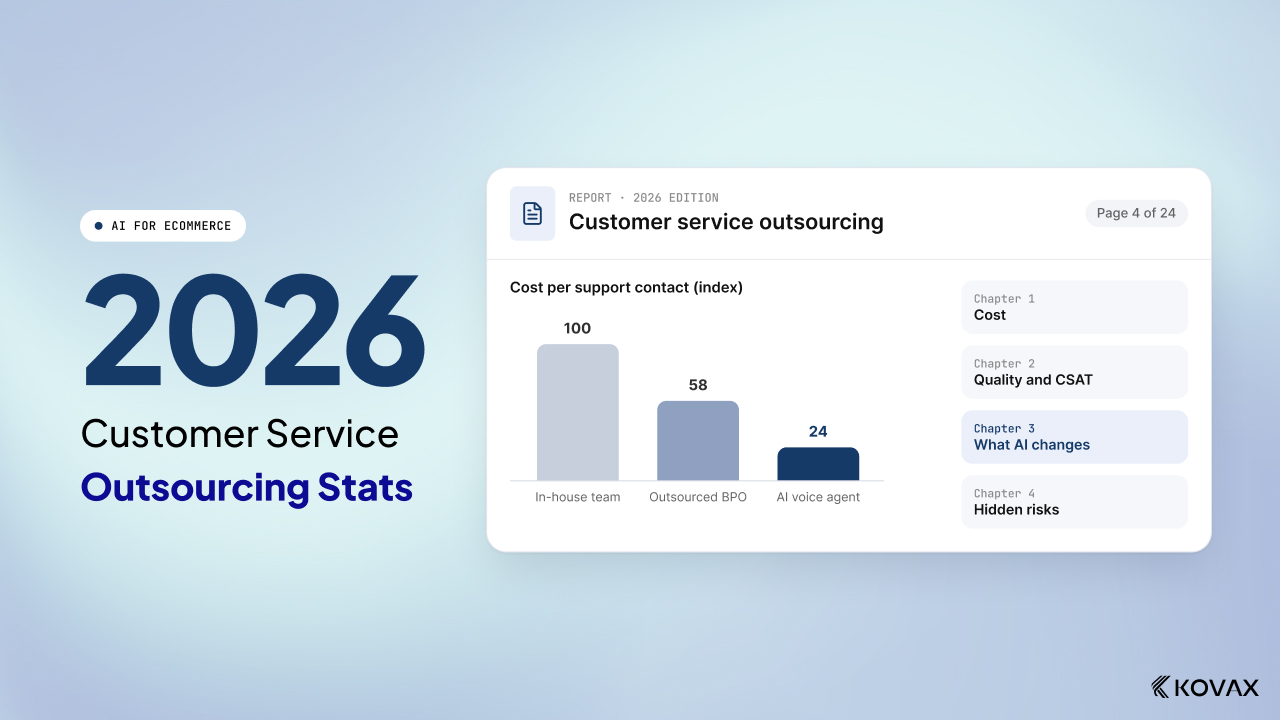
There is no single winner among in-house, outsourced, and AI-handled support. Each fits a different stage and a different kind of ticket, and most growing stores end up blending all three rather than picking one.
- In-house. Best when support is complex, brand-defining, or low-volume enough that one or two people can own it. You get full control and deep product knowledge, at the cost of salaries, benefits, and the ceiling on how fast you can scale.
- Outsourced. Best when volume is high and repetitive, and you need coverage or languages you cannot staff. You get flexibility and lower per-ticket cost, at the cost of some brand distance and management overhead.
- AI-handled. Best for the repetitive front line: order status, tracking, simple returns, which make up the bulk of ecommerce tickets. It answers instantly at any hour and never needs retraining, though it still needs a human path for anything genuinely unusual.
The AI slice is growing fast because the demand is there. 57% of business leaders expect customer service call volumes to rise by as much as a fifth over the next one to two years, per McKinsey research cited by Zendesk, and 60% of consumers say they want companies to adopt advanced voice AI, according to Zendesk. For a Shopify store, that often means automating the predictable questions, whether by phone, chat, or WhatsApp, and reserving human agents, in-house or outsourced, for the conversations that actually need judgment. Our guide to customer service automation for ecommerce covers where that line sits.
What tends to break when ecommerce stores outsource
The most common failure is not cost; it is context. An outsourced agent who cannot see the customer's order, catalog, or history gives slow or wrong answers, and ecommerce support lives or dies on that context. Knowing where things break lets you write it into the contract before it becomes your problem.
- Order and catalog access. If agents cannot see live Shopify order status, "where is my order" turns into a back-and-forth that frustrates everyone. Confirm the provider can integrate with your store data.
- Brand voice. Generic scripts read as generic. Supply tone-of-voice documentation and sample replies so answers still sound like you.
- The handoff. Decide upfront which tickets the external team resolves and which get escalated, and how fast, so complex issues do not sit in limbo.
- Peak-season readiness. Ramp-up takes weeks. A team onboarded in November will not be fluent for your Black Friday rush, so plan the transition months ahead.
Order-status questions are worth solving deliberately, because they are the single largest and most repetitive category for most stores. Our breakdown of what "where is my order" really costs shows why deflecting them, by any method, moves the needle most.
Common mistakes stores make when outsourcing support
- Choosing on hourly rate alone. The cheapest quote often carries the highest turnover and the most escalations, which cost more over a year than a slightly higher rate with a stable team.
- Skipping the itemized quote. Setup, quality assurance, tooling, and scaling fees stack up quietly. If a provider will not break them out, treat that as a warning sign.
- Outsourcing everything at once. Handing over complex, brand-specific tickets alongside the simple ones overwhelms a new team. Start with the repetitive front line.
- Forgetting the integration. Agents without access to Shopify order and catalog data cannot answer e-commerce questions well, no matter how good they are.
A simple way to decide
You can make this call with three questions. First, what share of your tickets is repetitive and low-judgment? If it is most of them, you have strong outsourcing or automation potential. If your tickets are mostly complex and brand-specific, keep them close.
Second, is your volume high and steady, or low and lumpy? High and steady rewards a dedicated outsourced team; low and lumpy often favors automation plus a small in-house core, since contract minimums can outweigh the savings.
Third, can you protect context and brand? If a provider can integrate with your Shopify data and follow your tone, outsourcing the repetitive tier is low-risk. If not, automate the front line first and revisit outsourcing once volume justifies the setup.
For most growing stores, the answer is a blend: automate the predictable questions, keep a small in-house team for the conversations that build loyalty, and outsource the middle if and when volume demands it.
FAQ
Is it cheaper to outsource customer service or hire in-house?
It depends on volume. At high, steady ticket loads, outsourcing at $8 to $22 per hour blended usually beats fully loaded in-house salaries. At low volume, contract minimums and setup fees can make a part-time hire or automation cheaper.
How much does it cost to outsource customer support for a small business?
Most small stores spend $2,000 to $8,000 a month for one to three offshore agents on chat and email during business hours, per Text's 2026 pricing guide. Round-the-clock or multilingual coverage pushes that 20% to 40% higher.
When should an ecommerce store outsource customer service?
When repetitive tickets are growing faster than you can hire, when you need coverage you cannot staff, or when seasonal spikes make full-time headcount wasteful. Hold off when tickets are complex, brand-defining, or still low in volume.
Does outsourcing hurt customer experience?
It can, if agents lack order context or brand training. It can also help, since slow support drives customers away and more than half will switch after a single bad experience, per Zendesk. The outcome depends on integration, scope, and provider quality, not on outsourcing itself.
Can AI replace outsourced customer support?
For the repetitive front line, order status, tracking, and simple returns, increasingly yes. For nuanced or emotional conversations, a human still wins. Most stores combine automation for volume with people for judgment.
Where to go from here
Outsourcing customer support pays off when it removes repetitive volume without removing the context and care your customers came for. Start by measuring which tickets are truly repetitive, then decide what to automate, what to keep in-house, and what to hand off. If you want to see how automating the predictable front line fits alongside human support, take a look at how Kovax handles customer service for Shopify stores.