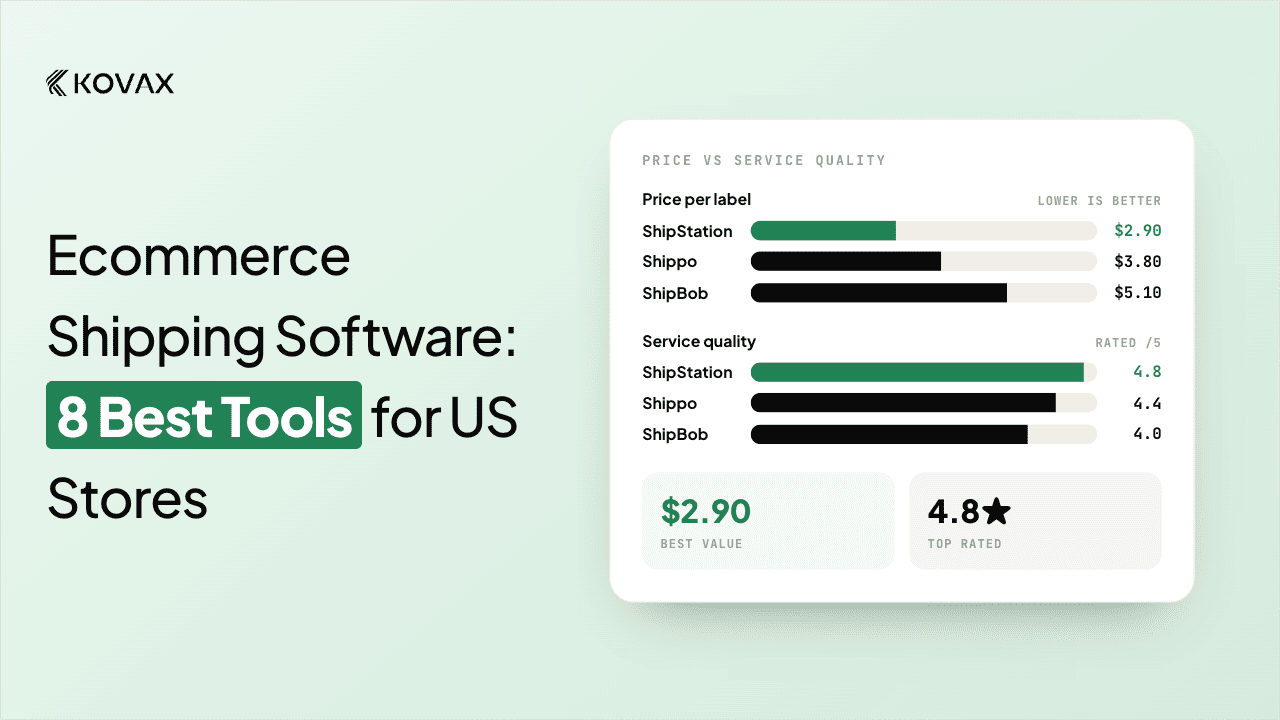
Most people shopping for ecommerce shipping software don't need "the best" tool. They need the one that fits how their store actually runs: where the orders come from, which carriers they use, and how many boxes go out each month.
This guide is for US-based online stores that ship mostly inside the US, with some international orders on the side. It compares 8 tools on price, plan limits and carriers, shows what each one really costs as you grow, and covers the 2026 changes that should shape your pick.
Last reviewed: October 14, 2026. Shipping software prices change often, so check the vendor page linked on each price before you buy.
How to choose ecommerce shipping software for your store
Use this table to find the ecommerce shipping software that fits your situation. Some tools fit more than one row.
| Your situation | Our pick | Why |
|---|---|---|
| Every order comes through Shopify | Shopify Shipping | Lives in your admin and costs nothing extra |
| You ship USPS or UPS only and want $0 software | Pirate Ship | No monthly fee, no markup, no label cap |
| You need FedEx or DHL Express but not a monthly bill yet | Shippo (free plan) | Covers 30 labels a month across all four carriers |
| You already have negotiated UPS or FedEx rates | Shippo Pro or ShipStation Standard | Both let you connect your own carrier accounts at no extra fee |
| Amazon is one of your main channels | Veeqo | Free shipping plan with Amazon-specific perks |
| You sell on 3+ channels and have a packing team | ShipStation | Strongest automation rules and multi-user plans |
| A regular share of your orders ships abroad | Easyship | Customs paperwork plus duties and taxes at checkout |
| You have a developer building custom checkout or warehouse flows | EasyPost | API-first, with 3,000 free labels a month |
| You're a small team that wants phone support and a fixed monthly price | ShippingEasy | US phone support, flat tiers by shipment volume |
Before you commit, run four quick checks:
- Count your users. Free plans often allow one login, and entry paid plans allow 3 to 5.
- Price your own carrier accounts. Some tools connect them free, while others charge a monthly or per-label fee.
- Check what the customer sees. Branded tracking pages and notification emails often sit on paid tiers.
- Plan for returns. Return labels are standard. A self-service returns portal usually isn't, and our guide to reducing ecommerce returns covers what to set up.
How we picked these 8 tools
We started from the tools that show up most often in US searches for ecommerce shipping software and Shopify shipping apps, then kept the ones that met all four of these rules:
- Published, self-serve pricing. You can see the price and sign up without a sales call.
- A direct Shopify connection, either built in or through an app.
- Labels from major US carriers, at least USPS and UPS.
- A distinct use case. We wanted eight different answers, not eight versions of the same tool.
What we left out, and why:
- Europe-first platforms such as Sendcloud. Sendcloud itself says it suits European merchants best.
- 3PLs like ShipBob. They store and ship your stock for you, which makes them a different purchase from software.
- Warehouse management and enterprise multi-carrier systems. These target high-volume warehouses with custom pricing, and most US stores reading this guide don't need them yet.
How we checked the details: we read each vendor's pricing and plan pages on October 14, 2026, and used monthly billing prices throughout. Watch for this on Shippo's site, which shows yearly billing by default. We didn't buy paid accounts on all eight tools, so treat the feature notes as what each company offers, not something we stress-tested.
We don't use affiliate links in this article.
What shipping software does (and what it doesn't)
Ecommerce shipping software sits between your store and the carriers. Day to day, it handles five jobs:
- Pulls orders from your store and marketplaces into one queue
- Compares carrier rates, so you can pick the cheapest or fastest option per package
- Buys and prints labels, usually in batches
- Sends tracking numbers back to your store and your customer
- Creates return labels when something comes back
What it won't do is store, pick or pack anything. That's the job of a third-party logistics provider (3PL). If you're stuck between doing fulfillment yourself and handing it off, our guide to in-house fulfillment vs a 3PL walks through that call.
Keep two bills in mind as you read. The software fee is what the app charges you. Postage is what you pay for each label. None of the prices in this guide include postage.
Some free ecommerce shipping software tools earn money through postage. Veeqo says it takes a small commission on labels bought through it, and Pirate Ship says the carriers pay it, not you. Nothing wrong with that, but it means the cheapest app doesn't always give you the lowest total cost. A free tool with weaker label rates can cost you more than a paid tool with better ones.
Ecommerce shipping software compared at a glance
Each tool name links to the vendor page we used for that row.
| Tool | Starting price (monthly billing) | Free option | Carriers | Best for | Main limit |
|---|---|---|---|---|---|
| ShipStation | $14.99/mo | 30-day trial | 200+ parcel carriers | 3+ sales channels with a packing team | Own carrier accounts and branded tracking need Standard ($29.99+) |
| Shopify Shipping | Comes with your Shopify plan | Yes | Shopify's negotiated rates | Shopify-only stores | Only covers orders inside Shopify |
| Pirate Ship | Free | Yes, no label cap | USPS, UPS | USPS or UPS at $0 software cost | No FedEx or DHL |
| Shippo | Free, then $19/mo | 30 labels a month | 40+ | Adding FedEx or DHL without a monthly fee | Free plan: 1 user, 5 cents per label on your own carrier accounts |
| Veeqo | Free | Unlimited shipments | Amazon Shipping, UPS, USPS, FedEx, DHL, OnTrac | Stores where Amazon is a main channel | Inventory tools cost from $19/mo |
| EasyPost | Free up to 3,000 labels a month | Yes | 100+ | Stores with a developer | Own carrier accounts cost $20/mo plus $0.08 a label |
| Easyship | Free, then $29/mo | 50 shipments a month | 550+ courier services | Regular international orders | Duties and taxes at checkout need Premier ($69/mo) |
| ShippingEasy | Free, then $19.99/mo | 25 shipments a month | USPS, UPS, FedEx, DHL | Small teams that want phone support | Free plan caps you at 3 stores |
If you only read one column, make it "Main limit." That's where most buyer's remorse comes from.
The 8 best shipping software tools for ecommerce
1. ShipStation: best for selling on several channels with a team
ShipStation is the ecommerce shipping software a lot of US stores end up on once orders start arriving from three or four places at once, say Shopify, Amazon, Etsy and TikTok Shop. What you're really paying for is the automation rules. Set them up once (route by weight, destination or channel) and the software labels most orders without anyone touching them.
Starter costs $14.99/month for 50 shipments, and the price climbs with volume up to 5,000 shipments. Standard starts at $29.99/month and Premium at $349.99/month. Every plan comes with a 30-day free trial, and yearly billing saves 20%.
The catch is on Starter. It allows 3 users, you can't plug in your own carrier accounts, and you don't get a branded tracking page. Standard fixes all three and allows 10 users. If you created your account before July 8, 2025, ShipStation says you may still pay carrier connection fees, so check your bill.
2. Shopify Shipping: best if you only sell on Shopify
If Shopify is your only storefront, ask yourself whether you need separate ecommerce shipping software at all. Shopify Shipping lives inside the admin, costs nothing on top of your Shopify plan, and lets you print up to 250 labels in one go. Tracking goes out to the customer on its own.
If you're on Grow, Advanced or Plus with Shopify Payments turned on, each eligible label also comes with up to $200 of shipping insurance at no extra cost.
It stops working as your only tool once you add a second channel. Amazon or wholesale orders sit outside Shopify, and that's usually when people move to a multichannel tool.
3. Pirate Ship: best for USPS and UPS at zero software cost
Pirate Ship charges no monthly fee, no markup and no payment fee, which makes it the cheapest ecommerce shipping software on this list. It advertises savings of up to 88% on USPS and UPS, and its site says it measures the UPS discounts against UPS Daily Rates. Your own savings depend on the service, package size and zone. It also opens up services like Priority Mail Cubic, which can cost a lot less for small, heavy boxes.
There's no cap on labels, and it connects to Shopify, Etsy, eBay, WooCommerce and others.
The trade-off is scope. There's no FedEx or DHL, and the automation is pretty basic. At low volume, who cares. At a few hundred orders a month, the extra clicking starts costing you more in time than you save in fees.
4. Shippo: best for adding FedEx or DHL without a monthly fee
Shippo is ecommerce shipping software for the awkward middle stage: you've outgrown printing labels one at a time, but you're not ready to sign up for a monthly plan. Even the free tier gets you discounted USPS, UPS, FedEx and DHL Express labels, unlimited store connections and some basic automation.
The free plan covers 30 labels a month. Pro costs $19/month for up to 200 labels on monthly billing, or $17/month if you pay yearly. It rises with volume, to $29/month for up to 500 labels and $79/month for up to 2,500.
Two things to know about the free plan. It's one login only, and Shippo charges 5 cents a label if you connect your own carrier account. Pro removes that fee, allows up to 5 users, and adds branded tracking and phone support.
5. Veeqo: best when Amazon is a main channel
Amazon owns Veeqo, and its shipping plan is free with unlimited shipments and unlimited users. That's unusually generous. Labels can earn up to 5% back in Veeqo Credits, and Amazon orders get claims-protected labels by default.
Shipping costs nothing. Inventory management starts at $19/month, and the High Volume plan at $350/month.
You don't have to sell on Amazon to use it. But if you don't, you skip its best perks, and the inventory sync and digital picking tools still sit behind the paid plans.
6. EasyPost: best if you have a developer
EasyPost centers everything on an application programming interface (API), so a developer can wire rates and labels straight into your own checkout or warehouse system, across 100+ carriers. For Shopify merchants who'd rather not touch code, EasyPost also has a simpler app called Nexus.
If you buy labels through EasyPost's own carrier accounts, the first 3,000 labels each month are free, and each label after that costs $0.08. Connecting your own carrier accounts costs $20/month plus $0.08 a label.
Without someone technical on the team, this probably isn't your first stop. It's less of a ready-made dashboard than ShipStation or Shippo, and EasyPost charges per shipment for extras like advanced tracking and insurance.
7. Easyship: best for regular international orders
Of all the ecommerce shipping software here, Easyship is the one built for international orders. It compares 550+ courier services, fills in the customs paperwork, and can show duties and taxes at checkout, so a customer in Toronto or London doesn't get a surprise bill at the door.
There's a free plan for 50 shipments a month. Plus costs $29/month for 500 shipments, Premier $69/month for 2,500, and Scale starts at $99/month. Yearly billing saves about 20%.
The annoying part: charging duties upfront at checkout (what shippers call delivered duty paid, or DDP) only comes with Premier. At least one recent App Store review also says harmonized system (HS) codes weren't syncing from Shopify, so test your international product data before you depend on it.
8. ShippingEasy: best for small teams that want phone support
ShippingEasy is a bit of an odd one, in a good way. Next to the usual shipping dashboard, you get basic customer marketing: email campaigns and, for Shopify stores, abandoned cart emails. Most ecommerce shipping software stops at the label.
Starter is free for up to 25 shipments a month. Growth costs $19.99/month for 26 to 200 shipments, Basic $29.99 for up to 500, and the tiers keep going up to 10,000. It advertises up to 82% off UPS Daily Rates, and you can phone its US-based support team.
The limits sit on the free plan, which connects to only three stores, and on carrier accounts. Bringing your own adds a monthly fee that depends on your plan.
What ecommerce shipping software actually costs at 100, 500 and 2,000 orders a month
Every comparison leads with the starting price, and for a growing store it's close to useless. This table shows the cheapest plan that covers each volume, using monthly billing prices from October 14, 2026. It covers the software fee only. Postage comes on top in every row.
| Tool | 100 orders/mo | 500 orders/mo | 2,000 orders/mo | What that plan includes or limits |
|---|---|---|---|---|
| Pirate Ship | $0 | $0 | $0 | USPS and UPS only |
| Shopify Shipping | $0 extra | $0 extra | $0 extra | Shopify orders only; you still pay your Shopify plan |
| Veeqo (Shipping plan) | $0 | $0 | $0 | Unlimited users; inventory tools cost extra |
| EasyPost (Wallet) | $0 | $0 | $0 | Free up to 3,000 labels a month with EasyPost's carrier accounts |
| Shippo | $19 (Pro) | $29 (Pro) | $79 (Pro) | Up to 5 users; own carrier accounts connect free |
| ShippingEasy | $19.99 (Growth) | $29.99 (Basic) | $69.99 (Select) | Unlimited stores; own carrier accounts add a fee |
| Easyship | $29 (Plus) | $29 (Plus) | $69 (Premier) | DDP checkout starts on Premier |
| ShipStation Starter | $29.99 | $39.99 | $119.99 | 3 users; no own carrier accounts or branded tracking |
| ShipStation Standard | $59.99 | $89.99 | $174.99 | 10 users; own carrier accounts and branded tracking |
Yearly billing lowers the Shippo, Easyship and ShipStation numbers by 10 to 20%.
Two things jump out.
At 2,000 orders a month, ShipStation Standard costs about $2,100 a year more than the free tools ($174.99 × 12). That money pays off if the automation saves real staff hours, like auto-splitting orders, rule-based routing or separate logins for a team of ten. If it doesn't, you're paying for a nicer dashboard.
The bigger lesson: the ecommerce shipping software fee is the small bill. Say your average label costs $8. At 2,000 orders, that's roughly $16,000 a month in postage, and a 5.9% carrier increase adds about $944 a month, more than five times ShipStation's top fee in this table. Before you switch tools, price your three most common package sizes in each app you're considering. The tool with the best label rates for your packages often beats the one with the lowest subscription.
ShipStation vs Shippo vs Pirate Ship for a small business
These three show up in nearly every small business shipping software search, so here they are side by side.
| ShipStation | Shippo | Pirate Ship | |
|---|---|---|---|
| Entry price (monthly billing) | $14.99/mo | Free (30 labels) | Free |
| Carriers | 200+ | 40+ | USPS, UPS |
| Own carrier accounts | Standard plan and up | 5 cents/label on free, free on Pro | Not listed |
| Users on entry plan | 3 | 1 | Not listed |
| Branded tracking | Standard plan and up | Pro plan and up | No |
Of these three ecommerce shipping software picks, Pirate Ship wins on cost, Shippo on flexibility, and ShipStation on automation. The situation table at the top of this guide shows which one fits your store.
2026 shipping changes US sellers should plan for
Two things changed this year, and both affect which ecommerce shipping software makes sense for a US store. We rechecked both on October 14, 2026.
Carriers keep raising prices. UPS raised list rates by an average of 5.9% effective December 22, 2025, and FedEx did the same on January 5, 2026. FedEx has already announced another average 5.9% increase effective January 4, 2027.
That 5.9% is an average, and averages hide things. Residential, oversized and remote-area surcharges can push your real increase well past it. Rate comparison in ecommerce shipping software can help here, since checking carriers on each label may turn up a lower price. How much you save depends on your packages, zones and rates.
The de minimis exemption is gone. The US suspended the $800 duty-free allowance for low-value imports from every country starting August 29, 2025.
On June 24, 2026, U.S. Customs and Border Protection made that suspension indefinite through interim final rules it published in the Federal Register. If you dropship from overseas suppliers or bring stock in as small parcels, those shipments now owe duties and need entry paperwork. For those stores, ecommerce shipping software with customs and duty tools isn't a nice extra anymore.
What to do about both: re-check your rate rules every time a carrier raises prices, and make sure your catalog has accurate HS codes and country of origin.
Where shipping software stops: after the label prints
Ecommerce shipping software is good at one moment: getting a label on a box. Once that box is moving and something goes wrong, it's mostly out of the picture.
A parcel sits at a sorting center for two days. A delivery fails because the apartment number was missing. The carrier scan just stops updating.
Each of those turns into a "where is my order" (WISMO) call, chat or email. A tracking link rarely settles it, because the customer has usually clicked it already. They want someone, or something, that can look at their actual order and tell them what's happening.
A few habits help no matter which tool you pick:
- Turn on address validation, so fewer labels go out to incomplete addresses
- Use a branded tracking page, so customers stay on your site instead of the carrier's
- Send a heads-up when a parcel stops moving, before the customer has to ask
- Track WISMO volume as an operations number, next to the ecommerce KPIs you already watch
We dig into what these contacts cost and how stores bring them down in our guide to WISMO and "where is my order" support. If you're still building out your app stack, our shortlist of Shopify apps for 2026 shows where a shipping app fits next to everything else.
Frequently asked questions
What is the best shipping software for a small business?
The best ecommerce shipping software for a small business depends on your carriers and channels. Pirate Ship costs nothing if USPS and UPS cover you, and Shippo's free plan adds FedEx and DHL Express.
Is Pirate Ship really free?
Yes. The carriers pay Pirate Ship, so you only pay for postage, but it supports only USPS and UPS.
Can I use my own UPS or FedEx account?
Yes, in most tools. Shippo Pro and ShipStation Standard connect them free, while EasyPost charges $20/month plus $0.08 a label.
What is shipping label software?
It lets you buy postage and print carrier labels from your computer instead of at the post office. Most ecommerce shipping software on this list also compares rates and sends tracking back to your store.
Do I need ecommerce shipping software at 50 orders a month?
Usually not. Shopify Shipping, Pirate Ship, Veeqo and Easyship's free plan (50 shipments a month) all cover that volume with no software fee. Shippo's free plan stops at 30 labels a month, and ShippingEasy's at 25.
Update log: October 14, 2026. We rechecked plan prices on monthly billing, label limits, user limits, carrier account fees, the UPS and FedEx rate changes, and US de minimis rules.
Related tool from Kovax, the company that publishes this blog: if "where is my order" calls take over your team's day once the labels go out, our Support and Tracking agent answers them by phone, WhatsApp, chat and email, using live Shopify order data.