Outbound sales is any contact your business starts. The customer did not raise their hand at that moment. You reached out first. For most Shopify merchants reading generic sales advice, that definition is where the confusion starts, because ecommerce outbound rarely looks like cold-calling strangers. This guide covers what outbound actually means for an online store, which lists are worth contacting, what the rules allow, and how to decide if it is worth doing at all.
What outbound sales means for an online store
Outbound sales is any contact your business starts. The customer did not raise their hand at that moment. You reached out first.
For a software company, that usually means cold-calling a stranger who has never heard of the brand. For an online store, it rarely means that, and this is the biggest source of confusion for merchants reading generic outbound advice.
A Shopify store already knows who its people are. Someone filled a cart and left. Someone bought a 30-day supply nine weeks ago. Someone placed a cash-on-delivery order that has not been confirmed. Each is a warm contact sitting in your own database, and reaching out to them is still outbound, because you started the conversation.
That distinction matters practically. Outbound to people you already have a relationship with is a fundamentally different exercise from buying a list of strangers, and the rules, response rates, and scripts all differ.
Why ecommerce outbound looks nothing like B2B cold calling
Most published outbound playbooks are written for business software sales. Long deal cycles, a named decision maker, a discovery call, a demo, a proposal. Almost none of that transfers.
Ecommerce outbound is short. The purchase decision is usually already made. What is missing is a small piece of friction: a shipping question, a size doubt, a payment that failed, or nothing more than distraction. So the job is not persuasion. The job is removing one specific obstacle and making it easy to finish. A call that runs 40 seconds and answers a real question will outperform a three-minute pitch every time.
The second difference is volume. A software company might work 200 accounts a quarter. A store with modest traffic can generate several hundred abandoned carts a week. Ecommerce outbound is a repeatable, high-frequency operation, which is why it tends to get automated rather than staffed.
The five lists worth calling
Almost all of the value sits in five segments. If you build nothing else, build these.
- Abandoned carts. Highest intent, shortest decay window. Worth contacting within hours, not days.
- Failed or pending payments. A payment that declined is a customer who wanted to buy and could not. Most stores send one automated email and stop there.
- Unconfirmed cash-on-delivery orders. If you sell in markets where cash on delivery is common, confirming the order before dispatch is the difference between a sale and a returned parcel. Our guide to reducing return-to-origin losses covers the economics of this.
- Replenishment windows. Consumables, supplements, pet food, skincare. If the average customer runs out at week ten, week nine is a reason to make contact that the customer will find useful rather than intrusive.
- Lapsed buyers. People who bought twice and then went quiet. This is the hardest of the five to get right, because the reason they stopped is usually invisible in your data.
Notice that none of these involve buying a list. Every one of them is built from data your store already holds, which is also what keeps you on the right side of the rules discussed further down.
What the abandoned cart numbers actually say
Abandoned carts get the most attention, so it is worth being precise about what the research supports.
The widely cited benchmark is an average documented cart abandonment rate of 70.22 percent, calculated across 50 separate studies and stable for over a decade.
The important detail sits underneath it. In the same research, 42 percent of United States online shoppers said they abandoned a cart simply because they were browsing and not ready to buy. Those people are not recoverable, and treating them as lost revenue will make any outbound program look like a failure.
Strip out the browsers, and the remaining reasons are concrete. 40 percent abandoned because extra costs such as shipping, tax, and fees were too high. Others cite slow delivery, a checkout that demanded an account, or a process that ran too long. These are the abandonments outbound can actually address, because each one is a question a person can answer.
As for returns, analysis of more than 143,000 abandoned cart email flows found an average placed order rate of 3.33 percent and revenue per recipient of $3.65, with the top 10 percent of brands reaching 7.69 percent and $28.89. Those figures cover email and come from 2023 sending data, so treat them as directional. They work best as a sanity check: if your recovery flow returns far less, the problem is the flow, not the channel. We compared how the same list performs across channels in our breakdown of email, SMS, and voice for cart recovery.
Writing an outbound sales script that does not sound like telemarketing
A good ecommerce outbound sales script is shorter than most people expect and has four moving parts.
Say who you are in the first sentence. Not the brand tagline. The store name and the reason for contact. Anything else reads as a scam attempt and gets hung up on.
Reference the specific thing. "You were looking at the merino crew in navy" works. "We noticed you visited our site" does not. The specificity is what signals this is not a mass dial.
Ask one open question and then stop talking. Usually a version of "Was there something that stopped you from finishing?" Most of the useful information in an outbound program comes from the answers to this question, not from the sales it closes.
Make finishing effortless. Send the link while you are still on the call, or complete the order over the phone. Do not ask them to go find the email.
What to leave out matters as much. Skip the discount in the first contact. Offering money off before you know why someone hesitated trains customers to abandon carts on purpose and gives away margin on people who would have bought anyway. Hold the incentive for a later touch, and only for carts large enough to justify it.
The rules most stores find out about too late
This is the part that gets skipped in most outbound guides, and it is the part that carries real financial risk in the United States.
Outbound calling is governed by the Federal Trade Commission's Telemarketing Sales Rule and, separately, by the Telephone Consumer Protection Act. A few provisions matter to almost every store.
Calling hours are fixed. Calls to a residence outside 8:00 a.m. to 9:00 p.m. local time at the customer's location are prohibited without prior consent. Local time means the customer's time zone, not yours.
The Do Not Call registry has an exception you probably qualify for. A seller may still call a registered number if it can demonstrate an established business relationship with that person and the person has not asked to stop being called. This is precisely why the five lists above are built from your own customers.
You must identify yourself and your purpose. The rule requires disclosing the identity of the seller and that the purpose of the call is to sell goods or services, promptly and clearly.
Dead air is a violation. A call counts as abandoned if a person answers and the telemarketer does not connect them to a sales representative within two seconds of their greeting. There is a safe harbour, but it caps abandonment at three percent of answered calls measured across a campaign. Predictive dialers routinely blow through this.
Recorded and synthetic voices are a separate, stricter category. Under the Telephone Consumer Protection Act, calls using an artificial or prerecorded voice to deliver a telemarketing message to a wireless number or residential line require prior express written consent. A live human calling a past customer and an automated voice calling the same person are not treated the same way, and the consent standards for artificial-voice calls have been the subject of active litigation and rulemaking through 2025 and 2026. Treat this area as unsettled and get current legal advice before running artificial-voice campaigns at volume.
None of this makes outbound impractical. It does mean compliance design comes before the campaign, not after the first complaint.
Humans, AI sales agents, or nothing at all
Three ways to staff this, and the right answer depends almost entirely on your volume.
A person on your team. Works below roughly 30 contacts a day. Cheap to start, no tooling, best conversation quality you will get. It stops working the moment the list outgrows the person, and it is the first task dropped when the store gets busy.
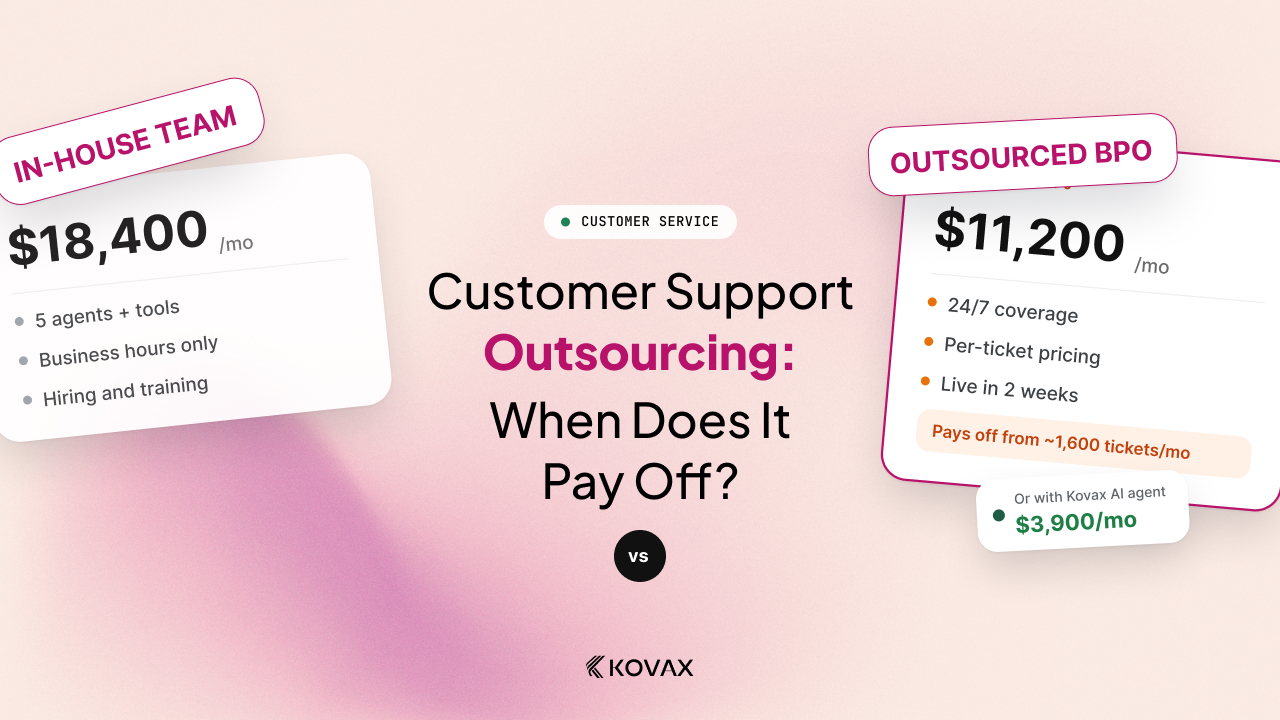
An outsourced team. Sensible in a narrow band, usually a few hundred contacts a day with predictable seasonality. The trade-off is script rigidity and the cost of training people on your catalog. We looked at when this pencils out in customer support outsourcing for ecommerce.
Automation, including an AI sales agent. Software that places the call, handles the reply, and hands off to a human when the conversation goes off script. It scales linearly and never skips a Tuesday, and it is worse than a good human at anything unusual. The compliance constraints above apply in full and are stricter here.
Below a hundred contacts a day, automation is usually solving a problem you do not have yet. Above a thousand, doing it manually is not a real option. The middle is a judgment call about whether the work is getting done consistently today.
Common mistakes people make with ecommerce outbound
- Treating the full 70 percent abandonment figure as a revenue target. Roughly four in ten of those shoppers were never going to buy. Set expectations against the recoverable slice.
- Leading with a discount. It costs margin on customers who would have converted anyway and teaches everyone else to wait.
- Contacting too late. Cart intent decays in hours. A follow-up on day three is a different, weaker conversation.
- Ignoring the compliance layer until something goes wrong. Calling hours, caller identification, and consent for recorded voices are cheap to get right in advance and expensive to fix afterwards.
- Measuring only closed sales. The reasons customers give for hesitating are frequently worth more than the recovered orders, because they point to fixable problems in your checkout.
A simple way to decide
Three questions, in order.
Do you have more than about 50 high-intent contacts a week that nobody currently follows up with? If not, fix your automated email flow first. Outbound calling on top of a broken email sequence is expensive duplication.
Can you name the single most common reason people abandon your checkout? If you cannot, run outbound manually for two weeks purely to collect answers. That data will likely be worth more than the sales.
Is the follow-up actually happening every day right now? Consistency, not sophistication, is what separates outbound programs that work from ones that quietly stop. If the answer is no and it has been no for a while, that is the argument for automating it.
FAQ
Is outbound sales worth it for a small Shopify store?
Below roughly 50 abandoned carts a week, the effort is usually better spent on checkout friction, since 40 percent of non-browsing abandonments trace back to unexpected extra costs. Above that, a simple follow-up routine starts paying for itself.
How quickly should I contact an abandoned cart?
Within a few hours. Intent decays fast, and a contact on day three is answering a question the customer has already stopped asking.
Can I legally call customers who abandoned a cart?
In the United States, generally yes if they are your own customer, you observe the 8:00 a.m. to 9:00 p.m. local time window, you identify yourself and your purpose, and you honour opt-out requests. Recorded and artificial-voice calls carry stricter consent requirements. Rules vary by country, so confirm for your markets.
Is calling better than email or SMS?
For most lists, no. Email is cheaper and scales further. Calling earns its place on high-value carts, failed payments, and cash-on-delivery confirmation, where a two-way conversation resolves something a one-way message cannot.
What conversion rate should I expect?
Email abandoned cart flows average around 3.33 percent placed orders. Phone contact on a high-intent segment usually converts better per contact and costs considerably more per contact, so compare on recovered revenue per hour rather than on rate alone.
Where to go from here
If the follow-up work is real but nobody is doing it consistently, that is the gap worth closing first. Kovax runs outbound calls for Shopify stores on carts, failed payments, and order confirmation.