TL;DR
- A business answering service picks up your phone in your company's name when you can't, then sends you the caller's details or acts on the call.
- There are three main types: live message-taking, live virtual receptionists, and AI answering. They differ a lot in price and in what they can do on a call.
- Live plans for small businesses are often quoted at $135 to $450 a month. CloudTalk says most small businesses pay $50 to $200 a month for an AI plan. Prices vary by source and by call volume.
- Billing rules matter as much as the headline price. Check overage, minute rounding, and after-hours fees.
- Running a Shopify store? Jump to the Shopify question.
Below are the questions business owners ask most when they look for an answering service, with a direct answer to each one.
What is a business answering service?
It is a company that answers your business calls for you. You forward your number to the provider, either all day, after hours only, or when nobody picks up. The provider greets callers in your business name, follows your instructions, and passes the result back to you by email, text, or an app.
The older name for this is a telephone answering service, and many providers still use it. Today the label covers everything from a person taking a message to an AI voice that holds a conversation. That is why two services both called a "business phone answering service" can differ by ten times in price.
What types of business answering service are there?
There are three main types.
Live message-taking. A trained operator takes the caller's name, number and reason for calling, then sends it to you. It is the cheapest live option and works when you mainly want to avoid voicemail. It rarely handles questions or bookings in depth.
Live virtual receptionist. This works like your front desk. The receptionist screens calls, transfers urgent ones, answers common questions from your instructions, captures lead details, and books appointments. A good professional answering service of this kind learns your business, so callers feel they reached your office. It costs more because a person spends real time on each call.
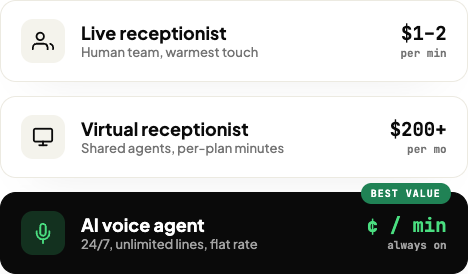
AI answering service. An AI voice answers the call, speaks naturally, pulls answers from your business information, takes messages, and can book appointments. You will see it called an AI receptionist, an AI front desk, or an AI call assistant. It answers instantly and can take many calls at once, at any hour. The limit is judgment: complex or sensitive calls should hand off to a person, so check how that handoff works.
How much does a business answering service cost?
Most small businesses pay somewhere between $50 and $450 a month, depending on whether the service is live or AI and how many calls they get. Published ranges disagree in places, which is normal because volume and features differ.
| Pricing model | How it works | Published range |
|---|---|---|
| Per minute | You pay for the time agents spend on your calls | $0.75 to $1.50 per minute, per PATLive and Alliance Virtual Offices |
| Per call | A flat fee for each answered call | $1.75 to $6 per call, per Vida. ReceptionHQ adds $1.99 per call on its entry plan |
| Tiered monthly (live) | A fixed fee that includes a block of minutes or calls | $135 to $450 a month for typical small business plans, per Housecall Pro, which cites AMBS Call Center's 2026 price guide |
| Flat monthly (AI) | One monthly fee for a set volume of AI-handled calls | CloudTalk says most small businesses pay $50 to $200 a month, with plans from $29 up to about $400. Alliance Virtual Offices puts AI at $20 to $100 |
A quick example shows why the model matters. Say you get 100 calls a month and each lasts about 3 minutes. At $1.00 per minute that is $300. At $2.50 per call it is $250. On an AI plan in the $50 to $200 range, the same volume costs less, but only if the AI can resolve those calls.
What do the well-known providers charge?
Here is what three providers publish on their own pricing pages, checked on October 21, 2026:
| Provider | Type | Published starting price |
|---|---|---|
| ReceptionHQ | Live message-taking | From $25 a month, plus $1.99 per answered call on the entry plan |
| ReceptionHQ | Live receptionist with transfers | From $35 a month |
| Abby Connect | Human, AI, or both | From $164 a month for 50 "Abby Minutes". AI minutes count as half |
| Ruby | Live virtual receptionist | From $250 a month for 50 minutes |
Prices change often, so confirm on the provider's page before you commit.
Live or AI: which is better?
Neither wins everywhere. Live is better for personal, high-trust calls. AI is better for routine calls at any hour.
| Live message-taking | Live virtual receptionist | AI answering | |
|---|---|---|---|
| Best for | Avoiding voicemail | Personal, high-trust calls | Routine calls at any hour |
| Handles complex or emotional calls | Limited | Yes | Should hand off to a person |
| Books appointments | Sometimes | Yes | Yes, with calendar integration |
| Pickup speed | A few rings | A few rings | Instant |
| Calls at the same time | Limited by staff | Limited by staff | Many |
| Typical cost | Lowest live option | Highest | Lowest overall |
A law firm taking a stressed caller's first call may want a person. A store answering "where is my order?" forty times a day likely does not. Some providers now offer both on one plan, so you can route routine calls to AI and sensitive ones to people.
Can an AI answering service replace a human one?
For routine calls, often yes. For sensitive, emotional, or high-stakes calls, most businesses still want a person, or an AI that hands off to a person quickly. Many teams now use both: AI picks up first and escalates when a call needs judgment.
What costs are not in the starting price?
Five things can raise your bill. Ask about each before you sign.
- Overage rates. Some providers charge two to three times the base per-minute rate once you pass your included minutes, which can turn a $149 plan into a $300 bill in a busy month.
- Minute rounding. Some services round every call up to the next full minute, so a 61-second call is billed as two. ReceptionHQ says it bills exact seconds on per-minute plans and that most competitors round up.
- After-hours and weekend fees. Some charge extra for nights and holidays. Abby Connect states it does not.
- Feature add-ons. Ruby notes that with some providers appointment scheduling, bilingual answering, call recordings, setup, or integrations may cost extra.
- Contracts. Many providers are month to month, but check, along with whether there is a free trial.
How do I choose a business answering service?
Work through these seven checks for your own business.
- Count your calls. Look at how many calls you get each month, how long they last, and how many come after hours. This tells you whether per-minute, per-call or flat pricing fits.
- Sort calls by type. If most calls are simple (hours, order status, booking), AI can cover them. If many are sensitive or high-value, you need people.
- Check what happens on a hard call. Ask how the service hands a caller to your team, and whether your team gets the full conversation so the caller does not repeat themselves.
- Test it with your own calls. Use the free trial, then call it yourself the way a customer would.
- Check integrations. Calendar, CRM, helpdesk, or store data should connect so details land where your team works.
- Check compliance. Healthcare and legal businesses need secure message handling and, in the US, HIPAA-compliant options.
- Read the billing terms. Look at overage, rounding, after-hours fees and cancellation before you start.
Which type fits my business?
Match your situation to the closest row.
| Your situation | Likely best fit |
|---|---|
| Solo owner who misses calls on jobs | Low-cost live message-taking or a flat AI plan |
| Law firm, clinic, or advisory practice | Live virtual receptionist, possibly with AI backup |
| Home services with urgent after-hours calls | Live or hybrid, with clear escalation rules |
| Online store with repetitive order questions | AI agent connected to your store data |
| Fast-growing business with spiky call volume | AI or hybrid, to avoid overage |
What about Shopify stores?
For a Shopify store, an AI voice agent connected to your store data usually fits better than a general message desk. Most store calls are the same few questions: where is my order, can I return this, is this in stock. A general answering service can take a message, but it cannot see your orders, so the customer still waits for a callback.
An AI voice agent built for Shopify can read your order and catalog data and answer the call itself, and pass the conversation to your team with context when it needs a person. Kovax is one of these. For store-specific detail, these Kovax guides go deeper:
- Shopify phone support without hiring covers handling store calls without adding staff.
- Customer service automation for ecommerce walks through the cost of phone support per call.
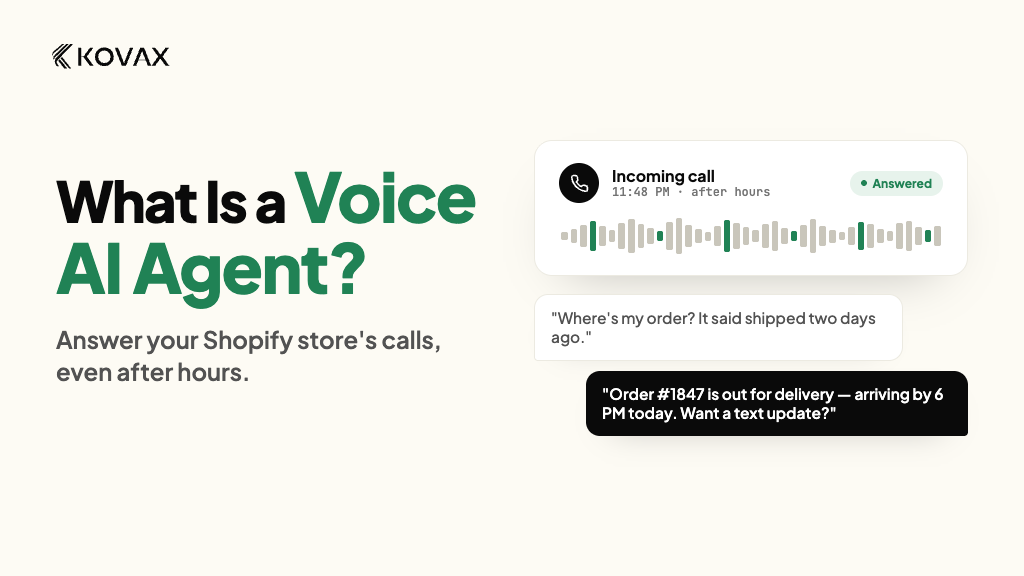
- What is a voice AI agent explains how an AI agent answers store calls after hours.
If you want to hear it on your own store, you can book a Kovax demo call.
Is a business answering service worth it?
It is worth it when the calls you miss cost more than the service. If one missed call can be a booked job, a new client, or a saved order, the math usually works. If you get only a few calls a month and most are low value, voicemail with a callback may be enough.
Is there a free answering service for small businesses?
Free options usually mean a voicemail tool such as Google Voice, or a limited trial of a paid service. A free trial is the safer way to test real call quality. ReceptionHQ and Abby Connect both offer free trials, so you can hear how your own calls would be handled before you pay.
What is the difference between an answering service and a virtual receptionist?
An answering service mainly captures messages. A virtual receptionist does more: screening, transferring, answering questions from your instructions, and booking appointments. The difference is how much the person or AI is allowed to do on the call.
FAQ
What is the best answering service for small businesses?
There is no single best one. The best fit depends on your call mix, your budget, and how much the caller needs to be handled by a person. Use the seven checks above, shortlist two or three providers, and run a free trial with real calls before you commit.
Do I need to change my business phone number?
No. You keep your number and forward calls to the provider, either all the time, after hours only, or when nobody picks up. Callers still dial the same number.
Can an answering service book appointments?
Live virtual receptionists and AI answering services usually can, if they connect to your calendar. Basic message-taking plans often cannot, so confirm this before you sign.
What should I prepare before I start?
Have four things ready:
- Your greeting and business hours
- Answers to the 5 to 10 questions callers ask most
- Rules for which calls go straight to you and which can wait
- Who gets messages, and by email, text, or app